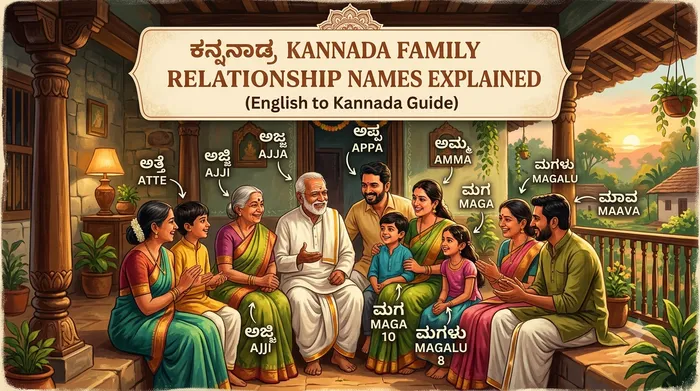
English gets by with a handful of family words - uncle, aunt, cousin, grandparent - and expects tone of voice or extra explanation to do the rest. Kannada, spoken by around 45 million people mostly in Karnataka, takes the opposite approach: nearly every family relationship gets its own dedicated word, and that word usually tells you exactly which side of the family the person belongs to.
Whether you're trying to address relatives correctly at a family function, learning Kannada, or documenting your own family tree, this guide breaks down the most common Kannada family relationship names in plain English.
Immediate Family
| English | Kannada (Romanized) |
|---|---|
| Father | Appa |
| Mother | Amma |
| Elder brother | Anna |
| Younger brother | Tamma |
| Elder sister | Akka |
| Younger sister | Tangi |
| Son | Maga |
| Daughter | Magalu |
| Husband | Ganda |
| Wife | Hendati |
As in several other South Indian languages, Kannada distinguishes elder siblings from younger ones with entirely different words, and it's common practice - especially in more traditional households - to address an older sibling as "Anna" or "Akka" rather than by name, as a mark of respect.
Grandparents
| English | Kannada (Romanized) |
|---|---|
| Grandfather | Ajja / Thatha |
| Grandmother | Ajji / Doddamma (regional) |
Most Kannada-speaking families use Ajja and Ajji for grandparents on either side, though some families - particularly in border regions with Andhra Pradesh or Tamil Nadu - use "Thatha" for grandfather, borrowed from neighboring Telugu and Tamil usage.
Uncles and Aunts
This is where Kannada kinship terms carry real information, encoding both which parent's side a relative is on and whether they're older or younger than that parent:
- Doddappa - father's elder brother
- Chikkappa - father's younger brother
- Doddamma - father's elder brother's wife, or mother's elder sister
- Chikkamma - father's younger brother's wife, or mother's younger sister
- Atte - father's sister (paternal aunt)
- Maava - father's sister's husband, or mother's brother (maternal uncle)
Notice how Doddamma and Chikkamma do double duty - covering both a paternal uncle's wife and a maternal aunt, depending on whether she's older or younger than your parent. This reflects how closely paternal-uncle and maternal-aunt relationships are treated in traditional Kannadiga family structures.
In-Laws
- Maava - father-in-law (same word as maternal uncle, since cross-cousin marriage was traditionally common in some Kannadiga communities)
- Atte - mother-in-law (same word as paternal aunt, for the same historical reason)
- Aliya - son-in-law, or a male cross-cousin
- Sose - daughter-in-law
- Bhaava - wife's brother, or husband's elder brother
- Nadini - husband's brother's wife
You may notice several of these words are reused from the blood-relative list above. That's not a coincidence - it reflects a traditional marriage pattern in many Kannadiga communities where cross-cousins (a maternal uncle's or paternal aunt's children) were considered natural marriage partners, so the vocabulary for "in-law" and "maternal uncle/paternal aunt" overlapped from the start.
Cousins
Like most Indian languages, Kannada doesn't have one single word equivalent to the English "cousin." Cousins are typically referred to using sibling terms (Anna, Tamma, Akka, Tangi) with a qualifying phrase - for instance, "doddappana maga" (elder paternal uncle's son). In casual modern conversation, many Kannada speakers simply say "cousin brother" or "cousin sister," borrowing the English term the way Marathi and Hindi speakers often do.
Why These Words Are Worth Recording
A kinship system is really a map of obligation and closeness, drawn in vocabulary instead of lines. The fact that Kannada folds "maternal uncle" and "father-in-law" into the same word, for example, is a direct trace of a marriage custom that shaped how Kannadiga families were structured for generations - something a plain family tree of names and dates wouldn't capture on its own.
If you're building your family tree, it's worth noting down not just who someone was, but what they were actually called by name at your same table growing up. My rOoOts lets you attach these relationship labels to the people in your tree, so words like Doddappa and Atte stay attached to the right person even after the language itself starts to fade from daily use.
Frequently Asked Questions
What is "uncle" called in Kannada?
It depends on the relationship: father's elder brother is Doddappa, father's younger brother is Chikkappa, and mother's brother (or father-in-law) is Maava.
Is there a single Kannada word for "cousin"?
No. Cousins are addressed using sibling terms (Anna, Akka, Tamma, Tangi) combined with a qualifier that identifies exactly which uncle or aunt they belong to.
Why do some Kannada in-law words match blood-relative words?
Because in many Kannadiga communities, marrying a cross-cousin (a maternal uncle's or paternal aunt's child) was traditionally common, so the words for "maternal uncle" and "father-in-law" (both Maava), or "paternal aunt" and "mother-in-law" (both Atte), became the same.
Do all Kannada speakers use the same grandparent terms?
Mostly Ajja and Ajji are used across Karnataka, though some families near the Andhra Pradesh and Tamil Nadu borders use Thatha, borrowed from neighboring languages.
How is respect shown through Kannada kinship terms?
Elders, including older siblings, are almost always addressed by their relationship title (Anna, Akka, Doddappa) rather than by first name, which is considered more respectful in traditional households.
Editor's picks
19 August 2026
Marathi Family Relationship Names Explained (English to Marathi Guide)
A complete English-to-Marathi guide to family relationship names, from parents and grandparents to in-laws and cousins, rooted in Maharashtra's family traditions.
18 August 2026
Gujarati Family Relationship Names Explained (English to Gujarati Guide)
A clear English-to-Gujarati guide to family relationship names, from kaka and foi to sasu and nanand, with tables you can actually use.
17 August 2026
Punjabi Family Relationship Names Explained (English to Punjabi Guide)
Learn the core Punjabi family relationship names, from Dada ji and Nani ji to Chacha, Bhua, and Mama ji, with the cultural context behind each term.
17 August 2026
Chinese Family Relationship Names Explained (English to Chinese Guide)
A clear guide to Chinese family relationship names in Mandarin, covering grandparents, aunts, uncles, and cousins on both the paternal and maternal sides.
16 August 2026
Bengali Family Relationship Names Explained (English to Bengali Guide)
A clear guide to Bengali family relationship names, from baba and ma to mama, pishi, jamaibabu and shoshur, and why Bengali kinship terms are so precise about generation and side of the family.
15 August 2026
Spanish Family Relationship Names Explained (English to Spanish Guide)
A clear guide to Spanish family relationship names, from parents and grandparents to in-laws, step-family, and the uniquely Latin American compadre/comadre bond, with regional terms useful for family history research.
Create Your Family Tree for Free
Start building your family history in minutes with the My rOoOts Free Family Tree Creator. Add parents, grandparents, children, and relatives, organize generations visually, and create a beautiful family tree that you can save and share.
👉 Create your free family tree: Free Family Tree Creator
No design skills required. Simply enter your family details and generate a clear, easy-to-read family tree online for free.
Check Zodiac Compatibility for Any Two People
Curious about how well two people match based on their date of birth? Try the My rOoOts Zodiac Compatibility Tool to compare zodiac signs, explore relationship compatibility, and get a quick compatibility score for couples, friends, or family members.
👉 Check compatibility now: Zodiac Compatibility Calculator
You can enter two dates of birth and even mention the relationship type to get a more personalized compatibility result.
Download a Free Family Tree Template
Want to draw your family tree yourself? The My rOoOts Family Tree Template provides a free printable blank pedigree chart for documenting your family history across multiple generations.
👉 Download a free family tree template: Family Tree Template
Choose a 3-generation, 4-generation, or 5-generation family tree template and save it as a PDF for printing, writing, and documenting your ancestors.
Discover the Meaning and Origin of Your Surname
Ever wondered where your family name came from? Use the My rOoOts Surname Meaning Lookup to explore surname meanings, origins, history, and etymology from different regions and cultures around the world.
👉 Discover your surname meaning: Surname Meaning Lookup
Learn more about your last name and explore the possible linguistic, geographic, cultural, and historical roots behind your family surname.
Start your family tree free
No account needed to begin. Build it in minutes, then save it whenever you're ready.
Build your family tree