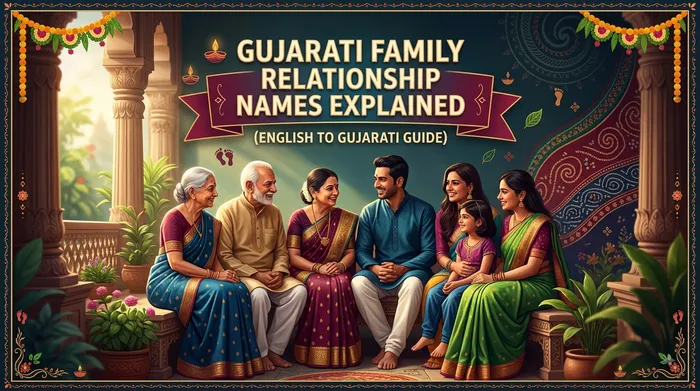
If you've ever been at a Gujarati wedding or family gathering and felt lost trying to figure out who's a "kaka" and who's a "mama," you're not alone. Gujarati, like most Indian languages, doesn't use one generic word for "uncle" or "aunt." Instead, it has a specific term for almost every branch of the family, and knowing them is a genuine act of respect, not just vocabulary. This guide breaks down the most common Gujarati family relationship names so you can use them correctly and understand how they fit into the wider family tree.
Why Gujarati Has So Many Relationship Words
In English, "uncle" covers your father's brother, your mother's brother, and both of their spouses' brothers. Gujarati keeps these relationships distinct because the word itself tells you exactly how someone connects to the family: whether they're on your father's side or your mother's, older or younger, by blood or by marriage. This precision is common across Indian languages and reflects how central the joint family structure has traditionally been in Gujarati culture.
Immediate Family
| English | Gujarati | Transliteration |
|---|---|---|
| Father | પિતા / બાપુજી | Pita / Bapuji |
| Mother | માતા / બા | Mata / Ba |
| Older brother | મોટો ભાઈ | Moto Bhai |
| Younger brother | નાનો ભાઈ | Nano Bhai |
| Older sister | મોટી બહેન | Moti Ben |
| Younger sister | નાની બહેન | Nani Ben |
| Son | દીકરો | Dikro |
| Daughter | દીકરી | Dikri |
Grandparents
| English | Gujarati | Transliteration |
|---|---|---|
| Paternal grandfather | દાદા | Dada |
| Paternal grandmother | દાદી | Dadi |
| Maternal grandfather | નાના | Nana |
| Maternal grandmother | નાની | Nani |
Notice the pattern: paternal grandparents are Dada and Dadi, while maternal grandparents are Nana and Nani. This split by side of the family shows up throughout Gujarati kinship terms.
Aunts, Uncles, and Their Spouses
This is where Gujarati really diverges from English:
- Kaka - father's younger brother
- Kaki - Kaka's wife
- Moto Bapa (also called Mota Kaka in some families) - father's elder brother
- Foi - father's sister
- Fua - Foi's husband
- Mama - mother's brother
- Mami - Mama's wife
- Masi - mother's sister
- Masa - Masi's husband
So while English speakers say "uncle" for four different men in the family, a Gujarati speaker automatically signals whether that uncle is on mom's side or dad's, older or younger than a parent, and by blood or by marriage.
In-Laws
Marriage brings its own set of terms, since a Gujarati household has traditionally welcomed a daughter-in-law into the husband's family:
- Sasu - mother-in-law
- Sasra - father-in-law
- Jeth - husband's older brother
- Dyar - husband's younger brother
- Nanand - husband's sister
- Salo - wife's brother
- Sali - wife's sister
Cousins
Gujarati generally doesn't have separate words for "cousin" the way English does. Instead, cousins are addressed as "bhai" (brother) or "ben" (sister), often with the connecting relative named alongside, such as "kaka na dikra" (paternal uncle's son) or "mama ni dikri" (maternal uncle's daughter). This reflects a broader cultural pattern: cousins raised together are often treated with the same closeness as siblings, so the language reflects that closeness rather than marking distance.
Quick Reference Table
| Relation | Gujarati Term |
|---|---|
| Father's brother (younger) | Kaka |
| Father's brother (elder) | Moto Bapa |
| Father's sister | Foi |
| Mother's brother | Mama |
| Mother's sister | Masi |
| Husband's sister | Nanand |
| Husband's older brother | Jeth |
| Wife's brother | Salo |
Keeping These Terms Straight in Your Own Family Tree
If your family speaks Gujarati at home, these terms are worth recording alongside names and dates when you build out your family tree. English-language "uncle" and "aunt" labels flatten distinctions that mattered enormously to how relationships actually worked, and that your grandparents' generation likely used every day. Recording the actual Gujarati term next to each relative preserves a piece of the culture, not just the connection.
Frequently Asked Questions
What is the Gujarati word for uncle?
There isn't one single word. It depends on which side of the family and which type of uncle: Kaka (father's younger brother), Moto Bapa (father's elder brother), Mama (mother's brother), or Fua and Masa (an aunt's husband).
What do you call your father's sister in Gujarati?
Foi. Her husband is called Fua.
What is the Gujarati term for mother's sister?
Masi. Her husband is called Masa.
Is there a Gujarati word for cousin?
Not a single dedicated word. Cousins are typically called "bhai" (brother) or "ben" (sister), usually with the connecting relative mentioned, like "mama na dikra" for a maternal uncle's son.
Why do Gujarati and other Indian languages have so many specific family terms compared to English?
Because the exact relationship, which side of the family, birth order, and blood versus marriage, historically mattered for roles and responsibilities within a joint family household. The vocabulary reflects that structure.
Editor's picks
17 August 2026
Punjabi Family Relationship Names Explained (English to Punjabi Guide)
Learn the core Punjabi family relationship names, from Dada ji and Nani ji to Chacha, Bhua, and Mama ji, with the cultural context behind each term.
17 August 2026
Chinese Family Relationship Names Explained (English to Chinese Guide)
A clear guide to Chinese family relationship names in Mandarin, covering grandparents, aunts, uncles, and cousins on both the paternal and maternal sides.
16 August 2026
Bengali Family Relationship Names Explained (English to Bengali Guide)
A clear guide to Bengali family relationship names, from baba and ma to mama, pishi, jamaibabu and shoshur, and why Bengali kinship terms are so precise about generation and side of the family.
15 August 2026
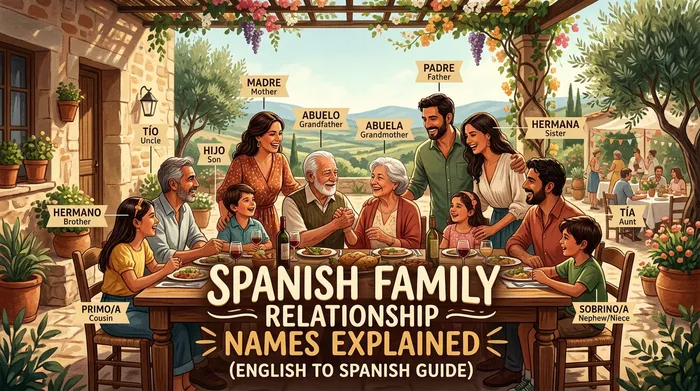
Spanish Family Relationship Names Explained (English to Spanish Guide)
A clear guide to Spanish family relationship names, from parents and grandparents to in-laws, step-family, and the uniquely Latin American compadre/comadre bond, with regional terms useful for family history research.
9 August 2026
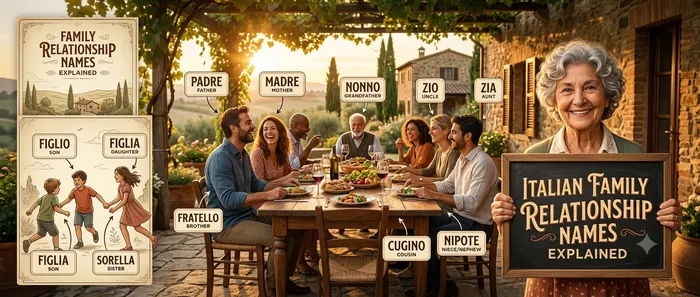
Italian Family Relationship Names Explained
A complete English-to-Italian guide to family relationship names, covering parents, siblings, grandparents, cousins, in-laws, step-family and more with clear tables.
9 August 2026
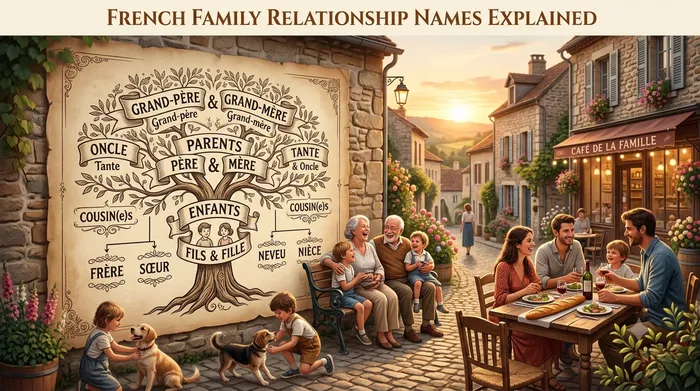
French Family Relationship Names Explained (English to French Guide)
A complete English-to-French guide to family relationship names, covering parents, siblings, grandparents, in-laws, cousins, step-family, and more with clear tables and examples.
Create Your Family Tree for Free
Start building your family history in minutes with the My rOoOts Free Family Tree Creator. Add parents, grandparents, children, and relatives, organize generations visually, and create a beautiful family tree that you can save and share.
👉 Create your free family tree: Free Family Tree Creator
No design skills required. Simply enter your family details and generate a clear, easy-to-read family tree online for free.
Check Zodiac Compatibility for Any Two People
Curious about how well two people match based on their date of birth? Try the My rOoOts Zodiac Compatibility Tool to compare zodiac signs, explore relationship compatibility, and get a quick compatibility score for couples, friends, or family members.
👉 Check compatibility now: Zodiac Compatibility Calculator
You can enter two dates of birth and even mention the relationship type to get a more personalized compatibility result.
Download a Free Family Tree Template
Want to draw your family tree yourself? The My rOoOts Family Tree Template provides a free printable blank pedigree chart for documenting your family history across multiple generations.
👉 Download a free family tree template: Family Tree Template
Choose a 3-generation, 4-generation, or 5-generation family tree template and save it as a PDF for printing, writing, and documenting your ancestors.
Discover the Meaning and Origin of Your Surname
Ever wondered where your family name came from? Use the My rOoOts Surname Meaning Lookup to explore surname meanings, origins, history, and etymology from different regions and cultures around the world.
👉 Discover your surname meaning: Surname Meaning Lookup
Learn more about your last name and explore the possible linguistic, geographic, cultural, and historical roots behind your family surname.
Start your family tree free
No account needed to begin. Build it in minutes, then save it whenever you're ready.
Build your family tree