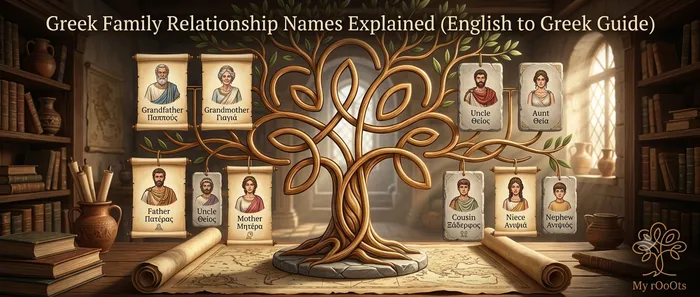
If you've spent any time around a Greek family, you already know that "yiayia" and "pappous" (grandmother and grandfather) get used constantly, often shouted across a kitchen. But Greek kinship vocabulary goes a lot deeper than those two words, and it carries real information: whether someone is related by blood or marriage, which side of the family they're on, and sometimes even birth order. If you're building out a family tree that includes Greek relatives, or just trying to keep track of who's who at a family gathering, this guide walks through the terms you'll actually need.
Why Greek Family Terms Matter for Your Family Tree
Greek, like many Mediterranean and Balkan languages, tends to be more precise than English about family relationships. English uses "aunt" for your mother's sister and your father's brother's wife alike. Greek doesn't collapse those distinctions the same way, and knowing the difference matters if you're transcribing old letters, labeling photographs, or interviewing an older relative about the family's history. Getting a term wrong in a family history document can also blur a relationship that genealogical research depends on being precise about.
Core Immediate Family Terms
| English | Greek | Transliteration |
|---|---|---|
| Father | Πατέρας / Μπαμπάς | Pateras / Babas |
| Mother | Μητέρα / Μαμά | Mitera / Mama |
| Son | Γιος | Gios |
| Daughter | Κόρη | Kori |
| Brother | Αδερφός | Aderfos |
| Sister | Αδερφή | Aderfi |
| Husband | Σύζυγος | Syzygos |
| Wife | Σύζυγος | Syzygos (same word, gender shown by article) |
Grandparents and Great-Grandparents
- Grandfather - Παππούς (Pappous)
- Grandmother - Γιαγιά (Yiayia)
- Great-grandfather - Προπάππους (Propappous)
- Great-grandmother - Προγιαγιά (Proyiayia)
These two words, yiayia and pappous, are probably the most widely recognized Greek family words outside Greece itself, largely because they're used so affectionately and so often that they've become part of everyday speech in Greek diaspora communities.
Aunts, Uncles, and Cousins
Greek doesn't distinguish maternal and paternal aunts/uncles with separate root words the way some Asian languages do, but it does distinguish blood relatives from those who joined the family by marriage:
- Uncle (blood relative) - Θείος (Thios)
- Aunt (blood relative) - Θεία (Thia)
- Uncle by marriage - Θείος εξ αγχιστείας (less commonly used in casual speech; most families just say Thios)
- Cousin (male) - Ξάδερφος (Xaderfos)
- Cousin (female) - Ξαδέρφη (Xaderfi)
- Second cousin - Δεύτερος ξάδερφος (Defteros xaderfos)
One quirk worth knowing: many Greek families use "thios" and "thia" loosely for close family friends of an older generation, similar to how some cultures use "auntie" for a parent's close friend. It's a term of respect and warmth as much as a strict genealogical label, so don't assume every "thios" in an old letter or photo caption is a blood relative.
In-Laws
- Father-in-law - Πεθερός (Petheros)
- Mother-in-law - Πεθερά (Pethera)
- Brother-in-law - Γαμπρός (Gambros) - this word is also used for a son-in-law or a bride's new husband
- Sister-in-law - Νύφη (Nifi) - also used for a daughter-in-law or new bride
This overlap trips up a lot of people doing family history research: gambros and nifi are used for multiple different in-law relationships depending on context, so a single old document using either word doesn't tell you precisely which relationship it means without more context from the surrounding text.
Godparents and Best Man/Woman: A Uniquely Greek Family Role
No guide to Greek family vocabulary is complete without koumbaros (male) and koumbara (female). These refer to a best man, maid of honor, or godparent, and in Greek Orthodox culture, this relationship is treated as close to a family bond as blood or marriage. A koumbaros or koumbara is often listed in family histories right alongside blood relatives, because the relationship is considered that significant and often carries into the next generation, with children sometimes calling their parents' koumbaros "godfather" for life.
Building These Terms Into Your Family Tree
If you're documenting a Greek branch of your family, a few practical habits help:
- Record the Greek term alongside the English one when you transcribe letters, gravestones, or church records, since the original word sometimes carries information (like blood vs. marriage) that a direct English translation loses.
- Note koumbaros/koumbara relationships separately, since they function socially like family but won't show up correctly if you only track blood and marriage ties.
- Ask living relatives to clarify ambiguous terms like gambros and nifi in old documents while you still can - these are exactly the kind of details that get lost within a generation.
Frequently Asked Questions
What do you call your grandmother in Greek?
Yiayia (Γιαγιά) is the standard word for grandmother in Greek, and it's used just as warmly and constantly in English-speaking Greek diaspora families as it is in Greece itself.
Is "koumbaros" a family member?
Not by blood or marriage in the strict sense, but culturally, yes. A koumbaros or koumbara (best man, maid of honor, or godparent) is treated as an honorary but genuinely significant family relationship in Greek Orthodox tradition, often lasting a lifetime and passing into the next generation.
Does Greek have separate words for maternal and paternal aunts and uncles?
No. Unlike some other languages, Greek uses the same core words - thios and thia - for aunts and uncles on either side of the family, though the distinction between a blood relative and one who joined by marriage is sometimes marked.
What does "gambros" mean exactly?
Gambros is a flexible term that can mean brother-in-law, son-in-law, or a bride's new husband, depending on context. It's one of the trickier words to interpret precisely in old family documents without additional context.
How do I say "family tree" in Greek?
The phrase is "οικογενειακό δέντρο" (oikogeneiako dentro), literally "family tree" - a useful phrase to know if you're searching Greek-language genealogy records or talking to Greek-speaking relatives about your research.
Editor's picks
25 August 2026
Filipino Family Relationship Names Explained (English to Tagalog Guide)
From Kuya and Ate to the unique world of Filipino godparents, here's a plain-language guide to Tagalog family relationship terms and what makes the Filipino kinship system so distinctive.
23 August 2026
Portuguese Family Relationship Names Explained (English to Portuguese Guide)
A clear guide to Portuguese family and kinship terms in English, covering immediate family, in-laws, and the differences between Brazilian and European Portuguese.
23 August 2026
Polish Family Relationship Names Explained (English to Polish Guide)
A complete guide to Polish family and kinship terms in English, including the maternal-paternal uncle and aunt distinctions that matter for genealogy research.
9 August 2026
French Family Relationship Names Explained (English to French Guide)
A complete English-to-French guide to family relationship names, covering parents, siblings, grandparents, in-laws, cousins, step-family, and more with clear tables and examples.
17 August 2026
Chinese Family Relationship Names Explained (English to Chinese Guide)
A clear guide to Chinese family relationship names in Mandarin, covering grandparents, aunts, uncles, and cousins on both the paternal and maternal sides.
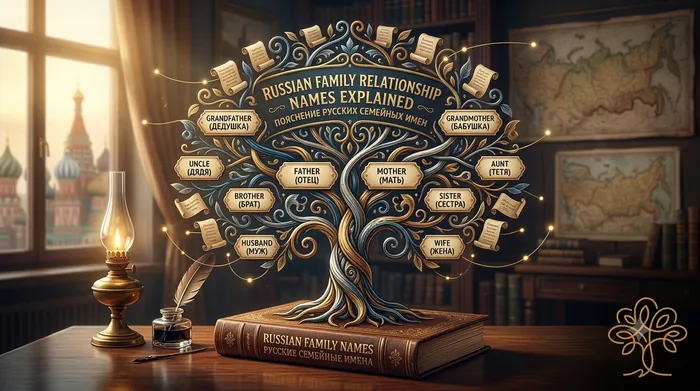
20 August 2026
Russian Family Relationship Names Explained (English to Russian Guide)
An English-to-Russian guide to family relationship names, including the distinct in-law terms Russian uses depending on which side of the family you married into.
Download a Free Family Tree Template
Want to draw your family tree yourself? The My rOoOts Family Tree Template provides a free printable blank pedigree chart for documenting your family history across multiple generations.
👉 Download a free family tree template: Family Tree Template
Choose a 3-generation, 4-generation, or 5-generation family tree template and save it as a PDF for printing, writing, and documenting your ancestors.
Check Zodiac Compatibility for Any Two People
Curious about how well two people match based on their date of birth? Try the My rOoOts Zodiac Compatibility Tool to compare zodiac signs, explore relationship compatibility, and get a quick compatibility score for couples, friends, or family members.
👉 Check compatibility now: Zodiac Compatibility Calculator
You can enter two dates of birth and even mention the relationship type to get a more personalized compatibility result.
Create Your Family Tree for Free
Start building your family history in minutes with the My rOoOts Free Family Tree Creator. Add parents, grandparents, children, and relatives, organize generations visually, and create a beautiful family tree that you can save and share.
👉 Create your free family tree: Free Family Tree Creator
No design skills required. Simply enter your family details and generate a clear, easy-to-read family tree online for free.
Start your family tree free
No account needed to begin. Build it in minutes, then save it whenever you're ready.
Build your family tree