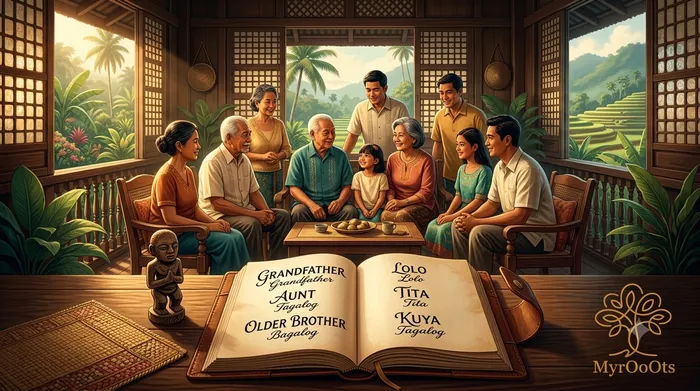
If you've spent any time around a Filipino family, you've probably noticed something quickly: almost nobody goes by their first name alone. Older siblings, cousins, aunts, uncles, even close family friends all get titles attached to their names, Ate Maria, Kuya Jun, Tita Susan, and figuring out who's actually blood-related versus who's an honorary relative can be genuinely confusing if you didn't grow up with the system. This guide breaks down the Filipino, specifically Tagalog, family relationship vocabulary in plain English.
Why Filipino Kinship Terms Work Differently
Most English speakers organize family vocabulary around exact relationship type: brother, cousin, uncle. Tagalog kinship terms layer in something English mostly ignores, relative age and generation, and something else English doesn't really have at all, a formal godparent system that functions almost like a second family tree.
That's why a term like "Kuya" isn't really translatable with a single English word. It doesn't just mean "older brother", it's used for any older male relative or family friend close to your own generation, and it's said with real respect, not as a nickname.
Core Filipino Family Terms
| Tagalog Term | English Meaning | Notes |
|---|---|---|
| Nanay / Ina | Mother | "Nanay" is warmer and far more common in daily speech |
| Tatay / Ama | Father | "Tatay" is the everyday term |
| Kuya | Older brother (or older male relative/peer) | Used even for non-relatives out of respect |
| Ate | Older sister (or older female relative/peer) | Same respect-based usage as Kuya |
| Nakababatang Kapatid | Younger sibling | Tagalog has no single word distinguishing younger brother from younger sister the way it does for older siblings |
| Lolo | Grandfather | |
| Lola | Grandmother | |
| Tito / Tiyo | Uncle | Often used for any older male family friend too |
| Tita / Tiya | Aunt | Same broad, respectful usage as Tito |
| Pinsan | Cousin | Tagalog does not distinguish first, second, or removed cousins the way English genealogy does |
| Manugang | Son-in-law or daughter-in-law | |
| Biyenan | Parent-in-law | |
| Bilas | Spouse of your sibling-in-law | A relationship English has no single word for at all |
The Part That Surprises Outsiders: Ninong and Ninang
The single most distinctive feature of Filipino family structure is the compadre system, inherited from centuries of Spanish colonial Catholic tradition. When a child is baptized, confirmed, or married, godparents are formally named:
- Ninong - godfather
- Ninang - godmother
- Inaanak - godchild
These aren't symbolic titles. A Ninong or Ninang is treated as genuine extended family for life, often expected to help financially with school, gifts, and major milestones, and Filipino families can easily have a dozen or more godparents across a child's baptism and confirmation alone. Genealogists researching Filipino ancestry quickly learn that godparent names in old church baptismal records are just as important as parents' names, since they reveal who the family's real social and economic network was.
A Quick Way to Think About the System
A Filipino Family's "Two Trees"

Blood Family Tree
└── Parents, grandparents, siblings, cousins (Pinsan), aunts and uncles (Tito/Tita)

Compadre (Godparent) Tree
└── Ninong and Ninang named at baptism
    └── Treated as lifelong extended family
        └── Their own children become like cousins ("kumpareng" relationships)
Honorifics Aren't Optional
One more thing that trips up people learning the system: in Filipino culture, calling an older relative or family friend by their first name alone, without Kuya, Ate, Tito, or Tita in front of it, can come across as disrespectful. This is one of the clearest ways Filipino family vocabulary differs from English, where first names are the default and titles are reserved for formal situations. If you're building out a Filipino branch of your family tree, it's worth recording these honorifics alongside names, since they often carry real information about age order and closeness that a bare name doesn't.
Building This Into Your Own Family Tree
A few practical tips if you're documenting Filipino relatives:
- Record both the person's given name and any Kuya/Ate/Tito/Tita title used within the family, it often tells you their relative age or generation at a glance
- Note godparents (Ninong/Ninang) separately from blood relatives, but don't discard them, they're historically significant for tracing family social networks
- Where possible, note whether a "Tito" or "Tita" is a blood uncle/aunt or an honorary one, since Filipino families use the term broadly
- Remember that "Pinsan" covers all cousins regardless of degree, so ask follow-up questions to place cousins correctly on a Western-style family tree
Frequently Asked Questions
What does Kuya mean in a Filipino family?
Kuya is used for an older brother, but also for any older male relative or close family friend around the same generation. It's a term of respect as much as a kinship label.
What is the difference between Tito and Ninong?
Tito is an uncle, typically a blood relative or the husband of an aunt. Ninong is a godfather, chosen formally at a baptism, confirmation, or wedding, and is treated as extended family even though there's no blood relation.
Does Tagalog have separate words for cousins like English does?
No. Tagalog uses a single word, "Pinsan", for all cousins regardless of whether they'd be called a first cousin, second cousin, or a cousin once removed in English genealogical terms.
Why do Filipino families use so many honorific titles?
The titles Kuya, Ate, Tito, and Tita reflect a cultural emphasis on respecting age and family hierarchy. Using a first name alone for an older relative or family friend can be seen as overly familiar or disrespectful.
Is the godparent system unique to Filipino culture?
Godparent traditions exist in many Catholic cultures, but the Filipino compadre system is unusually extensive, often involving multiple godparents per child who remain active, lifelong extended family members rather than a purely ceremonial role.
Editor's picks
23 August 2026
Portuguese Family Relationship Names Explained (English to Portuguese Guide)
A clear guide to Portuguese family and kinship terms in English, covering immediate family, in-laws, and the differences between Brazilian and European Portuguese.
23 August 2026
Polish Family Relationship Names Explained (English to Polish Guide)
A complete guide to Polish family and kinship terms in English, including the maternal-paternal uncle and aunt distinctions that matter for genealogy research.
9 August 2026
French Family Relationship Names Explained (English to French Guide)
A complete English-to-French guide to family relationship names, covering parents, siblings, grandparents, in-laws, cousins, step-family, and more with clear tables and examples.
17 August 2026
Chinese Family Relationship Names Explained (English to Chinese Guide)
A clear guide to Chinese family relationship names in Mandarin, covering grandparents, aunts, uncles, and cousins on both the paternal and maternal sides.
20 August 2026
Russian Family Relationship Names Explained (English to Russian Guide)
An English-to-Russian guide to family relationship names, including the distinct in-law terms Russian uses depending on which side of the family you married into.
20 August 2026
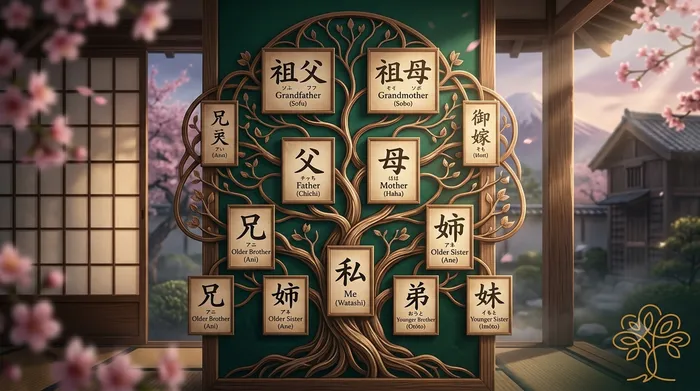
Japanese Family Relationship Names Explained (English to Japanese Guide)
A clear English-to-Japanese guide to family relationship names, including the age-ranked sibling terms and the own-family-vs-other-family rule that trips up most learners.
Check Zodiac Compatibility for Any Two People
Curious about how well two people match based on their date of birth? Try the My rOoOts Zodiac Compatibility Tool to compare zodiac signs, explore relationship compatibility, and get a quick compatibility score for couples, friends, or family members.
👉 Check compatibility now: Zodiac Compatibility Calculator
You can enter two dates of birth and even mention the relationship type to get a more personalized compatibility result.
Download a Free Family Tree Template
Want to draw your family tree yourself? The My rOoOts Family Tree Template provides a free printable blank pedigree chart for documenting your family history across multiple generations.
👉 Download a free family tree template: Family Tree Template
Choose a 3-generation, 4-generation, or 5-generation family tree template and save it as a PDF for printing, writing, and documenting your ancestors.
Create Your Family Tree for Free
Start building your family history in minutes with the My rOoOts Free Family Tree Creator. Add parents, grandparents, children, and relatives, organize generations visually, and create a beautiful family tree that you can save and share.
👉 Create your free family tree: Free Family Tree Creator
No design skills required. Simply enter your family details and generate a clear, easy-to-read family tree online for free.
Start your family tree free
No account needed to begin. Build it in minutes, then save it whenever you're ready.
Build your family tree