IPS Rank Structure Explained: Complete Hierarchy from ASP to DGP
The Indian Police Service (IPS) is one of the three All India Services. Officers of the IPS lead state police forces and serve in key central agencies. Their rank structure is closely linked to the senior hierarchy of state police forces, yet it follows a distinct career path shaped by central recruitment, cadre allocation, and both state and central postings. This guide explains the IPS rank structure in simple terms.
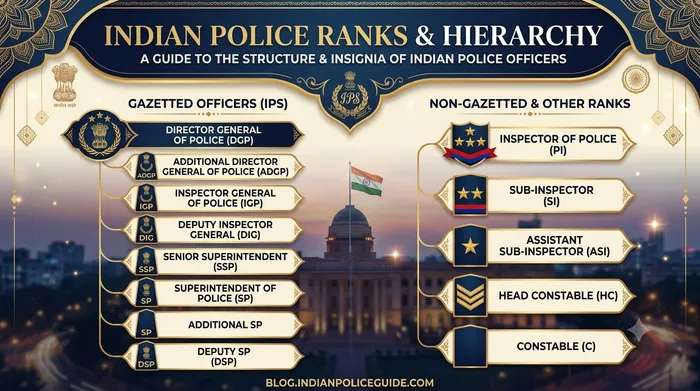
Overview of the IPS Hierarchy
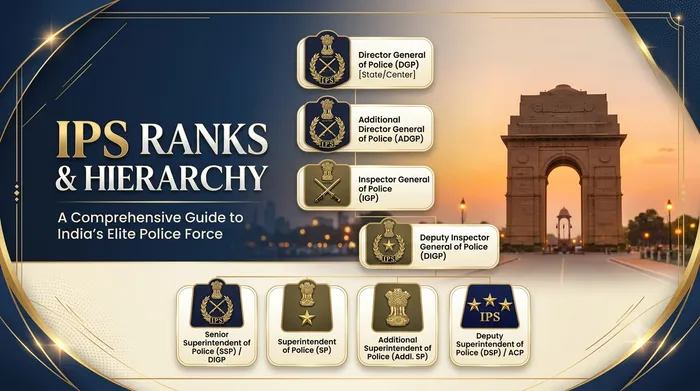
The standard progression for an IPS officer looks like this:
Assistant Superintendent of Police (ASP) / Deputy Superintendent of Police (DSP)
├── Additional Superintendent of Police
├── Superintendent of Police (SP)
├── Senior Superintendent of Police (SSP) / equivalent
├── Deputy Inspector General of Police (DIG)
├── Inspector General of Police (IG)
├── Additional Director General of Police (ADG)
└── Director General of Police (DGP) / Director General (DG)
These ranks are used both in state cadres and, with equivalent designations, in central organisations.
Rank-by-Rank Breakdown
| Rank | Typical Level | Common Responsibilities |
|---|---|---|
| ASP / DSP | Entry / Junior Scale | Sub-divisional leadership, field training |
| Additional SP | Junior / Senior Scale | Supporting district or unit command |
| Superintendent of Police (SP) | Senior Scale | District police head or equivalent unit command |
| Senior SP / equivalent | Selection Grade | Larger districts or important units |
| Deputy Inspector General (DIG) | DIG Grade | Range command or specialised wing leadership |
| Inspector General (IG) | IG Grade | Zone or major functional charge |
| Additional Director General (ADG) | ADG Grade | State-level portfolio or central equivalent |
| Director General (DG / DGP) | Apex Scale | Head of state police or major central organisation |
Entry into the IPS
IPS officers are selected through the Union Public Service Commission (UPSC) Civil Services Examination. After selection they undergo training at the Sardar Vallabhbhai Patel National Police Academy (SVPNPA) in Hyderabad.
On completion of training, officers are allotted to a state cadre (or a joint cadre). They usually begin as Assistant Superintendent of Police (ASP) in the field. In some contexts the same rank is referred to as Deputy Superintendent of Police (DSP).
Progression Through the Ranks
Promotion in the IPS depends on a combination of seniority, performance appraisal, vacancy, and empanelment at higher levels.
- Early promotions (up to SP level) largely follow time-scale and batch seniority.
- From DIG onwards, officers must be empanelled for higher grades by the central government.
- Batch mates can progress at different speeds depending on performance, cadre strength, and available vacancies.
A typical (but not guaranteed) timeline sees officers reaching SP rank in their early to mid-career, DIG in mid-career, and the highest ranks closer to the end of their service.
State Cadre vs Central Deputation
IPS officers spend a significant part of their careers in their allotted state cadre. They also serve on central deputation in organisations such as:
- Intelligence Bureau (IB)
- Central Bureau of Investigation (CBI)
- National Investigation Agency (NIA)
- Central Armed Police Forces (CRPF, BSF, CISF, ITBP, SSB, etc.)
- Ministries and other central agencies
On central deputation the rank titles remain equivalent, although the exact designation may differ (for example, Joint Director, Additional Director, or Special Director in the IB or CBI).
Apex Positions
The highest operational rank in a state is usually Director General of Police (DGP), the professional head of the state police force. At the Centre, officers can rise to Director of the Intelligence Bureau, Directors General of the various Central Armed Police Forces, or other equivalent apex posts.
Only a small percentage of any batch reaches the very highest grades. Empanelment at the ADG and DG levels is selective and involves both the state and central governments.
Rank Insignia and Recognition
IPS officers wear distinctive badges of rank on their uniforms. The insignia become more elaborate with seniority, using stars, the national emblem, and crossed sword and baton combinations at the highest levels. These visible markers help identify authority within the force and in public interactions.
IPS Careers and Family Histories
In many Indian families, service in the IPS or the wider police has become a multi-generational tradition. Parents, children, and relatives often share experiences of training, district postings, promotions, and central deputation. These careers generate detailed personal records of ranks held, places served, and significant events.
Preserving these details alongside family relationships creates a meaningful historical record. A digital family tree can organise ranks, postings, years of service, and personal stories in one private place. You can begin building such a record for free, with no sign-up required, at the My rOoOts create-tree page.
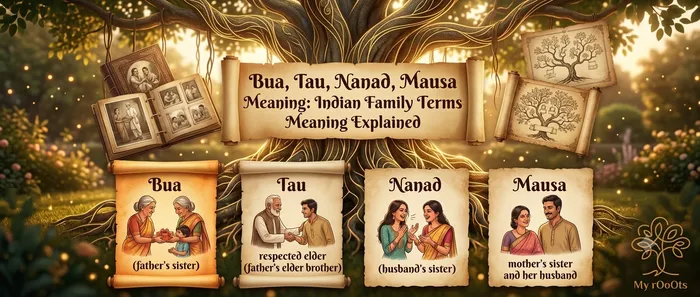
The family tree generator offers a simple way to start with known names and relationships. An ancestor timeline generator helps place career milestones against family events. When relatives from different branches contribute information, a relationship calculator can clarify kinship terms commonly used in Indian families.
Why Understanding the IPS Rank Structure Matters
Clear knowledge of the ranks helps in several practical ways:
- Interpreting official announcements and news reports
- Understanding the level of authority and experience behind a designation
- Accurately recording career details in family histories
- Appreciating the long progression from entry-level ASP to the apex ranks
The structure balances field leadership at the district level with senior strategic roles at the state and national levels.
Conclusion
The IPS rank structure begins at Assistant Superintendent of Police (or DSP) and rises through Additional SP, Superintendent of Police, DIG, IG, and ADG to the apex rank of Director General of Police or equivalent central Director General posts. Officers move between state cadre postings and central deputation while carrying the same rank hierarchy.
For families connected to the IPS, documenting each rank, posting, and personal milestone creates a lasting record of public service. Combining those details with a well-organised digital family tree ensures that both professional achievements and family relationships remain clear and accessible for future generations.
Editor's picks

5 August 2026
Sheriff vs Police Chief: Who Has More Authority?
Sheriff vs Police Chief - who holds more authority? Learn the key differences in jurisdiction, appointment, powers, and real-world influence across U.S. law enforcement.
5 August 2026
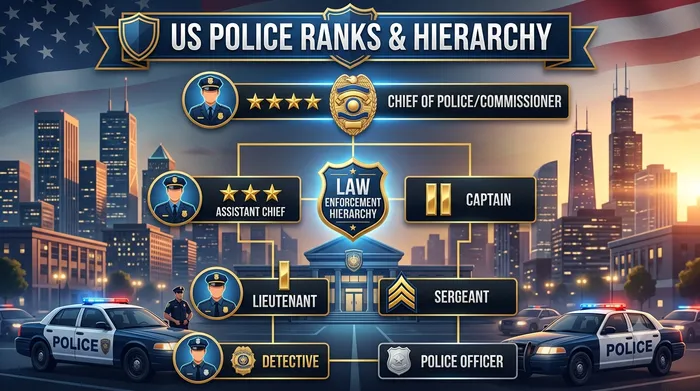
U.S. Police Ranks Explained: From Officer to Chief
A clear guide to U.S. police ranks from Officer to Chief, including typical hierarchy, responsibilities, variations by department, and how ranks progress in American law enforcement.
19 August 2026
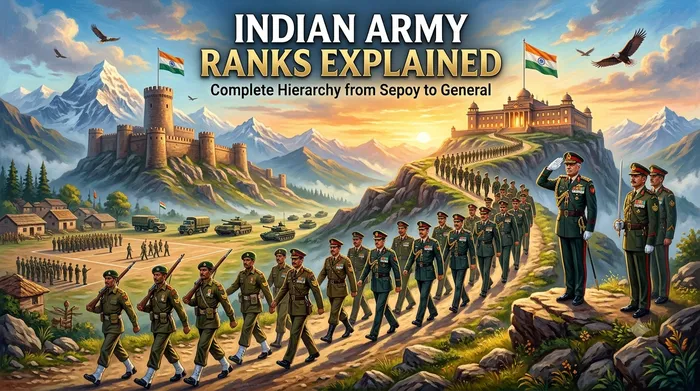
Indian Army Ranks Explained: Complete Hierarchy from Sepoy to General
A clear guide to Indian Army rank structure, from Sepoy through Havildar and the officer ranks up to General, for anyone researching a family member's military service.
29 July 2026
Military Officer Ranks Explained: Understanding the Hierarchy and Preserving Defence Family Legacies
Learn about military officer ranks, from entry-level positions to senior command roles, and discover how My rOoOts helps families preserve the service journeys, achievements, and memories of defence personnel across generations.
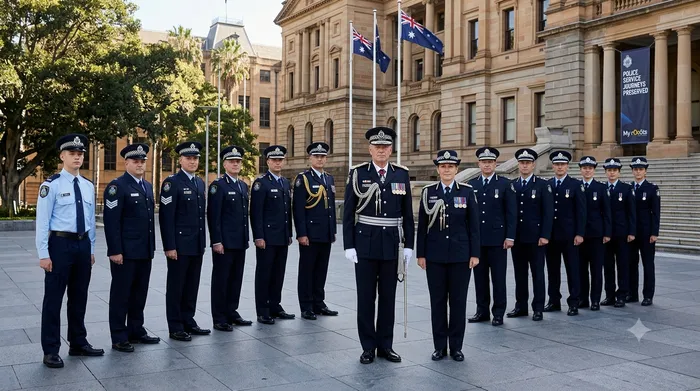
29 July 2026
Police Officer Ranks Explained: Understanding the Hierarchy and Family Legacy of Law Enforcement Careers
Explore the hierarchy of police officer ranks, from constable to senior leadership roles, and learn how My rOoOts helps families preserve the service journeys, achievements, and stories of law enforcement members.
Create Your Family Tree for Free
Start building your family history in minutes with the My rOoOts Free Family Tree Creator. Add parents, grandparents, children, and relatives, organize generations visually, and create a beautiful family tree that you can save and share.
👉 Create your free family tree: Free Family Tree Creator
No design skills required. Simply enter your family details and generate a clear, easy-to-read family tree online for free.
Check Zodiac Compatibility for Any Two People
Curious about how well two people match based on their date of birth? Try the My rOoOts Zodiac Compatibility Tool to compare zodiac signs, explore relationship compatibility, and get a quick compatibility score for couples, friends, or family members.
👉 Check compatibility now: Zodiac Compatibility Calculator
You can enter two dates of birth and even mention the relationship type to get a more personalized compatibility result.
Download a Free Family Tree Template
Want to draw your family tree yourself? The My rOoOts Family Tree Template provides a free printable blank pedigree chart for documenting your family history across multiple generations.
👉 Download a free family tree template: Family Tree Template
Choose a 3-generation, 4-generation, or 5-generation family tree template and save it as a PDF for printing, writing, and documenting your ancestors.
Discover the Meaning and Origin of Your Surname
Ever wondered where your family name came from? Use the My rOoOts Surname Meaning Lookup to explore surname meanings, origins, history, and etymology from different regions and cultures around the world.
👉 Discover your surname meaning: Surname Meaning Lookup
Learn more about your last name and explore the possible linguistic, geographic, cultural, and historical roots behind your family surname.
Start your family tree free
No account needed to begin. Build it in minutes, then save it whenever you're ready.
Build your family tree