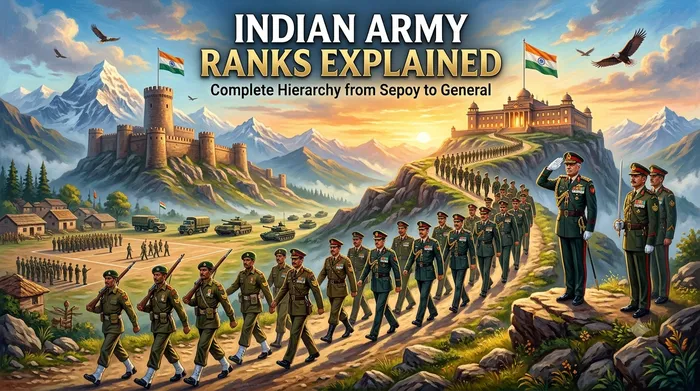
If you've ever come across an old military record, a discharge certificate, or a grandfather's medal box marked with an unfamiliar rank, making sense of Indian Army ranks can feel like decoding a second language. The structure is actually quite logical once you separate it into two tracks - the ranks soldiers rise through, and the separate track for commissioned officers - which this guide walks through from the ground up.
Two Separate Ladders
The Indian Army, like most Commonwealth-derived militaries, splits its personnel into two broad categories with entirely separate rank ladders:
- Junior Commissioned Officers (JCOs) and Other Ranks - soldiers who enlist and rise through the ranks based on service and merit.
- Commissioned Officers - typically entering via institutions like the National Defence Academy or Officers Training Academy, holding a president's commission from the start of their career.
Understanding which ladder a family member's rank belongs to is usually the first step in making sense of an old service record.
Other Ranks and JCOs
| Rank | Notes |
|---|---|
| Sepoy | Entry-level soldier (equivalent to Private) |
| Lance Naik | First promotion, junior non-commissioned officer |
| Naik | Equivalent to Corporal |
| Havildar | Equivalent to Sergeant |
| Naib Subedar | Junior Commissioned Officer (JCO) |
| Subedar | Senior JCO |
| Subedar Major | Most senior JCO rank, often a key link between soldiers and officers |
A soldier typically enlists as a Sepoy and can rise all the way to Subedar Major purely through years of service, conduct and merit-based promotion boards, without ever holding a formal commission.
Commissioned Officer Ranks
| Rank | Rough Equivalent Elsewhere |
|---|---|
| Lieutenant | Junior-most commissioned officer |
| Captain | - |
| Major | - |
| Lieutenant Colonel | Commands a battalion, in many cases |
| Colonel | - |
| Brigadier | Commands a brigade |
| Major General | - |
| Lieutenant General | - |
| General | Chief of the Army Staff, the Army's most senior serving officer |
Commissioned officers begin their careers already holding a rank equivalent to or above the most senior JCO, which is why family stories sometimes mention a relative who "became an officer" as a distinct milestone from simply being promoted within the ranks.
How the Two Tracks Relate to Each Other
Sepoy (entry-level soldier)
└── Lance Naik -> Naik -> Havildar (non-commissioned progression)
    └── Naib Subedar -> Subedar -> Subedar Major (JCO progression, merit-based)

Lieutenant (commissioned entry point, separate track)
└── Captain -> Major -> Lieutenant Colonel -> Colonel
    └── Brigadier -> Major General -> Lieutenant General -> General
It's a common misconception that a soldier is simply promoted "through" the officer ranks after reaching Subedar Major. In practice, the two tracks are structurally separate; a small number of exceptional JCOs are commissioned as officers later in their careers, but this is a distinct, separate appointment rather than an automatic next step.
Why This Matters for Family History Research
Military service records are some of the richest documents a family historian can find - they often include date of enlistment, unit, place of birth, and next of kin, in addition to rank. But a rank alone, without knowing which track it belongs to, can be misread. A "Subedar" might sound junior next to a "Major," but a Subedar Major has often served 20-30 years and commands real respect and authority within a unit, distinct from (not below) a young Lieutenant a few years into service.
When recording a family member's military history in your own family tree, it helps to note the rank exactly as it appears on the record, along with the approximate years of service, rather than translating it into a rough modern equivalent - ranks, regiment names and even rank titles themselves have changed over the decades since independence in 1947.
Frequently Asked Questions
What is the entry-level rank in the Indian Army?
For soldiers enlisting directly, it's Sepoy. For those entering as commissioned officers, the entry rank is Lieutenant.
What does JCO mean?
Junior Commissioned Officer - a rank tier (Naib Subedar, Subedar, Subedar Major) that sits between non-commissioned soldiers and commissioned officers, reached through merit-based promotion rather than a formal commission.
Can a soldier become a commissioned officer later in their career?
Yes, though it's uncommon - a small number of JCOs are selected for commissioning as officers later in their service, but this is a separate appointment process rather than an automatic promotion.
What is the highest rank in the Indian Army?
General, held by the Chief of the Army Staff, the Army's senior-most serving officer.
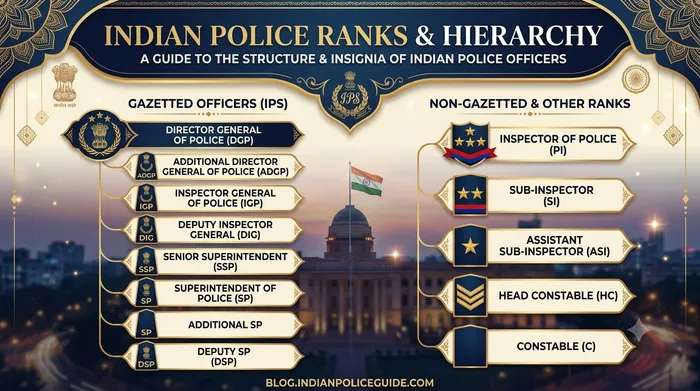
How is this different from Indian Police ranks?
The Indian Army and Indian Police maintain entirely separate rank structures and chains of command - a Havildar and a Head Constable, for instance, are roughly comparable in seniority but belong to completely different services with no direct equivalence in law or protocol.
Editor's picks
5 August 2026
Indian Police Ranks Explained: Constable to DGP
A clear guide to Indian police ranks from Constable to Director General of Police (DGP), including the full hierarchy, responsibilities, IPS vs state police, and how officers progress.
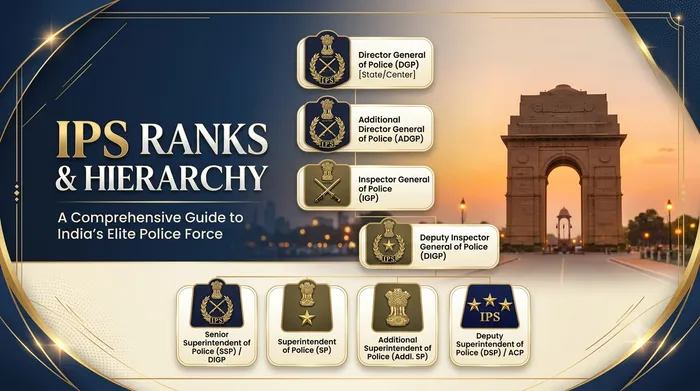
5 August 2026
IPS Rank Structure Explained: Complete Hierarchy from ASP to DGP
A clear explanation of the IPS rank structure from Assistant Superintendent of Police to Director General of Police, including hierarchy, promotions, state vs central postings, and career progression.
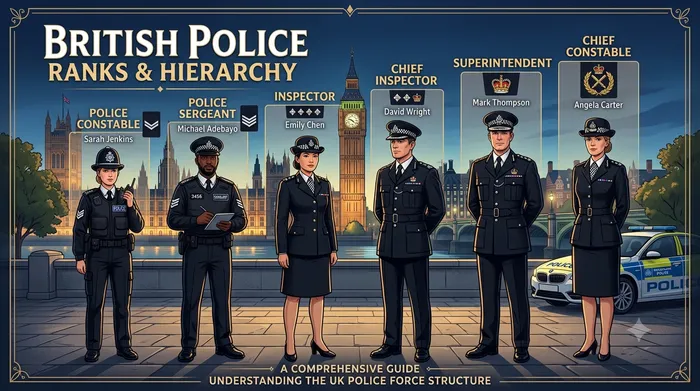
5 August 2026
British Police Ranks Explained: Constable to Chief Constable
A clear guide to British police ranks from Constable to Chief Constable, including the full hierarchy, responsibilities, variations, and how officers progress through the ranks.
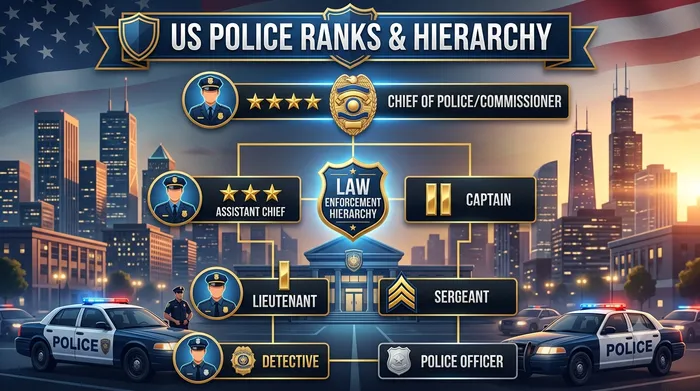
5 August 2026
U.S. Police Ranks Explained: From Officer to Chief
A clear guide to U.S. police ranks from Officer to Chief, including typical hierarchy, responsibilities, variations by department, and how ranks progress in American law enforcement.

5 August 2026
Sheriff vs Police Chief: Who Has More Authority?
Sheriff vs Police Chief - who holds more authority? Learn the key differences in jurisdiction, appointment, powers, and real-world influence across U.S. law enforcement.

5 August 2026
Joseon Dynasty Explained: Korea’s Longest-Lasting Kingdom
Discover the Joseon Dynasty, Korea’s longest-lasting kingdom. Learn its founding, kings, Confucian society, major events, cultural legacy, and lasting impact on modern Korea.
Create Your Family Tree for Free
Start building your family history in minutes with the My rOoOts Free Family Tree Creator. Add parents, grandparents, children, and relatives, organize generations visually, and create a beautiful family tree that you can save and share.
👉 Create your free family tree: Free Family Tree Creator
No design skills required. Simply enter your family details and generate a clear, easy-to-read family tree online for free.
Check Zodiac Compatibility for Any Two People
Curious about how well two people match based on their date of birth? Try the My rOoOts Zodiac Compatibility Tool to compare zodiac signs, explore relationship compatibility, and get a quick compatibility score for couples, friends, or family members.
👉 Check compatibility now: Zodiac Compatibility Calculator
You can enter two dates of birth and even mention the relationship type to get a more personalized compatibility result.
Download a Free Family Tree Template
Want to draw your family tree yourself? The My rOoOts Family Tree Template provides a free printable blank pedigree chart for documenting your family history across multiple generations.
👉 Download a free family tree template: Family Tree Template
Choose a 3-generation, 4-generation, or 5-generation family tree template and save it as a PDF for printing, writing, and documenting your ancestors.
Discover the Meaning and Origin of Your Surname
Ever wondered where your family name came from? Use the My rOoOts Surname Meaning Lookup to explore surname meanings, origins, history, and etymology from different regions and cultures around the world.
👉 Discover your surname meaning: Surname Meaning Lookup
Learn more about your last name and explore the possible linguistic, geographic, cultural, and historical roots behind your family surname.
Start your family tree free
No account needed to begin. Build it in minutes, then save it whenever you're ready.
Build your family tree