Joseon Dynasty Explained: Korea’s Longest-Lasting Kingdom
The Joseon Dynasty ruled Korea for more than five centuries, making it one of the longest-lasting royal houses in world history. Founded in 1392 and lasting until the late 19th and early 20th centuries, Joseon shaped the language, culture, social values, and political traditions that still influence Korea today. This guide explains the dynasty in clear terms for beginners.
Founding of the Dynasty
The Joseon Dynasty was established in 1392 by Yi Seong-gye, a military commander who became King Taejo. He overthrew the preceding Goryeo Dynasty amid internal weakness and external pressure. The new dynasty took the name Joseon, recalling an ancient Korean kingdom, and moved the capital to Hanyang, the city known today as Seoul.
Yi Seong-gye and his successors adopted Neo-Confucianism as the official state ideology. This philosophy emphasized moral governance, hierarchical social order, education, and loyalty to the ruler and family.
Timeline of Major Periods
| Period | Approximate Years | Key Characteristics |
|---|---|---|
| Early Joseon | 1392–c. 1500 | Consolidation, cultural flourishing |
| Mid Joseon | c. 1500–1600 | Political factionalism, Japanese invasions |
| Late Joseon | c. 1600–1800 | Recovery, isolation, scholarly culture |
| Final Century | 1800–1897/1910 | Internal reform attempts, foreign pressure, end |
The dynasty formally became the Korean Empire in 1897 under King Gojong, but the royal house continued until Japanese annexation in 1910.
Important Kings and Their Legacies
Several rulers stand out in Joseon history:
- King Taejo (r. 1392–1398): Founder of the dynasty.
- King Sejong the Great (r. 1418–1450): Created Hangul, the Korean alphabet; advanced science, agriculture, and music.
- King Yeongjo (r. 1724–1776) and King Jeongjo (r. 1776–1800): Period of relative stability and cultural revival.
- King Gojong (r. 1863–1907): Last monarch of Joseon and first emperor of the Korean Empire.
Sejong’s creation of Hangul in 1443–1446 remains one of the most significant cultural achievements in Korean history, giving ordinary people a practical writing system.
Government and Social Structure
Joseon society was highly structured according to Confucian principles.
Joseon social hierarchy
├── Yangban (scholar-official elite)
│   ├── Civil officials
│   └── Military officials
├── Chungin (middle people – technical specialists)
├── Sangmin (commoners – farmers, artisans, merchants)
└── Cheonmin (lowborn – certain hereditary occupations)
The king stood at the top, supported by a bureaucracy selected largely through civil service examinations that tested knowledge of Confucian texts. The yangban class dominated politics, land ownership, and education for most of the dynasty.
Major Historical Events
Several turning points defined Joseon history:
- Imjin War (1592–1598): Massive Japanese invasions under Toyotomi Hideyoshi. Korea suffered enormous destruction but ultimately repelled the attackers with Ming Chinese assistance and the naval leadership of Admiral Yi Sun-sin.
- Manchu Invasions (1627 and 1636–1637): Forced Joseon to submit to the Qing Dynasty as a tributary state.
- Policy of Isolation: After these invasions, Joseon limited foreign contact, earning the nickname “Hermit Kingdom” from Western observers.
- 19th-Century Pressures: Internal peasant uprisings, competition between reformist and conservative factions, and growing interference from China, Japan, and Western powers.
- End of the Dynasty: In 1897 the kingdom was renamed the Korean Empire. Japan formally annexed Korea in 1910, ending more than five centuries of Joseon rule.
Culture, Science, and Daily Life
Joseon culture produced lasting achievements:
- Hangul, the Korean alphabet
- Advances in astronomy, medicine, agriculture, and printing
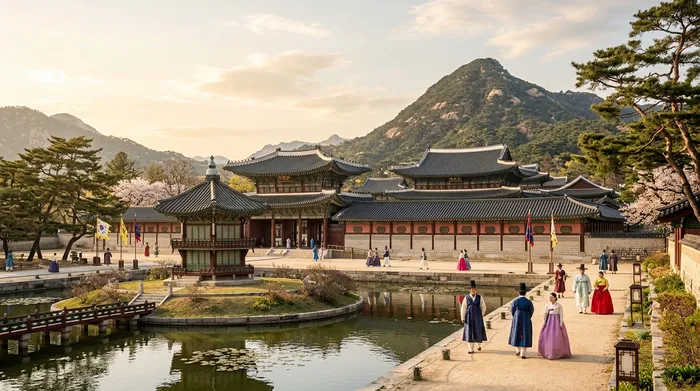
- Distinctive architecture, including palaces such as Gyeongbokgung and temples
- Confucian academies (seowon) and a strong emphasis on education
- Literature, painting, and ceramics that reflected both elite and popular tastes
Family and ancestry held central importance. Genealogical records (jokbo) were carefully maintained by yangban families and many others, tracking lineages across generations.
Legacy in Modern Korea
The Joseon Dynasty left deep marks on both South and North Korea:
- Confucian values regarding education, family hierarchy, and social harmony remain influential
- Hangul is the official script
- Historical sites, royal tombs, and traditional clothing (hanbok) continue to shape cultural identity
- Modern Korean attitudes toward authority, scholarship, and family obligation still reflect Joseon-era patterns
Many Korean families today can trace their ancestry into the Joseon period through surviving genealogical books and clan records.
Preserving Family Histories from the Joseon Era
Because genealogy was taken so seriously during Joseon, many Korean families possess detailed records that stretch back centuries. These documents list names, generations, clan seats, and sometimes official positions held under the dynasty.
Digitizing and organizing such information helps protect it for future generations. A clear digital family tree can hold ancestral names, clan details, and historical notes in one private, shareable place. You can begin building that record for free, with no sign-up required, at the My rOoOts create-tree page.
The family tree generator offers a simple starting point. An ancestor timeline generator can place Joseon-era ancestors against the dynasty’s major periods. When relatives contribute information from different branches, a relationship calculator helps clarify traditional kinship terms.
Conclusion
The Joseon Dynasty ruled Korea from 1392 until the early 20th century, making it the longest-lasting kingdom in Korean history. Founded by King Taejo and guided by Neo-Confucian principles, it produced Hangul, endured devastating invasions, maintained a rigid social order, and left a cultural legacy that still shapes Korea today.
For anyone interested in Korean history or family roots, understanding Joseon provides essential context. Many modern Korean families carry names, clan identities, and ancestral stories that began during this remarkable five-hundred-year era. Preserving those stories in a well-organized digital family tree ensures that the connection between past and present remains clear and accessible.
Create Your Family Tree for Free
Start building your family history in minutes with the My rOoOts Free Family Tree Creator. Add parents, grandparents, children, and relatives, organize generations visually, and create a beautiful family tree that you can save and share.
👉 Create your free family tree: Free Family Tree Creator
No design skills required. Simply enter your family details and generate a clear, easy-to-read family tree online for free.
Check Zodiac Compatibility for Any Two People
Curious about how well two people match based on their date of birth? Try the My rOoOts Zodiac Compatibility Tool to compare zodiac signs, explore relationship compatibility, and get a quick compatibility score for couples, friends, or family members.
👉 Check compatibility now: Zodiac Compatibility Calculator
You can enter two dates of birth and even mention the relationship type to get a more personalized compatibility result.
Download a Free Family Tree Template
Want to draw your family tree yourself? The My rOoOts Family Tree Template provides a free printable blank pedigree chart for documenting your family history across multiple generations.
👉 Download a free family tree template: Family Tree Template
Choose a 3-generation, 4-generation, or 5-generation family tree template and save it as a PDF for printing, writing, and documenting your ancestors.
Discover the Meaning and Origin of Your Surname
Ever wondered where your family name came from? Use the My rOoOts Surname Meaning Lookup to explore surname meanings, origins, history, and etymology from different regions and cultures around the world.
👉 Discover your surname meaning: Surname Meaning Lookup
Learn more about your last name and explore the possible linguistic, geographic, cultural, and historical roots behind your family surname.
Start your family tree free
No account needed to begin. Build it in minutes, then save it whenever you're ready.
Build your family tree