Goryeo Dynasty Explained: The Kingdom That Gave Korea Its Name
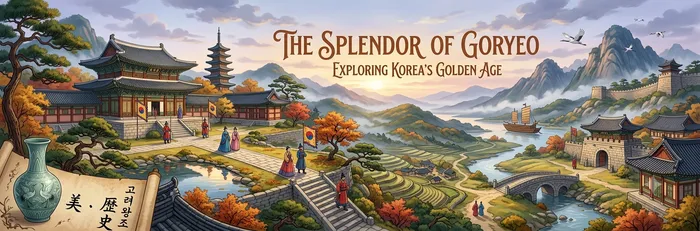
The Goryeo Dynasty ruled Korea from 918 to 1392. It unified the peninsula after the turbulent Later Three Kingdoms period and left a lasting mark on Korean identity, culture, and even the country’s modern name. The English word “Korea” comes directly from “Goryeo.” This guide explains the dynasty’s history, achievements, and legacy in clear terms for beginners.
Founding and Unification
Goryeo was founded in 918 by Wang Geon, who became King Taejo. He rose to power during the collapse of the earlier Unified Silla period and the fighting among the Later Three Kingdoms (Later Goguryeo, Later Baekje, and Silla).
Through military campaigns and political alliances, Wang Geon and his successors brought the peninsula under one rule. In 936 Goryeo completed the reunification, establishing a centralized kingdom that would last nearly five centuries.
The capital was established at Gaegyeong (present-day Kaesong in North Korea).
Timeline of Major Periods
| Period | Approximate Years | Key Features |
|---|---|---|
| Early Goryeo | 918–c. 1100 | Unification, strong monarchy, cultural growth |
| Middle Goryeo | c. 1100–1170 | Aristocratic dominance, external threats |
| Military Regime | 1170–1270 | Military strongmen control the court |
| Mongol Domination | 1270–1356 | Yuan oversight, royal intermarriage with Mongols |
| Late Goryeo | 1356–1392 | Attempts at reform, decline, fall to Joseon |
Government, Society, and Buddhism
Goryeo developed a sophisticated central government influenced by Chinese models yet adapted to Korean conditions. A civil service examination system selected officials, although aristocratic families retained great influence.
Buddhism served as the dominant state religion and cultural force. Monasteries held land and political power, and Buddhist thought shaped art, literature, and daily life. This stands in contrast to the later Joseon Dynasty, which elevated Neo-Confucianism and often restricted Buddhism.
Social hierarchy placed the king at the top, followed by powerful aristocratic clans, officials, commoners, and lower status groups.
Goryeo social and political order
├── King and royal clan
├── Aristocratic families and civil officials
├── Military elites (especially during military rule)
├── Commoners (farmers, artisans, merchants)
└── Lower status groups
Cultural Achievements
Goryeo is remembered for several outstanding cultural accomplishments:
- Celadon pottery: Distinctive blue-green ceramics prized for their elegance and technical skill. Goryeo celadon remains one of the most admired traditions in East Asian ceramic history.
- Tripitaka Koreana: A complete collection of Buddhist scriptures carved onto more than 80,000 wooden blocks. Created in the 13th century as a form of national prayer during the Mongol invasions, it is preserved today at Haeinsa Temple and is a UNESCO Memory of the World register item.
- Printing and scholarship: Advances in printing technology and the production of historical and Buddhist texts.
- Art and architecture: Buddhist sculpture, painting, and temple construction flourished.
These achievements reflect a society that valued both religious devotion and refined craftsmanship.
External Challenges and Invasions
Goryeo faced repeated military pressure from northern peoples:
- Khitan (Liao) invasions in the 10th and 11th centuries
- Conflicts with the Jurchen
- Devastating Mongol invasions beginning in 1231
After decades of resistance and destruction, Goryeo entered a period of Mongol (Yuan) domination. Korean kings married Mongol princesses, and the court came under strong Yuan influence. Although the dynasty continued, its independence was limited until the mid-14th century.
Decline and Fall
In the late 14th century Goryeo weakened under internal power struggles, corruption, and the rising influence of the military commander Yi Seong-gye. In 1392 Yi Seong-gye overthrew the Goryeo royal house and founded the Joseon Dynasty, ending nearly five hundred years of Goryeo rule.
Despite its fall, Goryeo’s political and cultural foundations strongly influenced the succeeding Joseon state.
Why Goryeo Matters
The dynasty’s significance can be summarized in several points:
- It gave Korea the name by which the country is known in much of the world.
- It achieved lasting unification of the peninsula.
- It produced internationally recognized cultural treasures, especially celadon and the Tripitaka Koreana.
- It maintained Korean identity and institutions through periods of foreign invasion and domination.
- Many modern Korean clans and family traditions trace aspects of their history to the Goryeo period.
Family Histories and Genealogical Continuity
Korean families have long maintained genealogical records that often reach back into the Goryeo and Joseon eras. Clan seats, ancestral names, and generational lines were carefully preserved, especially among elite families.
Organizing these records in a clear digital format helps protect them and makes them accessible to younger generations. A digital family tree can hold ancestral names, clan information, and historical notes in one private place. You can begin building that record for free, with no sign-up required, at the My rOoOts create-tree page.
The family tree generator provides a simple starting point. An ancestor timeline generator can place Goryeo-era ancestors against the dynasty’s major periods. When relatives from different branches contribute details, a relationship calculator helps clarify traditional kinship terms.
Conclusion
The Goryeo Dynasty (918–1392) unified Korea, gave the country its modern international name, and created a distinctive Buddhist-influenced civilization remembered for celadon ceramics and the Tripitaka Koreana. It survived repeated invasions, endured a period of Mongol domination, and finally gave way to the Joseon Dynasty in 1392.
For anyone exploring Korean history or family roots, Goryeo forms an essential chapter. Many Korean lineages carry names and traditions that began or solidified during this medieval kingdom. Preserving those connections in a well-organized digital family tree keeps the link between past and present alive for future generations.
Create Your Family Tree for Free
Start building your family history in minutes with the My rOoOts Free Family Tree Creator. Add parents, grandparents, children, and relatives, organize generations visually, and create a beautiful family tree that you can save and share.
👉 Create your free family tree: Free Family Tree Creator
No design skills required. Simply enter your family details and generate a clear, easy-to-read family tree online for free.
Check Zodiac Compatibility for Any Two People
Curious about how well two people match based on their date of birth? Try the My rOoOts Zodiac Compatibility Tool to compare zodiac signs, explore relationship compatibility, and get a quick compatibility score for couples, friends, or family members.
👉 Check compatibility now: Zodiac Compatibility Calculator
You can enter two dates of birth and even mention the relationship type to get a more personalized compatibility result.
Download a Free Family Tree Template
Want to draw your family tree yourself? The My rOoOts Family Tree Template provides a free printable blank pedigree chart for documenting your family history across multiple generations.
👉 Download a free family tree template: Family Tree Template
Choose a 3-generation, 4-generation, or 5-generation family tree template and save it as a PDF for printing, writing, and documenting your ancestors.
Discover the Meaning and Origin of Your Surname
Ever wondered where your family name came from? Use the My rOoOts Surname Meaning Lookup to explore surname meanings, origins, history, and etymology from different regions and cultures around the world.
👉 Discover your surname meaning: Surname Meaning Lookup
Learn more about your last name and explore the possible linguistic, geographic, cultural, and historical roots behind your family surname.
Start your family tree free
No account needed to begin. Build it in minutes, then save it whenever you're ready.
Build your family tree