Sheriff vs Police Chief: Who Has More Authority?
Many people assume that a Police Chief outranks a Sheriff or vice versa. The reality is more nuanced. In the United States, Sheriffs and Police Chiefs operate under different legal foundations, geographic boundaries, and lines of accountability. Understanding those differences is the only way to answer the question of who has more authority.
Quick Overview of the Two Roles
| Aspect | Sheriff | Police Chief |
|---|---|---|
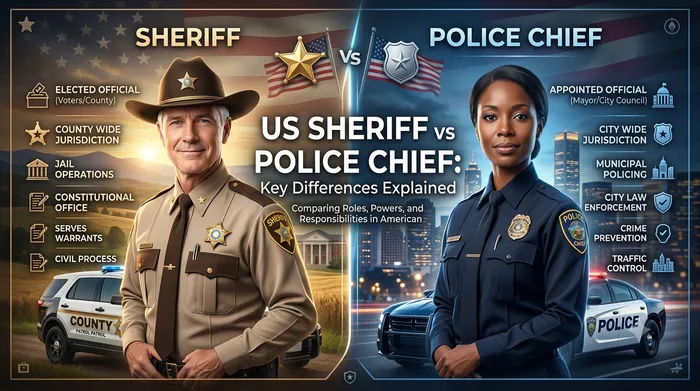
| How selected | Usually elected by county voters | Appointed by mayor, city manager, or council |
| Primary jurisdiction | Entire county (especially unincorporated areas) | City or municipal limits only |
| Typical responsibilities | Law enforcement, jails, courts, civil process | Municipal policing and public safety |
| Political independence | Generally higher (answers to voters) | Lower (answers to city government) |
| Term | Fixed elective term (often 4 years) | Serves at the pleasure of appointing authority |
How Sheriffs Get Their Authority
In most states the Sheriff is a constitutional or statutory county officer. This means the position exists under state law or the state constitution rather than simply under local ordinance. Because Sheriffs are usually elected, they answer directly to the voters of the county.
Common powers of a Sheriff’s office include:
- Law enforcement in unincorporated areas of the county
- Operation of the county jail
- Court security and service of civil process (subpoenas, evictions, etc.)
- In many places, concurrent authority inside cities within the county
The exact list of duties varies by state. Some Sheriffs run large full-service agencies; others focus more heavily on jails and courts while municipal police handle most city crime.
How Police Chiefs Get Their Authority
A Police Chief is almost always an appointed position. The Chief is hired by the mayor, city manager, or city council and can usually be removed by the same authority. The Chief’s power is limited to the geographic boundaries of the city or town that employs them.
Typical responsibilities include:
- Patrol, investigations, and traffic enforcement inside the city
- Community policing and crime prevention programs
- Management of the municipal police budget and personnel
- Reporting to city leadership on public-safety performance
Because the role is appointed, a Police Chief’s authority is tied to the confidence of local elected officials and, indirectly, to city residents.
Geographic Scope vs Organizational Size
Authority can be measured in different ways.
Authority comparison factors
├── Geographic reach
│   ├── Sheriff → usually the entire county
│   └── Police Chief → city limits only
├── Legal independence
│   ├── Sheriff → often constitutionally protected and elected
│   └── Police Chief → serves at the pleasure of city government
├── Operational resources
│   ├── Large-city Chief → may command far more officers and budget
│   └── Rural Sheriff → may have fewer personnel but broader territory
└── Statutory duties
├── Sheriff → frequently includes jails, courts, civil process
└── Police Chief → focused on municipal law enforcement
In a major city the Police Chief may oversee thousands of officers and a budget larger than many entire county governments. In a rural county the Sheriff may be the primary law-enforcement presence across hundreds of square miles. Neither automatically “outranks” the other; their authority simply operates in different domains.
Overlapping Jurisdiction and Cooperation
In practice, Sheriffs and Police Chiefs often share or coordinate authority:
- City police handle most calls inside municipal boundaries.
- The Sheriff’s office remains responsible for the county jail and court services that serve the whole county, including the cities.
- On major incidents, mutual-aid agreements and joint task forces bring both agencies together.
- In some states the Sheriff retains the legal right to exercise law-enforcement powers inside cities, even when a municipal police department exists.
Conflicts occasionally arise over who takes the lead on a particular investigation or event. These are usually resolved through local custom, written agreements, or, in rare cases, state law.
State-by-State Variation
The balance of power is not identical everywhere:
- In some states the Sheriff is a powerful, full-service elected official with broad authority.
- In others the Sheriff’s role is more limited, and large city Police Chiefs effectively dominate local law enforcement.
- A few states have unique arrangements (for example, consolidated city-county governments or appointed Sheriffs).
Anyone comparing specific offices should check the relevant state statutes and local charters rather than relying on a single national model.
Political Accountability and Public Perception
Because most Sheriffs are elected, they campaign, raise funds, and face voters every few years. This can give them greater political independence but also subjects them to electoral pressures. Police Chiefs are insulated from direct elections yet remain vulnerable to changes in city administration. A new mayor can often replace a Chief more easily than voters can remove a Sheriff mid-term.
Public perception sometimes treats the Sheriff as the higher county-wide authority and the Chief as the top city official. In legal and operational terms, each is supreme within their own defined sphere.
Documenting Careers in Law Enforcement Families
Many American families include both Sheriffs and Police Chiefs across generations, or officers who later rose to one of these positions. Recording the exact titles, agencies, years of service, and responsibilities creates a valuable historical record.
A digital family tree can capture these career details alongside personal and family information. You can begin building such a record for free, with no account required, at the My rOoOts create-tree page.
The family tree generator offers a simple starting point. An ancestor timeline generator helps place service milestones against family events. When relatives contribute information from different branches, a relationship calculator can clarify kinship connections.
Conclusion
Neither the Sheriff nor the Police Chief automatically holds more authority than the other. The Sheriff generally possesses broader geographic jurisdiction, greater political independence through election, and statutory duties that often include jails and courts. The Police Chief holds clear authority inside city limits and commands the municipal police force, which in large cities can be a very large organization.
Authority is therefore best understood as complementary rather than hierarchical. Each role derives power from different sources and operates within different boundaries. For citizens, researchers, and families with ties to law enforcement, recognizing these distinctions produces a more accurate picture of how American policing is structured at the local level.
Create Your Family Tree for Free
Start building your family history in minutes with the My rOoOts Free Family Tree Creator. Add parents, grandparents, children, and relatives, organize generations visually, and create a beautiful family tree that you can save and share.
👉 Create your free family tree: Free Family Tree Creator
No design skills required. Simply enter your family details and generate a clear, easy-to-read family tree online for free.
Check Zodiac Compatibility for Any Two People
Curious about how well two people match based on their date of birth? Try the My rOoOts Zodiac Compatibility Tool to compare zodiac signs, explore relationship compatibility, and get a quick compatibility score for couples, friends, or family members.
👉 Check compatibility now: Zodiac Compatibility Calculator
You can enter two dates of birth and even mention the relationship type to get a more personalized compatibility result.
Download a Free Family Tree Template
Want to draw your family tree yourself? The My rOoOts Family Tree Template provides a free printable blank pedigree chart for documenting your family history across multiple generations.
👉 Download a free family tree template: Family Tree Template
Choose a 3-generation, 4-generation, or 5-generation family tree template and save it as a PDF for printing, writing, and documenting your ancestors.
Discover the Meaning and Origin of Your Surname
Ever wondered where your family name came from? Use the My rOoOts Surname Meaning Lookup to explore surname meanings, origins, history, and etymology from different regions and cultures around the world.
👉 Discover your surname meaning: Surname Meaning Lookup
Learn more about your last name and explore the possible linguistic, geographic, cultural, and historical roots behind your family surname.
Start your family tree free
No account needed to begin. Build it in minutes, then save it whenever you're ready.
Build your family tree