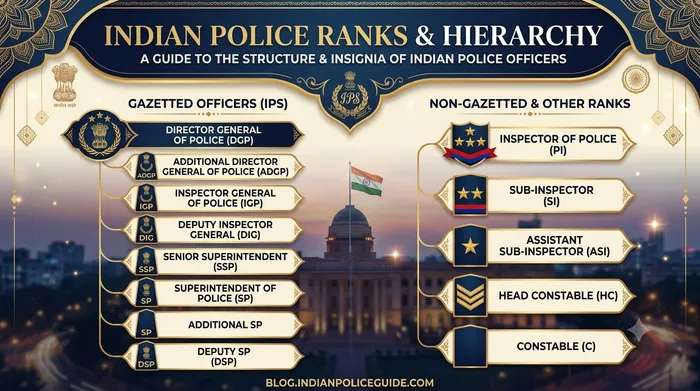
Indian Police Ranks Explained: Constable to DGP
The Indian police system has a well-defined rank structure that runs from the constabulary to the highest leadership of a state force. Understanding these ranks helps when reading news, following official communications, or documenting family service histories. This guide explains the common ranks used across most state police forces in India, from Constable to Director General of Police (DGP).
The Overall Rank Hierarchy
A simplified view of the structure in most states looks like this:
Director General of Police (DGP)
├── Additional Director General of Police (ADGP)
├── Inspector General of Police (IGP)
├── Deputy Inspector General (DIG)
├── Senior SP / Additional Commissioner
├── Superintendent of Police (SP) / Deputy Commissioner of Police
├── Additional SP / Deputy Commissioner of Police
├── Deputy Superintendent of Police (DSP) / Assistant Commissioner of Police (ACP)
├── Inspector
├── Sub-Inspector (SI)
├── Assistant Sub-Inspector (ASI)
├── Head Constable
└── Constable
Exact titles can vary slightly between states and between regular district policing and police commissionerates in large cities.
Rank-by-Rank Overview
| Rank | Category | Typical Role |
|---|---|---|
| Constable | Constabulary | Front-line policing, patrol, assistance |
| Head Constable | Constabulary | Senior constable duties, limited supervision |
| Assistant Sub-Inspector (ASI) | Subordinate | Investigative support, station duties |
| Sub-Inspector (SI) | Subordinate | Station House Officer in smaller stations, investigations |
| Inspector | Subordinate / Supervisory | Station House Officer, circle or unit in-charge |
| Deputy Superintendent of Police (DSP) / ACP | Gazetted (State / IPS entry) | Sub-division or area leadership |
| Superintendent of Police (SP) | Senior Gazetted | District or major unit command |
| Deputy Inspector General (DIG) | Senior | Range or specialised wing leadership |
| Inspector General (IG) | Senior | Zone or large functional responsibility |
| Additional Director General (ADG) | Top leadership | Major portfolio or additional charge |
| Director General of Police (DGP) | Force head | Overall command of the state police |
Constabulary and Subordinate Ranks
Constable and Head Constable
These form the largest part of any police force. Constables perform patrol duty, handle traffic, assist in investigations, and maintain public order. Head Constables are experienced personnel who often take on additional responsibilities within the station or unit.
Assistant Sub-Inspector and Sub-Inspector
Sub-Inspectors are frequently the Station House Officers (SHOs) of smaller police stations and lead investigations. Assistant Sub-Inspectors support them in case work and station management.
Inspector
Inspectors usually head larger police stations or serve as circle officers. They supervise Sub-Inspectors and are responsible for the overall functioning of their charge.
Gazetted Officer Ranks
From Deputy Superintendent of Police onwards, officers are gazetted.
Deputy Superintendent of Police (DSP) / Assistant Commissioner of Police (ACP)
This is the entry rank for many State Police Service officers and the starting rank for Indian Police Service (IPS) officers (who join as Assistant Superintendent of Police in some cadres). They typically handle a sub-division or an equivalent urban area.
Superintendent of Police (SP)
The SP is usually the head of a district police force or an equivalent major unit. This is one of the most visible and responsible field ranks in the Indian system.
Senior Ranks – DIG, IG, ADG
Deputy Inspectors General often supervise a range (a group of districts) or head specialised wings. Inspectors General hold still larger territorial or functional charges. Additional Directors General manage major portfolios such as law and order, intelligence, or administration at the state level.
Director General of Police (DGP)
The DGP is the professional head of the state police force. The officer is responsible for the overall leadership, discipline, and performance of the entire organisation and reports to the state government.
IPS Officers and State Police Service
Two main streams feed the higher ranks:
- Indian Police Service (IPS): All-India service officers allotted to state cadres. They enter at the ASP/DSP level and can rise to DGP.
- State Police Service: Officers promoted from within the state police who can also reach senior ranks, including sometimes the DGP position depending on state rules and vacancy.
In practice, most DGP-level posts are held by senior IPS officers.
Commissionerates vs District System
Large cities often operate under a Police Commissionerate system. Titles change even though the rank equivalence remains similar:
| District System | Commissionerate Equivalent |
|---|---|
| DSP | Assistant Commissioner of Police (ACP) |
| SP | Deputy Commissioner of Police (DCP) |
| DIG / IG | Joint Commissioner / Additional Commissioner |
| Higher ranks | Commissioner of Police and above |
The Commissioner of Police in a major city holds authority comparable to a senior IG or ADG level officer.
How Promotion Works
Promotion depends on a combination of factors:
- Length of service and vacancies
- Annual performance appraisals
- Departmental examinations (especially at subordinate levels)
- Seniority and merit lists
- For IPS officers, central and state-level empanelment processes at higher ranks
Movement from the subordinate ranks into the gazetted ranks is competitive. Progress through the senior IPS ranks becomes increasingly selective.
Preserving Police Service Histories in Families
In India it is common to find families with multiple generations in the police — from Constables and Sub-Inspectors to IPS officers who reached SP, DIG, or higher ranks. These careers produce detailed records of postings, promotions, medal awards, and personal experiences that form an important part of family heritage.
A digital family tree can organise ranks held, districts or units served, years of service, and family relationships in one private place. You can start building such a record for free, with no sign-up required, at the My rOoOts create-tree page.
The family tree generator helps begin with known names and relationships. An ancestor timeline generator can place postings and promotions against family events. When relatives from different branches contribute, a relationship calculator assists with kinship terms commonly used across Indian families.
Why Rank Structure Matters
Knowing the ranks helps in practical ways:
- Understanding news reports and official statements
- Recognising the level of authority in any given situation
- Accurately recording family service details
- Appreciating the experience required at each stage of a police career
The system balances large numbers of front-line personnel with clear leadership layers that maintain command and accountability across an entire state.
Conclusion
Indian police ranks progress from Constable through Head Constable, ASI, Sub-Inspector, and Inspector into the gazetted ranks of DSP, SP, DIG, IG, ADG, and finally Director General of Police. IPS officers and State Police Service officers share the higher ranks, while large cities often use commissionerate titles that parallel the same hierarchy.
For families with a tradition of police service, documenting each rank, posting, and personal story creates a lasting record. Combining those details with a clear digital family tree ensures that both professional achievements and family connections remain organised and accessible for future generations.
Frequently Asked Questions About Indian Police Ranks and IPS
What are the ranks of police officers in India?
The Indian police hierarchy generally includes ranks such as Constable, Head Constable, Assistant Sub-Inspector (ASI), Sub-Inspector (SI), Inspector, Deputy Superintendent of Police (DSP), Additional Superintendent of Police (ASP), Superintendent of Police (SP), Deputy Inspector General (DIG), Inspector General (IG), Additional Director General of Police (ADGP), and Director General of Police (DGP).
The exact structure and titles can vary between states and police organizations.
What is the highest police rank in India?
Director General of Police (DGP) is generally the highest regular rank in a state police force. The DGP heads the state police organization.
At the national level, different police organizations may have their own heads and structures.
What is IPS?
IPS stands for Indian Police Service. It is one of India's three All India Services, along with the Indian Administrative Service (IAS) and Indian Forest Service (IFoS).
IPS officers can serve in senior leadership positions in state police forces, central police organizations, and other law-enforcement roles.
Is IPS a police rank?
No. IPS is a service, not a rank.
An officer belongs to the Indian Police Service and may hold different ranks or posts during their career, such as ASP, SP, DIG, IG, ADGP, or DGP.
What is the difference between IPS and SP?
IPS is a service, while SP is a rank or designation.
An IPS officer can be posted as an SP, but an SP is not necessarily an IPS officer in every context. State police services can also have officers serving at equivalent or related levels depending on the applicable rules.
Is every SP an IPS officer?
No. Although many SP positions are held by IPS officers, not every person holding an SP-level position necessarily belongs to the IPS. State Police Service officers can also reach senior positions through promotion and applicable service rules.
What does SP stand for in police?
SP stands for Superintendent of Police.
An SP is a senior police officer who may be responsible for policing a district or another major police unit, depending on the state's organizational structure.
Who is higher, SP or DSP?
SP is higher than DSP.
DSP stands for Deputy Superintendent of Police. An SP generally occupies a higher position in the police hierarchy than a DSP.
Who is higher, SP or ASP?
SP is generally higher than ASP.
ASP stands for Assistant Superintendent of Police. It is commonly an early field posting for IPS officers, while SP is a more senior position.
Who is higher, DSP or Inspector?
DSP is higher than Inspector.
A typical hierarchy places Inspector below DSP, although exact organizational structures can vary between police forces.
Who is higher, Inspector or Sub-Inspector?
Inspector is higher than Sub-Inspector (SI).
A Sub-Inspector is generally a supervisory officer below the Inspector rank.
Who is higher, SI or ASI?
Sub-Inspector (SI) is higher than Assistant Sub-Inspector (ASI).
The usual progression is ASI → SI → Inspector.
What is the full form of SI in police?
SI stands for Sub-Inspector.
A Sub-Inspector is a police officer who generally performs investigation, law-and-order, station, and supervisory duties depending on the posting.
What is the full form of ASI in police?
ASI stands for Assistant Sub-Inspector.
ASI is generally below the rank of Sub-Inspector and above Head Constable.
What is the full form of SHO?
SHO stands for Station House Officer.
The SHO is responsible for the functioning of a police station. SHO is generally a posting or role rather than a separate police rank. An Inspector or Sub-Inspector may serve as an SHO depending on the police organization.
Is SHO a rank?
No. SHO is generally a designation or responsibility, not a separate rank.
The officer serving as SHO may be an Inspector or Sub-Inspector depending on the police station and state police structure.
What is the rank of an SHO?
An SHO may be an Inspector or Sub-Inspector, depending on the police force and the size or importance of the police station.
Who is higher, SHO or Inspector?
It depends on what is being compared because SHO is a post, while Inspector is a rank.
An Inspector serving as an SHO holds the Inspector rank. A Sub-Inspector may also serve as an SHO in some police organizations.
What is DSP?
DSP stands for Deputy Superintendent of Police.
DSP is a senior state police rank generally associated with supervisory responsibility over police units or subdivisions.
Is DSP an IPS officer?
A DSP is not necessarily an IPS officer.
DSP is commonly associated with State Police Service officers, although IPS officers can hold equivalent or related postings during their careers.
What is the difference between DSP and ACP?
DSP and ACP are generally equivalent-level designations used in different policing structures.
DSP means Deputy Superintendent of Police and is commonly used in district or state police structures. ACP means Assistant Commissioner of Police and is commonly used in commissionerate police systems.
What is ACP in police?
ACP stands for Assistant Commissioner of Police.
ACP is a designation commonly used in police commissionerates, particularly in metropolitan areas.
Is ACP higher than DSP?
ACP and DSP are generally considered equivalent-level designations, with the exact hierarchy depending on the applicable police organization and service rules.
What is SP?
SP stands for Superintendent of Police.
An SP is a senior police officer who may oversee a district or another major police unit.
What is SSP?
SSP stands for Senior Superintendent of Police.
SSP is a senior police designation used in some states and police organizations. Depending on the structure, an SSP may head a district or major police unit.
Who is higher, SP or SSP?
Where both designations are used in the same organizational structure, SSP is generally considered senior to SP. However, police designations and district structures vary between states.
What is DIG in police?
DIG stands for Deputy Inspector General of Police.
DIG is a senior police rank above SP and below IG in the conventional hierarchy.
Who is higher, DIG or SP?
DIG is higher than SP.
A simplified senior-rank sequence is:
SP → DIG → IG → ADGP → DGP
What is IG in police?
IG stands for Inspector General of Police.
IG is a senior police rank generally above DIG and below ADGP in the conventional hierarchy.
Who is higher, IG or DIG?
IG is higher than DIG.
The conventional progression is:
DIG → IG → ADGP → DGP
What is ADGP?
ADGP stands for Additional Director General of Police.
ADGP is one of the highest senior police ranks and is generally positioned below DGP in the conventional hierarchy.
Who is higher, ADGP or IG?
ADGP is higher than IG in the conventional police rank hierarchy.
Who is higher, DGP or ADGP?
DGP is higher than ADGP.
DGP stands for Director General of Police and is generally the highest rank in a state police hierarchy.
Who is higher, DGP or IG?
DGP is higher than IG.
The conventional senior hierarchy is:
IG → ADGP → DGP
Who is higher, DGP or IPS?
This comparison is not technically correct because DGP is a rank/post while IPS is a service.
An IPS officer can be appointed to the rank of DGP. Therefore, an officer can be both an IPS officer and a DGP.
Can an IPS officer become DGP?
Yes. IPS officers can reach the rank of DGP subject to eligibility, seniority, selection, vacancies, and applicable government rules.
Can a non-IPS officer become DGP?
The appointment of senior police officers is governed by applicable service rules and legal requirements. The DGP position in a state police force is ordinarily associated with senior IPS officers.
What is the hierarchy of IPS ranks?
IPS officers can serve at various levels during their careers. A simplified progression commonly includes:
ASP → SP → DIG → IG → ADGP → DGP
The exact posting titles, grades, and responsibilities can vary.
What is the first posting of an IPS officer?
After completing the required training, an IPS officer generally begins field service as an Assistant Superintendent of Police (ASP).
The exact training and posting arrangements can change according to government rules and the officer's cadre.
What is the entry-level rank of an IPS officer?
The initial field-level posting of an IPS officer is generally Assistant Superintendent of Police (ASP).
What is the difference between ASP and SP?
ASP means Assistant Superintendent of Police, while SP means Superintendent of Police.
ASP is generally an earlier career posting for an IPS officer, while SP represents a more senior level.
What is the difference between IPS and police?
IPS is one service within India's police and law-enforcement system.
Not every police officer is an IPS officer. India has multiple police services and ranks, including state police personnel and officers belonging to the Indian Police Service.
Are all police officers IPS officers?
No. Only a small portion of India's police officers belong to the IPS.
The police force also includes personnel from state police services and ranks such as Constable, Head Constable, ASI, SI, Inspector, and other levels.
What is the difference between IPS and State Police Service?
IPS is an All India Service, while State Police Service officers belong to the police service of a particular state.
State Police Service officers can also be promoted into the IPS under applicable rules.
Can a State Police Service officer become an IPS officer?
Yes. State Police Service officers can be inducted into the IPS through promotion, subject to the applicable eligibility requirements, selection process, vacancies, and service rules.
Can an SI become IPS?
An SI does not normally become an IPS officer directly through a simple promotion from the SI rank.
A police officer may progress through the state police hierarchy and potentially become eligible for induction into the IPS through the applicable State Police Service promotion route.
Can a constable become IPS?
A constable does not normally move directly from Constable to IPS. Officers generally progress through the relevant police service structure and would need to meet the applicable requirements for entering or being inducted into the IPS.
How many stars does an IPS officer have?
The number and style of stars or other insignia depend on the officer's rank and uniform system. IPS itself does not represent one fixed number of stars, because IPS officers serve at different ranks.
How many stars does an SP have?
The insignia worn by an SP can depend on the specific rank, service, and uniform regulations. It is better to identify the officer's actual rank rather than assume that every IPS officer or SP has the same insignia.
Who is the head of police in a state?
The Director General of Police (DGP) is generally the head of the state police force.
However, the precise administrative structure can differ between states.
Who is the head of police in a district?
In many states, the Superintendent of Police (SP) is responsible for policing in a district.
Some districts may use the designation SSP or have different arrangements depending on the state's police structure.
Who is the head of a police station?
The police station is generally headed by the Station House Officer (SHO).
The SHO may be an Inspector or Sub-Inspector depending on the police organization.
Who is higher, Commissioner or SP?
This depends on the type of police organization and the specific commissionerate structure.
A Police Commissioner heads a commissionerate and exercises powers and responsibilities that may correspond to several senior police and executive functions. Direct comparisons between Commissioner and SP should therefore consider the particular city and state structure.
What is a Police Commissioner?
A Police Commissioner is the head of a commissionerate police system in a city or metropolitan area.
Commissionerates are structured differently from traditional district police systems.
What is the difference between Commissioner and DGP?
A DGP is a police rank, while Commissioner is generally a post or designation.
A Commissioner can be an IPS officer and may hold a senior rank such as ADGP or DGP depending on the city and organizational structure.
What is the difference between Commissionerate and district police?
In a traditional district police system, the SP generally leads district policing.
In a commissionerate system, a Police Commissioner leads the city or metropolitan police organization and may exercise additional powers assigned under the applicable laws.
What is the difference between ACP and DCP?
ACP means Assistant Commissioner of Police, while DCP means Deputy Commissioner of Police.
In a commissionerate system, DCP is generally senior to ACP.
Who is higher, ACP or DCP?
DCP is generally higher than ACP in a commissionerate police hierarchy.
What is DCP in police?
DCP stands for Deputy Commissioner of Police.
It is a senior designation commonly used in commissionerate police systems.
Is DCP equivalent to SP?
In many commissionerate structures, DCP is broadly comparable to SP-level responsibility, although exact rank equivalence depends on the applicable organizational and service structure.
Who is higher, DCP or ACP?
DCP is generally higher than ACP.
A simplified commissionerate hierarchy is:
ACP → DCP → Additional CP → Commissioner of Police
The exact structure varies by city.
What is Additional Commissioner of Police?
The Additional Commissioner of Police is a senior post in a commissionerate police system and generally ranks above DCP and below the Commissioner, subject to the specific organizational structure.
What is Joint Commissioner of Police?
A Joint Commissioner of Police is a senior leadership position in some commissionerate systems. The exact rank and responsibilities vary between police organizations.
What is the complete Indian police rank hierarchy?
A simplified hierarchy from junior to senior is:
Constable → Head Constable → ASI → SI → Inspector → DSP/ACP → ASP → SP/DCP → DIG → IG → ADGP → DGP
This is a simplified representation. India has multiple police organizations, state-specific structures, commissionerates, and specialized forces, so the exact hierarchy can differ.
Which is higher, police Inspector or IPS?
This is not a direct rank comparison because IPS is a service, while Inspector is a rank.
An IPS officer can hold several ranks during their career, beginning with postings such as ASP and potentially progressing to SP, DIG, IG, ADGP and DGP.
Which is higher, IAS or IPS?
IAS and IPS are different All India Services, so neither is simply a higher rank than the other.
IAS officers primarily work in civil administration, while IPS officers are responsible for policing and law enforcement.
Is IPS higher than DSP?
This is not a technically precise comparison. IPS is a service, whereas DSP is a police rank.
An IPS officer can hold postings at levels that are senior to DSP.
Is IPS higher than SP?
Again, IPS and SP are different types of terms. IPS is a service and SP is a rank/designation.
An IPS officer can serve as an SP and later progress to higher ranks.
What comes after SP in the police hierarchy?
A simplified senior progression after SP is:
SP → DIG → IG → ADGP → DGP
The exact career progression and postings depend on the officer's service and applicable rules.
What comes after Inspector in the police hierarchy?
A simplified progression is:
Inspector → DSP/ACP → SP/DCP → DIG → IG → ADGP → DGP
The exact route differs between state police, commissionerate systems, and services.
What comes after SI in police?
A typical progression within the police hierarchy is:
SI → Inspector → DSP-level position → SP-level position
However, career progression depends on the officer's service, recruitment route, promotions, vacancies, and applicable state rules.
What is the difference between police rank and police designation?
A rank describes an officer's formal position in the police hierarchy, while a designation or posting describes the role the officer performs.
For example, SHO is generally a posting or responsibility, while Inspector is a rank.
Why are police ranks different in different cities?
India uses both district police systems and commissionerate systems, and states can have their own organizational structures.
As a result, titles such as SP, DCP, ACP and Commissioner can be used differently depending on the policing model.
Are IPS officers posted only in state police?
No. IPS officers can serve in state police organizations, central police organizations, government departments, and other law-enforcement or administrative assignments, depending on their cadre and posting.
What does an IPS officer do?
IPS officers perform leadership, policing, investigation, law-and-order, intelligence, security, administration, and other responsibilities depending on their posting.
How does someone become an IPS officer?
There are two principal routes associated with the IPS: direct recruitment through the Union Public Service Commission Civil Services Examination and induction of eligible State Police Service officers through the applicable promotion process.
Is UPSC required to become an IPS officer?
For direct recruitment into the IPS, candidates enter through the UPSC Civil Services Examination.
There is also a promotion route through which eligible State Police Service officers can be inducted into the IPS.
What is the difference between IPS and UPSC?
UPSC is the Union Public Service Commission, the constitutional body that conducts examinations including the Civil Services Examination.
IPS is the Indian Police Service, one of the services for which candidates can be selected through the Civil Services Examination.
Is IPS an officer or a rank?
An IPS officer is an officer belonging to the Indian Police Service. IPS itself is not a rank.
The officer's rank changes throughout their career.
What does DGP stand for?
DGP stands for Director General of Police.
It is one of the highest police ranks in India and is generally the rank held by the head of a state police force.
What does DIG stand for?
DIG stands for Deputy Inspector General of Police.
It is a senior police rank generally positioned below IG and above SP.
What does IG stand for?
IG stands for Inspector General of Police.
It is a senior police rank above DIG and below ADGP in the conventional hierarchy.
What does ADGP stand for?
ADGP stands for Additional Director General of Police.
It is a senior police rank generally positioned below DGP.
What does SP stand for?
SP stands for Superintendent of Police.
It is a senior police rank or designation commonly associated with district policing.
What does DSP stand for?
DSP stands for Deputy Superintendent of Police.
It is a senior police rank commonly found in state police structures.
What does ACP stand for?
ACP stands for Assistant Commissioner of Police.
It is a designation commonly used in commissionerate police systems.
What does DCP stand for?
DCP stands for Deputy Commissioner of Police.
It is a senior designation commonly used in commissionerate systems.
What does SI stand for?
SI stands for Sub-Inspector.
It is a police rank generally below Inspector and above ASI.
What does SHO stand for?
SHO stands for Station House Officer.
The SHO is responsible for the functioning of a police station and may be an Inspector or Sub-Inspector depending on the police organization.
Editor's picks
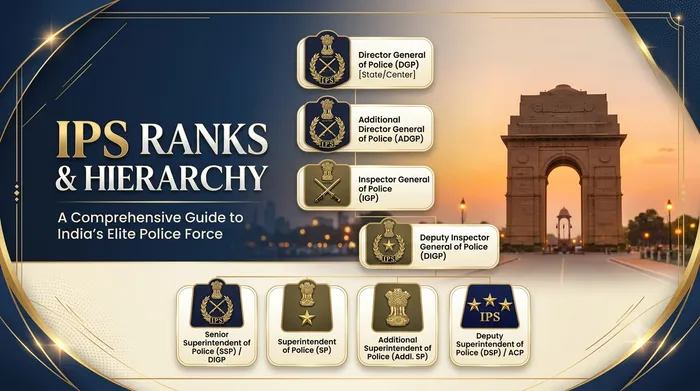
5 August 2026
IPS Rank Structure Explained: Complete Hierarchy from ASP to DGP
A clear explanation of the IPS rank structure from Assistant Superintendent of Police to Director General of Police, including hierarchy, promotions, state vs central postings, and career progression.
9 August 2026
Narendra Modi Family History and Tree: Parents, Siblings, and Ancestral Roots
Explore Narendra Modi’s family history, including his parents Damodardas and Heeraben Modi, siblings, early life in Vadnagar, and a clear look at his family tree and roots.

5 August 2026
U.S. Police Ranks Explained: From Officer to Chief
A clear guide to U.S. police ranks from Officer to Chief, including typical hierarchy, responsibilities, variations by department, and how ranks progress in American law enforcement.

5 August 2026
Sheriff vs Police Chief: Who Has More Authority?
Sheriff vs Police Chief - who holds more authority? Learn the key differences in jurisdiction, appointment, powers, and real-world influence across U.S. law enforcement.
5 August 2026
Is Indira Gandhi Related to Mahatma Gandhi? A Simple Family Explanation
Is Indira Gandhi related to Mahatma Gandhi? The short answer is no. This simple guide explains the two different families, the shared surname, and how the confusion began.
Create Your Family Tree for Free
Start building your family history in minutes with the My rOoOts Free Family Tree Creator. Add parents, grandparents, children, and relatives, organize generations visually, and create a beautiful family tree that you can save and share.
👉 Create your free family tree: Free Family Tree Creator
No design skills required. Simply enter your family details and generate a clear, easy-to-read family tree online for free.
Check Zodiac Compatibility for Any Two People
Curious about how well two people match based on their date of birth? Try the My rOoOts Zodiac Compatibility Tool to compare zodiac signs, explore relationship compatibility, and get a quick compatibility score for couples, friends, or family members.
👉 Check compatibility now: Zodiac Compatibility Calculator
You can enter two dates of birth and even mention the relationship type to get a more personalized compatibility result.
Download a Free Family Tree Template
Want to draw your family tree yourself? The My rOoOts Family Tree Template provides a free printable blank pedigree chart for documenting your family history across multiple generations.
👉 Download a free family tree template: Family Tree Template
Choose a 3-generation, 4-generation, or 5-generation family tree template and save it as a PDF for printing, writing, and documenting your ancestors.
Discover the Meaning and Origin of Your Surname
Ever wondered where your family name came from? Use the My rOoOts Surname Meaning Lookup to explore surname meanings, origins, history, and etymology from different regions and cultures around the world.
👉 Discover your surname meaning: Surname Meaning Lookup
Learn more about your last name and explore the possible linguistic, geographic, cultural, and historical roots behind your family surname.
Start your family tree free
No account needed to begin. Build it in minutes, then save it whenever you're ready.
Build your family tree