Public Family Trees/Lord Krishna/Vajra
Vajra
· Male · Dwaraka
7
Generation
16
Ancestors
0
Descendants
0
Children
0
Marriages
Family Snapshot
Expand full treeVajra
Biography
Vajra was the son of Aniruddha and Usha, and great-grandson of Krishna. After the internecine destruction of the Yadavas following Krishna's departure, he was the only male survivor of the main line. Installed as king of Mathura and later associated with Indraprastha by the Pandavas, he continued the Yadava lineage.
Photos of Vajra
1 photo from the Lord Krishna family album
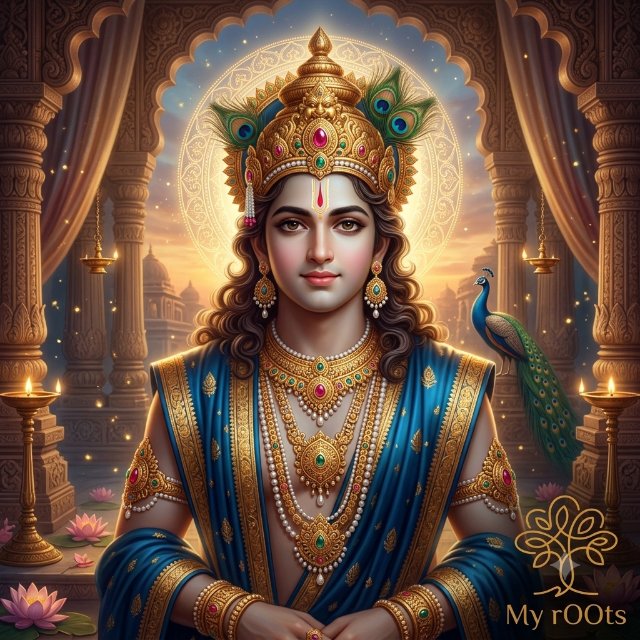
Have old family photos? Give every relative a profile and a photo gallery in your own family tree.
Start your tree, freeLife Timeline
Legacy
King of Mathura and Indraprastha
A defining role in the story of the Lord Krishna family.
Your turn
Map your own family the way Vajra's is mapped
Free, with no sign-up to start. Add yourself, then your parents and grandparents, and watch the tree grow.
More people in the Lord Krishna family tree
View all 35 peopleBalarama
Gen 4
Balarama, the elder brother of Krishna, is an incarnation of Shesha. Transferred from Devaki's womb to Rohini's, he grew up in Gokul. Known for his immense strength, plough weapon, and role as Krishna's constant companion, he participated in many adventures and the Mahabharata war as a neutral observer who taught Duryodhana and Bhima.
Krishna
Gen 4
Lord Krishna, the eighth avatar of Vishnu, was born to Vasudeva and Devaki in Mathura. Raised in Gokul by Nanda and Yashoda, he performed numerous lilas, defeated Kamsa, and established Dwaraka. Central figure of the Mahabharata and Bhagavad Gita, he is worshipped as the Supreme Personality of Godhead in Vaishnavism. He had eight principal queens and thousands of other wives, fathering many sons including Pradyumna and Samba.
Rukmini
Gen 4
Rukmini, the chief queen of Krishna and incarnation of Lakshmi, was the daughter of King Bhishmaka of Vidarbha. She chose Krishna over Shishupala and was abducted by him in the rakshasa style of marriage. Mother of Pradyumna and nine other sons plus daughter Charumati, she is central to Krishna's life in Dwaraka and is worshipped as Rakhumai in Maharashtra.
Bhanu
Gen 5
Bhanu was the eldest son of Krishna and Satyabhama. One of the ten sons of Satyabhama listed in the Bhagavata Purana, he was a prominent Yadava prince.
Charudeshna
Gen 5
Charudeshna was one of the ten sons of Krishna and Rukmini. A valiant Yadava prince equal in qualities to his father, he is listed among the prominent sons in the Bhagavata Purana and other texts.
Devaki
Gen 3
Devaki was the daughter of Devaka and mother of Krishna. Married to Vasudeva, she was imprisoned by her cousin Kamsa after a divine prophecy that her eighth child would kill him. Six of her sons were killed by Kamsa; the seventh (Balarama) was transferred to Rohini and the eighth was Krishna. She is revered as the mother of the divine avatar.
Kunti
Gen 3
Kunti, originally named Pritha, was the daughter of Shurasena and sister of Vasudeva. Adopted by King Kuntibhoja, she became the mother of the Pandavas through divine boons and wife of Pandu. She is a central figure in the Mahabharata, known for her wisdom, devotion, and strength in adversity.
Vasudeva
Gen 3
Vasudeva, also known as Anakadundubhi, was a Yadava prince of the Vrishni clan and father of Krishna and Balarama. Son of Shurasena, he married Devaki and Rohini among others. Imprisoned by Kamsa after a prophecy, he secretly carried newborn Krishna to Gokul. He was known for his piety and righteousness.
Bhishmaka
Gen 1
Bhishmaka was the king of Vidarbha and father of Rukmini and Rukmi. He belonged to the Bhoja dynasty. Though initially inclined toward Rukmini's marriage to Krishna, political pressures led to the planned marriage with Shishupala that Krishna thwarted.
Devaka
Gen 1
Devaka was a Yadava prince of the Andhaka clan and the father of Devaki. He was the brother of Ugrasena and thus the uncle of Kamsa. As maternal grandfather of Krishna, he belongs to the Yadava lineage of Mathura.
Devamidha
Gen 1
Devamidha was a prominent Yadava ruler and the father of Shurasena. He belonged to the Vrishni lineage descending from Yadu. As the paternal great-grandfather of Krishna, he represents an important link in the lunar dynasty of the Yadavas.
Related Family Stories
Tudor Family Tree - The House of Tudor from Henry VII to Elizabeth I
The House of Tudor was the royal family that ruled England and Wales from 1485 to 1603, founded by Henry VII after his victory at Bosworth Field and ending with the death of his granddaughter Elizabeth I. In five reigns the dynasty took England out of the Roman Catholic church, made the monarch the head of a national religion, and turned a peripheral kingdom into a naval and literary power. This tree follows the line from the Welsh courtier Owen Tudor and the dowager queen Catherine of Valois down to Elizabeth I, together with the Brandon, Grey and Clifford cousins and the Scottish line that ended in James VI and I. ## Origins The family name comes from Penmynydd in Anglesey, north Wales, where the Tudors were landed gentry in the service of the princes of Gwynedd. Owen Tudor came to the English court in the 1420s and married Catherine of Valois, the widow of Henry V. Their sons Edmund and Jasper Tudor were half-brothers of Henry VI, who raised them to earldoms in 1452. Edmund's marriage to Lady Margaret Beaufort, a great-granddaughter of John of Gaunt, added the senior Lancastrian claim to the throne, and their only child, born after his father's death, became Henry VII. His marriage to Elizabeth of York, eldest daughter of Edward IV, joined the two houses whose rivalry had driven the Wars of the Roses and gave the dynasty its red and white rose. ## Notable members Henry VII rebuilt the crown's finances and secured the new dynasty through marriage alliances with Spain and Scotland. Henry VIII married six times and broke with Rome, and his three surviving children each reigned in turn: Edward VI as a Protestant boy king, Mary I as the first queen to rule England in her own right, and Elizabeth I for forty-four years. Around them stand the cousins who carried royal blood without the crown, among them Lady Jane Grey, queen for nine days, her sisters Catherine and Mary Grey, and Margaret Pole, Countess of Salisbury, one of the last Plantagenets. ## The Scottish and Suffolk lines Henry VII's daughters carried the blood outward. Margaret Tudor married James IV of Scotland, and her line runs through James V and Mary, Queen of Scots, to James VI and I, who inherited England in 1603. Mary Tudor married Charles Brandon, 1st Duke of Suffolk, and their daughters Frances and Eleanor Brandon produced the Grey and Clifford claimants whom Henry VIII's will preferred over the Scottish descendants of his elder sister. ## Significance No English dynasty changed the country more in so few generations. The Tudors created the Church of England, absorbed the wealth of the monasteries into the crown, brought Wales formally into the English legal and parliamentary system, and built the navy that met the Spanish Armada. The Elizabethan settlement shaped English religion for centuries, and the Elizabethan decades produced Shakespeare, Spenser and the first English voyages to the Americas. When Elizabeth I died unmarried in 1603, the throne passed peacefully to her Scottish cousin, and the two crowns were joined in one person for the first time. | Fact | Details | |---|---| | Origin | Penmynydd, Anglesey, Wales | | Ruled | England, Wales and Ireland, 1485 to 1603 | | Founder | Owen Tudor, through his son Edmund Tudor | | Monarchs | Henry VII, Henry VIII, Edward VI, Mary I, Elizabeth I | | Emblem | The Tudor rose, red and white combined | | Principal seats | Richmond, Greenwich, Hampton Court and Whitehall palaces | | Ended | Death of Elizabeth I in 1603, succeeded by James VI of Scotland |
Vanderbilt Family Tree - America's Gilded Age Dynasty
The Vanderbilts are an American family who rose from Dutch farming stock on Staten Island to hold the largest private fortune in the United States, built by Cornelius Vanderbilt, known as the Commodore, out of nineteenth century shipping and railroads, and known today for the Gilded Age houses their descendants built and for figures from Consuelo, Duchess of Marlborough, to the journalist Anderson Cooper. ## Origins on Staten Island The family descends from Jan Aertsen van der Bilt, a Dutch settler who reached New Netherland in the seventeenth century and whose descendants farmed on Staten Island for generations. Cornelius Vanderbilt (1794-1877) was born there, the son of a boatman, and began work as a teenager carrying freight across New York Harbour in a single sailing barge. He married his first cousin Sophia Johnson in 1813. ## The railroad fortune Vanderbilt moved from sail to steam, dominated the Hudson River and coastal trade, and after the Civil War turned to railroads, consolidating the New York Central system and building Grand Central Depot. He left almost the whole fortune to one son, William Henry Vanderbilt, who nearly doubled it in eight years before dividing it evenly among his own eight children. They built the family's great houses: The Breakers and Marble House at Newport, Biltmore House in North Carolina, Hyde Park on the Hudson, Florham in New Jersey and Shelburne Farms in Vermont. ## Notable members The third and fourth generations produced Consuelo Vanderbilt, who married the 9th Duke of Marlborough and became a social reformer in England; the sculptor Gertrude Vanderbilt Whitney, founder of the Whitney Museum of American Art; Alfred Gwynne Vanderbilt, who died in the sinking of the Lusitania; and Harold Stirling Vanderbilt, who won the America's Cup three times and invented contract bridge. The modern line runs through Reginald Claypoole Vanderbilt to the designer Gloria Vanderbilt and her son, the CNN anchor Anderson Cooper. ## Significance No American family is more closely identified with the Gilded Age. The Vanderbilts set the pattern for how new industrial wealth was spent, and then for how quickly such a fortune disperses across many heirs. What endures is institutional: Vanderbilt University, the Whitney Museum, and the houses at Newport, Hyde Park, Shelburne and Asheville that are now museums and public estates. | Fact | Details | | --- | --- | | Founder | Cornelius Vanderbilt (1794-1877), the Commodore | | Origin | Staten Island, New York, of Dutch descent | | Source of wealth | Steamboat shipping, then the New York Central railroads | | Famous houses | The Breakers, Marble House, Biltmore House, Hyde Park | | Best known members | Consuelo Vanderbilt, Gertrude Vanderbilt Whitney, Gloria Vanderbilt, Anderson Cooper | | Generations covered | Five, from the Commodore to Anderson Cooper |
Bourbon Family Tree - The House of Bourbon in France and Spain
The House of Bourbon is a European royal dynasty, descended in the male line from the Capetian kings of France, that ruled France from 1589 to 1792 and again from 1814 to 1848, and that still reigns in Spain today under King Felipe VI. Over four centuries its members also held the thrones of Navarre, Naples and Sicily, Parma and Etruria, which makes it one of the most widely established royal houses in European history. ## Origins The family takes its name from the lordship of Bourbon in the Auvergne, centred on Bourbon-l'Archambault. Its royal line descends from Robert, Count of Clermont, a younger son of King Louis IX of France, whose marriage to Beatrice of Burgundy, heiress of Bourbon, carried the name into the Capetian house in 1272. For three centuries afterwards the Bourbons were powerful French princes of the blood rather than kings. That changed with Antoine de Bourbon, Duke of Vendome, whose marriage to Jeanne d'Albret, queen regnant of Navarre, produced Henry of Navarre. When the Valois line died out in 1589, Henry was the senior Capetian heir, and he took the French throne as Henry IV. ## Notable members Henry IV ended the French Wars of Religion and issued the Edict of Nantes in 1598. His son Louis XIII, guided by Cardinal Richelieu, built the centralised state that Louis XIV, the Sun King, carried to its height across a reign of seventy-two years, the longest of any European sovereign, and to the palace of Versailles. Louis XV and then Louis XVI inherited that system, and Louis XVI and his queen, Marie Antoinette, were swept away by the French Revolution in 1792. The dynasty returned with Louis XVIII in 1814 and Charles X in 1824, and in 1830 the crown passed to Louis Philippe I of the cadet House of Orleans, the last king to rule in France. ## The Spanish branch In 1700 the childless Charles II of Spain left his crown to Philip, Duke of Anjou, a grandson of Louis XIV. Philip became Philip V, the first Bourbon king of Spain, at the cost of the War of the Spanish Succession, which ended with his renunciation of any claim to the French throne. His descendants include the reforming Charles III, Ferdinand VII, Isabella II, Alfonso XII and Alfonso XIII, who left Spain in 1931. The monarchy was restored in 1975 under Juan Carlos I, grandson of Alfonso XIII, who presided over Spain's transition to democracy and abdicated in 2014 in favour of his son Felipe VI. Felipe's elder daughter Leonor, Princess of Asturias, is heir to the throne. ## Significance No other family links the absolute monarchy of Versailles to a working constitutional monarchy in twenty-first century Madrid. Bourbon marriages tied the house to the Habsburgs of Austria and Spain, the dukes of Savoy, the Medici of Florence and the British royal family, so a Bourbon family tree doubles as a map of European dynastic politics from the Reformation to the present day. | Fact | Details | | --- | --- | | Family name | House of Bourbon (Maison de Bourbon, Casa de Borbon) | | Place of origin | Bourbon-l'Archambault, Auvergne, France | | Founder of the line | Robert, Count of Clermont (1256-1317), son of Louis IX | | First king of France | Henry IV, reigned 1589 to 1610 | | Last king to rule France | Louis Philippe I, reigned 1830 to 1848 | | First king of Spain | Philip V, reigned 1700 to 1746 | | Head of the house in Spain | King Felipe VI, since 2014 | | Heir in Spain | Leonor, Princess of Asturias | | Principal seats | Versailles, Fontainebleau, the Louvre, the Royal Palace of Madrid |
Hohenzollern Family Tree - Prussia's Royal House from Frederick the Great to Kaiser Wilhelm II
The House of Hohenzollern is the German dynasty that ruled Brandenburg from 1415, held the Prussian crown from 1701, and gave Germany its three emperors between 1871 and the fall of the monarchy in 1918. This tree follows the senior Prussian line in one unbroken descent, from Frederick William the Great Elector, through the kings of Prussia and the German Emperors, down to Georg Friedrich, Prince of Prussia, the present head of the house. ## Origins The family takes its name from Hohenzollern Castle on a hill in the Swabian Alb, where a line of counts is recorded from the eleventh century. A Swabian Zollern married into the burgraviate of Nuremberg in 1192, and the Franconian branch that grew from it spent two centuries accumulating lands and credit with the Holy Roman Emperors. The decisive moment came in 1415, when Emperor Sigismund invested Frederick VI of Nuremberg as Elector of Brandenburg in return for his political and financial support. The Duchy of Prussia, a separate inheritance lying outside the Empire, passed to the Brandenburg electors in 1618, and Frederick William, the Great Elector, welded the two into a single functioning state after the devastation of the Thirty Years' War. ## Notable members Frederick I turned the electorate into a kingdom in 1701. His son Frederick William I, the Soldier King, built the army and the treasury that his own son, **Frederick the Great**, used to seize Silesia and to make Prussia a European power, while also composing music, building Sanssouci and corresponding with Voltaire. **Queen Louise** became the emotional centre of Prussian resistance to Napoleon. **Wilhelm I**, with Otto von Bismarck as his minister president, was proclaimed German Emperor at Versailles in 1871. His son **Frederick III** and the liberal English princess he married, Victoria, daughter of Queen Victoria, reigned for only ninety nine days. **Wilhelm II**, the last Kaiser, abdicated in 1918 and died in Dutch exile in 1941. ## Significance No other German family shaped the modern state so directly. Hohenzollern rulers created the Prussian civil service, compulsory schooling and the general staff, sponsored the Berlin academies and the Humboldt university model, and then used Prussian power to unify Germany around themselves. The monarchy ended with the revolution of November 1918, but the house continues as a private family: the headship passed from Wilhelm II to his eldest son, then to Louis Ferdinand, and in 1994 to Georg Friedrich, whose own father and uncles are part of the succession story told in this tree. ## Quick facts | Fact | Details | |---|---| | Family name | Hohenzollern | | Place of origin | Hohenzollern Castle, Swabia, southern Germany | | Ruled | Brandenburg from 1415, Prussia from 1618, Germany from 1871 | | Royal title | King in Prussia from 1701, King of Prussia from 1772 | | Imperial title | German Emperor, 1871 to 1918 | | German Emperors | Wilhelm I, Frederick III, Wilhelm II | | Monarchy ended | 9 November 1918 | | Present head of the house | Georg Friedrich, Prince of Prussia, since 1994 | | Principal residences | Berlin City Palace, Sanssouci and Cecilienhof at Potsdam, Charlottenburg | | Branch shown here | The senior Prussian line only, not Hohenzollern-Sigmaringen |
Frequently Asked Questions
Who were Vajra's parents?+−
Vajra's recorded parents are Aniruddha, Usha.
What did Vajra do?+−
Vajra is recorded as King of Mathura and Indraprastha in the Lord Krishna family tree.
Where was Vajra from?+−
Vajra's recorded native place is Dwaraka.
How many relatives of Vajra are recorded?+−
16 ancestors and 0 descendants of Vajra are recorded so far, within a tree of 35 people.
What family tree does Vajra belong to?+−
Vajra is recorded in the Lord Krishna family tree on My rOoOts, alongside 34 other people.
Every family has a story. Start telling yours.
Trace Vajra's connections across the Lord Krishnatree, or begin preserving your own family's history today.
Free. Private by default. GEDCOM export any time.