Public Family Trees/Lord Krishna/Rukmini
4
Generation
1
Ancestors
5
Descendants
3
Children
1
Marriages
Family Snapshot
Expand full treeBiography
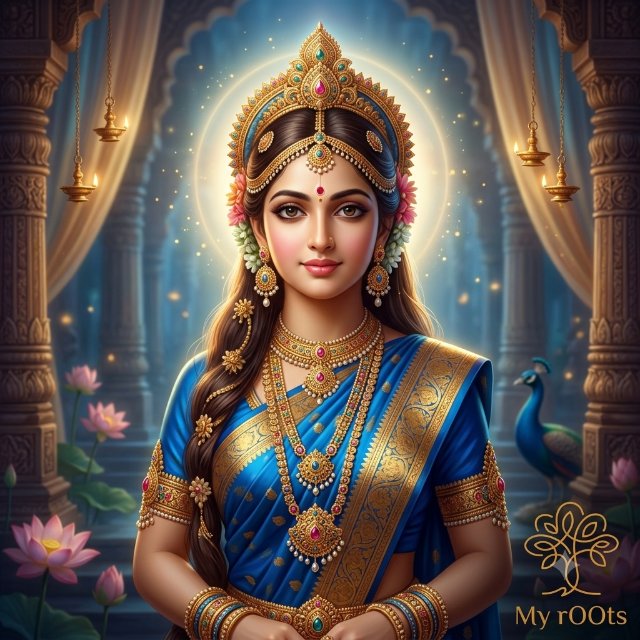
Rukmini, the chief queen of Krishna and incarnation of Lakshmi, was the daughter of King Bhishmaka of Vidarbha. She chose Krishna over Shishupala and was abducted by him in the rakshasa style of marriage. Mother of Pradyumna and nine other sons plus daughter Charumati, she is central to Krishna's life in Dwaraka and is worshipped as Rakhumai in Maharashtra.
Photos of Rukmini
1 photo from the Lord Krishna family album
Have old family photos? Give every relative a profile and a photo gallery in your own family tree.
Start your tree, freeLife Timeline
Next Generation
Family line continues
3 children recorded in this branch.
Legacy
Queen of Dwaraka
A defining role in the story of the Lord Krishna family.
Your turn
Map your own family the way Rukmini's is mapped
Free, with no sign-up to start. Add yourself, then your parents and grandparents, and watch the tree grow.
More people in the Lord Krishna family tree
View all 35 peopleBalarama
Gen 4
Balarama, the elder brother of Krishna, is an incarnation of Shesha. Transferred from Devaki's womb to Rohini's, he grew up in Gokul. Known for his immense strength, plough weapon, and role as Krishna's constant companion, he participated in many adventures and the Mahabharata war as a neutral observer who taught Duryodhana and Bhima.
Bhanu
Gen 5
Bhanu was the eldest son of Krishna and Satyabhama. One of the ten sons of Satyabhama listed in the Bhagavata Purana, he was a prominent Yadava prince.
Devaki
Gen 3
Devaki was the daughter of Devaka and mother of Krishna. Married to Vasudeva, she was imprisoned by her cousin Kamsa after a divine prophecy that her eighth child would kill him. Six of her sons were killed by Kamsa; the seventh (Balarama) was transferred to Rohini and the eighth was Krishna. She is revered as the mother of the divine avatar.
Kunti
Gen 3
Kunti, originally named Pritha, was the daughter of Shurasena and sister of Vasudeva. Adopted by King Kuntibhoja, she became the mother of the Pandavas through divine boons and wife of Pandu. She is a central figure in the Mahabharata, known for her wisdom, devotion, and strength in adversity.
Vajra
Gen 7
Vajra was the son of Aniruddha and Usha, and great-grandson of Krishna. After the internecine destruction of the Yadavas following Krishna's departure, he was the only male survivor of the main line. Installed as king of Mathura and later associated with Indraprastha by the Pandavas, he continued the Yadava lineage.
Vasudeva
Gen 3
Vasudeva, also known as Anakadundubhi, was a Yadava prince of the Vrishni clan and father of Krishna and Balarama. Son of Shurasena, he married Devaki and Rohini among others. Imprisoned by Kamsa after a prophecy, he secretly carried newborn Krishna to Gokul. He was known for his piety and righteousness.
Devaka
Gen 1
Devaka was a Yadava prince of the Andhaka clan and the father of Devaki. He was the brother of Ugrasena and thus the uncle of Kamsa. As maternal grandfather of Krishna, he belongs to the Yadava lineage of Mathura.
Devamidha
Gen 1
Devamidha was a prominent Yadava ruler and the father of Shurasena. He belonged to the Vrishni lineage descending from Yadu. As the paternal great-grandfather of Krishna, he represents an important link in the lunar dynasty of the Yadavas.
Shurasena
Gen 2
Shurasena was a powerful Yadava king after whom the Surasena kingdom was named. He was the father of Vasudeva and Kunti. Married to Marisha, he ruled Mathura and established the Surasena branch of the Yadavas. His descendants include Krishna and the Pandavas through Kunti.
Usha
Gen 6
Usha was the daughter of the demon king Banasura and wife of Aniruddha. After dreaming of Aniruddha, she had him brought to her palace, leading to his imprisonment and the subsequent war in which Krishna defeated Bana. Their marriage produced Vajra.
Marisha
Gen 2
Marisha was the wife of King Shurasena and mother of Vasudeva and Kunti. She belonged to the Naga community according to some traditions and was the paternal grandmother of Krishna.
Related Family Stories
Rothschild Family Tree - The European Banking Dynasty from Mayer Amschel to Today
The Rothschilds are a European banking dynasty founded in Frankfurt am Main by Mayer Amschel Rothschild (1744-1812), whose five sons established banking houses in Frankfurt, Vienna, Naples, London and Paris and together built the most powerful private financial network of the nineteenth century. ## Origins Mayer Amschel Rothschild was born in 1744 in the Judengasse, the walled Jewish street of Frankfurt am Main, where the family took its name from the red shield that had marked an ancestor's house. He began as a dealer in rare coins and medals, became court factor to Crown Prince Wilhelm of Hesse-Kassel in 1769, and turned that position into a banking business handling loans, bullion and government paper. With his wife Gutle Schnapper he had ten children who reached adulthood, five sons and five daughters. ## The five houses Mayer Amschel's decisive act was to place his sons in five cities so that the family could move money and news across borders as a single firm. Amschel Mayer stayed in Frankfurt, Salomon went to Vienna, Nathan to London, Carl to Naples and James to Paris. The brothers financed the allied campaigns against Napoleon, then the governments, railways and industries of nineteenth century Europe. The Naples house closed in 1860 with Italian unification, Frankfurt in 1901 for want of an heir, and Vienna in 1938 after the Anschluss. London and Paris survived, and their successors trade today as Rothschild and Co and the Edmond de Rothschild Group. ## Notable members Nathan Mayer Rothschild founded N M Rothschild and Sons and made London the centre of international lending. His son Lionel broke the bar on Jews sitting in Parliament, taking his Commons seat in 1858, and his grandson Nathan Mayer became the first Jewish member of the House of Lords in 1885. James Mayer de Rothschild dominated French finance under three regimes and bought Chateau Lafite, while his son Edmond funded the first Jewish agricultural settlements in Palestine. The family also produced naturalists and collectors rather than only bankers: Walter, 2nd Baron Rothschild, the zoologist to whom the Balfour Declaration was addressed in 1917; his brother Charles, the flea specialist who founded British nature conservation; Charles's daughter Dame Miriam Rothschild, a Fellow of the Royal Society; and another daughter, Nica, the patron of Thelonious Monk. Jacob, 4th Baron Rothschild, built RIT Capital Partners and chaired the trustees of the National Gallery. ## Significance The Rothschilds were the first banking family to operate as a genuinely international partnership, and for much of the nineteenth century they were the principal lenders to European states. Their name is attached to railways, mines, hospitals, museums, nature reserves, Bordeaux first growths and a long tradition of Jewish philanthropy. Repeated marriages between first cousins kept capital and control inside the family, which is why the branches of this tree cross back into one another so often. | Fact | Details | | --- | --- | | Founder | Mayer Amschel Rothschild (1744-1812) | | Matriarch | Gutle Schnapper (1753-1849) | | Origin | The Judengasse, Frankfurt am Main | | Children of the founder | Ten, five sons and five daughters | | The five houses | Frankfurt, Vienna, Naples, London, Paris | | Motto | Concordia, Integritas, Industria | | Principal firms | N M Rothschild and Sons, de Rothschild Freres, S. M. von Rothschild | | Still active today | Rothschild and Co, Edmond de Rothschild Group | | Known for | Government finance, railways, wine estates, natural history, art collections, philanthropy |
Bourbon Family Tree - The House of Bourbon in France and Spain
The House of Bourbon is a European royal dynasty, descended in the male line from the Capetian kings of France, that ruled France from 1589 to 1792 and again from 1814 to 1848, and that still reigns in Spain today under King Felipe VI. Over four centuries its members also held the thrones of Navarre, Naples and Sicily, Parma and Etruria, which makes it one of the most widely established royal houses in European history. ## Origins The family takes its name from the lordship of Bourbon in the Auvergne, centred on Bourbon-l'Archambault. Its royal line descends from Robert, Count of Clermont, a younger son of King Louis IX of France, whose marriage to Beatrice of Burgundy, heiress of Bourbon, carried the name into the Capetian house in 1272. For three centuries afterwards the Bourbons were powerful French princes of the blood rather than kings. That changed with Antoine de Bourbon, Duke of Vendome, whose marriage to Jeanne d'Albret, queen regnant of Navarre, produced Henry of Navarre. When the Valois line died out in 1589, Henry was the senior Capetian heir, and he took the French throne as Henry IV. ## Notable members Henry IV ended the French Wars of Religion and issued the Edict of Nantes in 1598. His son Louis XIII, guided by Cardinal Richelieu, built the centralised state that Louis XIV, the Sun King, carried to its height across a reign of seventy-two years, the longest of any European sovereign, and to the palace of Versailles. Louis XV and then Louis XVI inherited that system, and Louis XVI and his queen, Marie Antoinette, were swept away by the French Revolution in 1792. The dynasty returned with Louis XVIII in 1814 and Charles X in 1824, and in 1830 the crown passed to Louis Philippe I of the cadet House of Orleans, the last king to rule in France. ## The Spanish branch In 1700 the childless Charles II of Spain left his crown to Philip, Duke of Anjou, a grandson of Louis XIV. Philip became Philip V, the first Bourbon king of Spain, at the cost of the War of the Spanish Succession, which ended with his renunciation of any claim to the French throne. His descendants include the reforming Charles III, Ferdinand VII, Isabella II, Alfonso XII and Alfonso XIII, who left Spain in 1931. The monarchy was restored in 1975 under Juan Carlos I, grandson of Alfonso XIII, who presided over Spain's transition to democracy and abdicated in 2014 in favour of his son Felipe VI. Felipe's elder daughter Leonor, Princess of Asturias, is heir to the throne. ## Significance No other family links the absolute monarchy of Versailles to a working constitutional monarchy in twenty-first century Madrid. Bourbon marriages tied the house to the Habsburgs of Austria and Spain, the dukes of Savoy, the Medici of Florence and the British royal family, so a Bourbon family tree doubles as a map of European dynastic politics from the Reformation to the present day. | Fact | Details | | --- | --- | | Family name | House of Bourbon (Maison de Bourbon, Casa de Borbon) | | Place of origin | Bourbon-l'Archambault, Auvergne, France | | Founder of the line | Robert, Count of Clermont (1256-1317), son of Louis IX | | First king of France | Henry IV, reigned 1589 to 1610 | | Last king to rule France | Louis Philippe I, reigned 1830 to 1848 | | First king of Spain | Philip V, reigned 1700 to 1746 | | Head of the house in Spain | King Felipe VI, since 2014 | | Heir in Spain | Leonor, Princess of Asturias | | Principal seats | Versailles, Fontainebleau, the Louvre, the Royal Palace of Madrid |
Tudor Family Tree - The House of Tudor from Henry VII to Elizabeth I
The House of Tudor was the royal family that ruled England and Wales from 1485 to 1603, founded by Henry VII after his victory at Bosworth Field and ending with the death of his granddaughter Elizabeth I. In five reigns the dynasty took England out of the Roman Catholic church, made the monarch the head of a national religion, and turned a peripheral kingdom into a naval and literary power. This tree follows the line from the Welsh courtier Owen Tudor and the dowager queen Catherine of Valois down to Elizabeth I, together with the Brandon, Grey and Clifford cousins and the Scottish line that ended in James VI and I. ## Origins The family name comes from Penmynydd in Anglesey, north Wales, where the Tudors were landed gentry in the service of the princes of Gwynedd. Owen Tudor came to the English court in the 1420s and married Catherine of Valois, the widow of Henry V. Their sons Edmund and Jasper Tudor were half-brothers of Henry VI, who raised them to earldoms in 1452. Edmund's marriage to Lady Margaret Beaufort, a great-granddaughter of John of Gaunt, added the senior Lancastrian claim to the throne, and their only child, born after his father's death, became Henry VII. His marriage to Elizabeth of York, eldest daughter of Edward IV, joined the two houses whose rivalry had driven the Wars of the Roses and gave the dynasty its red and white rose. ## Notable members Henry VII rebuilt the crown's finances and secured the new dynasty through marriage alliances with Spain and Scotland. Henry VIII married six times and broke with Rome, and his three surviving children each reigned in turn: Edward VI as a Protestant boy king, Mary I as the first queen to rule England in her own right, and Elizabeth I for forty-four years. Around them stand the cousins who carried royal blood without the crown, among them Lady Jane Grey, queen for nine days, her sisters Catherine and Mary Grey, and Margaret Pole, Countess of Salisbury, one of the last Plantagenets. ## The Scottish and Suffolk lines Henry VII's daughters carried the blood outward. Margaret Tudor married James IV of Scotland, and her line runs through James V and Mary, Queen of Scots, to James VI and I, who inherited England in 1603. Mary Tudor married Charles Brandon, 1st Duke of Suffolk, and their daughters Frances and Eleanor Brandon produced the Grey and Clifford claimants whom Henry VIII's will preferred over the Scottish descendants of his elder sister. ## Significance No English dynasty changed the country more in so few generations. The Tudors created the Church of England, absorbed the wealth of the monasteries into the crown, brought Wales formally into the English legal and parliamentary system, and built the navy that met the Spanish Armada. The Elizabethan settlement shaped English religion for centuries, and the Elizabethan decades produced Shakespeare, Spenser and the first English voyages to the Americas. When Elizabeth I died unmarried in 1603, the throne passed peacefully to her Scottish cousin, and the two crowns were joined in one person for the first time. | Fact | Details | |---|---| | Origin | Penmynydd, Anglesey, Wales | | Ruled | England, Wales and Ireland, 1485 to 1603 | | Founder | Owen Tudor, through his son Edmund Tudor | | Monarchs | Henry VII, Henry VIII, Edward VI, Mary I, Elizabeth I | | Emblem | The Tudor rose, red and white combined | | Principal seats | Richmond, Greenwich, Hampton Court and Whitehall palaces | | Ended | Death of Elizabeth I in 1603, succeeded by James VI of Scotland |
Kennedy Family Tree - America's Political Dynasty
The Kennedy family is an Irish American political dynasty from Boston, Massachusetts, whose members have included the 35th President of the United States, three United States senators, four congressmen, several ambassadors, and the founders of the Peace Corps and the Special Olympics. Across four documented generations the family moved from a County Wexford farm to the White House, and its name became shorthand in American public life for both political ambition and public service. ## Origins The American line begins with Patrick Kennedy, a farmer's son from Dunganstown, near New Ross in County Wexford, who emigrated to East Boston during the Great Famine. His son, Patrick Joseph "P. J." Kennedy (1858 to 1929), built a livelihood in the liquor and banking trades and served in both houses of the Massachusetts legislature, becoming one of the Democratic ward leaders who ran the city's Irish Catholic politics. On the other side stood John Francis "Honey Fitz" Fitzgerald (1863 to 1950), congressman and twice Mayor of Boston. The two families joined in 1914 when P. J.'s son Joseph P. Kennedy Sr. married Honey Fitz's daughter Rose Fitzgerald. Their nine children, raised between Brookline, Bronxville and the compound at Hyannis Port on Cape Cod, form the generation the world knows. ## Notable members John F. Kennedy served as President from 1961 until his death in 1963, having previously represented Massachusetts in the House and Senate. His brother Robert F. Kennedy was Attorney General, then Senator from New York, and a candidate for the presidency in 1968. Their youngest brother Edward "Ted" Kennedy sat in the United States Senate for almost 47 years and was one of the most productive legislators of his era. The eldest son, Joseph P. Kennedy Jr., was a naval aviator killed on a volunteer mission in 1944. Away from elected office, Eunice Kennedy Shriver founded the Special Olympics, her husband Sargent Shriver created the Peace Corps and Head Start, and Jean Kennedy Smith founded the arts and disability organisation VSA before serving as United States Ambassador to Ireland. The following generations have produced congressmen, a lieutenant governor, ambassadors, documentary filmmakers, human rights advocates and journalists. ## Significance No other American family has combined electoral success, philanthropy and public visibility on this scale for so long. The Kennedys shaped the civil rights era, the space programme, immigration reform, health care legislation and the modern understanding of disability rights, and their private losses were mourned publicly in a way usually reserved for royalty. The Kennedy Library in Boston, the Kennedy Center in Washington and dozens of schools and institutions carry the name. | Fact | Details | | --- | --- | | Family name | Kennedy | | Irish origin | Dunganstown, County Wexford, Ireland | | American home | Boston and Hyannis Port, Massachusetts | | Founding couple | Patrick Joseph Kennedy and Mary Augusta Hickey | | Best known member | John F. Kennedy, 35th President of the United States | | Generations covered | Four | | Offices held | Presidency, US Senate, US House, ambassadorships, state office | | Institutions founded | Peace Corps, Special Olympics, Best Buddies, Citizens Energy |
Frequently Asked Questions
Who were Rukmini's parents?+−
Rukmini's recorded parent is Bhishmaka.
Who were Rukmini's children?+−
Rukmini has 3 recorded children: Pradyumna, Charudeshna, Charumati.
Who did Rukmini marry?+−
Rukmini married Krishna.
Who were Rukmini's siblings?+−
Rukmini has 1 recorded sibling: Rukmi.
What did Rukmini do?+−
Rukmini is recorded as Queen of Dwaraka in the Lord Krishna family tree.
Where was Rukmini from?+−
Rukmini's recorded native place is Vidarbha.
How many relatives of Rukmini are recorded?+−
1 ancestor and 5 descendants of Rukmini are recorded so far, within a tree of 35 people.
What family tree does Rukmini belong to?+−
Rukmini is recorded in the Lord Krishna family tree on My rOoOts, alongside 34 other people.
Every family has a story. Start telling yours.
Trace Rukmini's connections across the Lord Krishnatree, or begin preserving your own family's history today.
Free. Private by default. GEDCOM export any time.