Public Family Trees/Lord Krishna/Balarama
Balarama
· Male · Gokul
4
Generation
7
Ancestors
2
Descendants
2
Children
1
Marriages
Biography
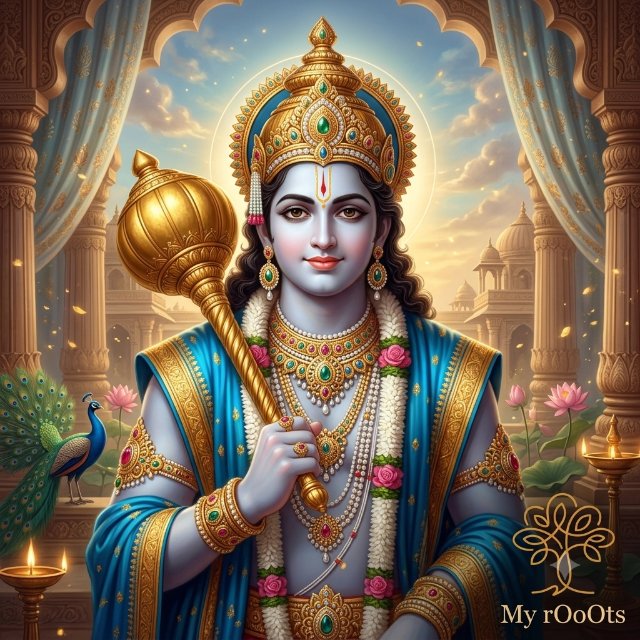
Balarama, the elder brother of Krishna, is an incarnation of Shesha. Transferred from Devaki's womb to Rohini's, he grew up in Gokul. Known for his immense strength, plough weapon, and role as Krishna's constant companion, he participated in many adventures and the Mahabharata war as a neutral observer who taught Duryodhana and Bhima.
Photos of Balarama
1 photo from the Lord Krishna family album
Have old family photos? Give every relative a profile and a photo gallery in your own family tree.
Start your tree, freeYour turn
Map your own family the way Balarama's is mapped
Free, with no sign-up to start. Add yourself, then your parents and grandparents, and watch the tree grow.
More people in the Lord Krishna family tree
View all 35 peoplePradyumna
Gen 5
Pradyumna was the eldest son of Krishna and Rukmini and an incarnation of Kamadeva. Abducted as an infant by the demon Shambara and raised by Mayavati, he later returned to Dwaraka. He married Rukmavati and fathered Aniruddha. A great warrior equal to his father, he played a major role in Yadava affairs.
Rukmini
Gen 4
Rukmini, the chief queen of Krishna and incarnation of Lakshmi, was the daughter of King Bhishmaka of Vidarbha. She chose Krishna over Shishupala and was abducted by him in the rakshasa style of marriage. Mother of Pradyumna and nine other sons plus daughter Charumati, she is central to Krishna's life in Dwaraka and is worshipped as Rakhumai in Maharashtra.
Aniruddha
Gen 6
Aniruddha was the son of Pradyumna and Rukmavati, and grandson of Krishna. A powerful warrior and one of the four Vyuhas of Vishnu, he was abducted by Usha, daughter of Banasura, leading to a great battle involving Krishna and Shiva. He married Usha and fathered Vajra, the sole survivor of the Yadava destruction.
Bhanu
Gen 5
Bhanu was the eldest son of Krishna and Satyabhama. One of the ten sons of Satyabhama listed in the Bhagavata Purana, he was a prominent Yadava prince.
Charudeshna
Gen 5
Charudeshna was one of the ten sons of Krishna and Rukmini. A valiant Yadava prince equal in qualities to his father, he is listed among the prominent sons in the Bhagavata Purana and other texts.
Charumati
Gen 5
Charumati was the daughter of Krishna and Rukmini. She married Bali, the son of Kritavarma. As the only daughter of Rukmini mentioned in the principal texts, she represents the continuation of the lineage through marriage alliances.
Kunti
Gen 3
Kunti, originally named Pritha, was the daughter of Shurasena and sister of Vasudeva. Adopted by King Kuntibhoja, she became the mother of the Pandavas through divine boons and wife of Pandu. She is a central figure in the Mahabharata, known for her wisdom, devotion, and strength in adversity.
Vajra
Gen 7
Vajra was the son of Aniruddha and Usha, and great-grandson of Krishna. After the internecine destruction of the Yadavas following Krishna's departure, he was the only male survivor of the main line. Installed as king of Mathura and later associated with Indraprastha by the Pandavas, he continued the Yadava lineage.
Bhishmaka
Gen 1
Bhishmaka was the king of Vidarbha and father of Rukmini and Rukmi. He belonged to the Bhoja dynasty. Though initially inclined toward Rukmini's marriage to Krishna, political pressures led to the planned marriage with Shishupala that Krishna thwarted.
Devamidha
Gen 1
Devamidha was a prominent Yadava ruler and the father of Shurasena. He belonged to the Vrishni lineage descending from Yadu. As the paternal great-grandfather of Krishna, he represents an important link in the lunar dynasty of the Yadavas.
Nanda
Gen 1
Nanda Maharaja was the foster father of Krishna and chief of the cowherds of Gokul and Vrindavan. A close friend of Vasudeva, he raised Krishna and Balarama with great affection. He is celebrated in Vaishnava tradition as the ideal devoted parent of the divine child.
Related Family Stories
Stuart Family Tree - The House of Stuart from Mary, Queen of Scots to Bonnie Prince Charlie
The House of Stuart was the royal dynasty that ruled Scotland from 1371 and both Scotland and England from 1603 until 1714, giving Britain fourteen monarchs from Robert II to Queen Anne as well as the Jacobite claimants who carried its cause into exile. Spelled Stewart in Scotland and Stuart after Mary, Queen of Scots adopted the French form, the family holds the unusual distinction of having united two crowns by inheritance rather than conquest, and of ending in a disputed succession that reshaped the British constitution. ## Origins The family took its name from its office. The Stewarts were hereditary High Stewards of Scotland, a post granted in the twelfth century to a Breton house settled in Renfrewshire. In 1315 Walter Stewart, 6th High Steward, married Marjorie Bruce, daughter of King Robert the Bruce. Their son became Robert II in 1371 when the direct Bruce line failed, and the stewardship turned into a crown. For more than two centuries afterwards the Stewarts ruled Scotland alone, through a run of reigns cut short by battle, captivity and long royal minorities that left the nobility unusually powerful. ## Notable members James IV, the most cultivated of the Scottish kings, married Margaret Tudor in 1503 and so planted the claim that would carry his descendants to the English throne. His granddaughter Mary, Queen of Scots became queen at six days old, reigned briefly and turbulently, and was deposed in 1567 and executed in England twenty years later. Her son, James VI of Scotland, inherited the English crown in 1603 as James I and became the first monarch to rule both kingdoms. His son Charles I lost the Civil Wars and his throne; Charles II returned at the Restoration in 1660; James II and VII was deposed in the Revolution of 1688, after which his daughters Mary II and Anne reigned in his place. In exile his son James Francis Edward Stuart and grandson Charles Edward Stuart, remembered as Bonnie Prince Charlie, led the Jacobite attempts to recover the throne, ending with the rising of 1745. ## Significance No other British dynasty changed the shape of the state so much. The Stuarts brought Scotland and England under one sovereign, presided over the King James Bible and the theatre of Shakespeare's late career, lost a king to Parliament, and provoked the settlements of 1689 and 1701 that made the monarchy answerable to Parliament and Protestant by statute. When Queen Anne died childless in 1714, the crown passed under the Act of Settlement to the descendants of her cousin Sophia of Hanover, granddaughter of James VI and I, so every British monarch since is still a Stuart descendant. | Fact | Details | | --- | --- | | Founder | Robert II, King of Scots from 1371 | | Ruled | Scotland 1371 to 1714; England and Ireland 1603 to 1714 | | Origin | Renfrewshire, Scotland | | Union of the Crowns | 1603, under James VI of Scotland and I of England | | Last reigning monarch | Anne, Queen of Great Britain, died 1714 | | Jacobite claimants | James Francis Edward, Charles Edward and Henry Benedict Stuart | | Succeeded by | The House of Hanover, through Sophia of Hanover |
The Jackson Family Tree - Michael Jackson
Rockefeller Family Tree - America's Oil and Philanthropy Dynasty
The Rockefeller family is an American business and philanthropic dynasty founded on the Standard Oil fortune of John D. Rockefeller, whose descendants have shaped American banking, conservation, medicine, modern art and national politics across five generations. From a modest upstate New York farmhouse the family rose to control the largest industrial enterprise of the Gilded Age, then spent the twentieth century converting that fortune into foundations, museums, parks and public office. ## Origins The line begins with William Avery Rockefeller (1810-1906), a traveling salesman from Granger, New York, and his wife Eliza Davison (1813-1889), who married in 1837 and raised six children in Richford, Moravia and Owego before the family moved to Ohio. Their eldest son, John D. Rockefeller, began as a Cleveland bookkeeper, entered oil refining in 1863 and incorporated the Standard Oil Company in 1870 together with his younger brother William Rockefeller. By the 1880s Standard Oil refined the great majority of American petroleum, until the Supreme Court ordered its dissolution in 1911. ## Notable members John D. Rockefeller and Laura Spelman Rockefeller had four children who reached adulthood, among them the Chicago arts patron Edith Rockefeller McCormick and the family's only son, John D. Rockefeller Jr. With Abby Aldrich Rockefeller, a co-founder of the Museum of Modern Art, John Jr. had six children who defined the family's public face: Abby "Babs" Rockefeller Mauze, the philanthropist John D. Rockefeller III, Nelson Rockefeller, who served four terms as Governor of New York and then as Vice President of the United States, the conservationist and venture capitalist Laurance Rockefeller, Winthrop Rockefeller, Governor of Arkansas, and the banker David Rockefeller of Chase Manhattan. Their children, known within the family as the Cousins, include Senator Jay Rockefeller of West Virginia, the Asmat art collector Michael Rockefeller, Lieutenant Governor Winthrop Paul Rockefeller of Arkansas, the economist Neva Goodwin and the Synergos founder Peggy Dulany. ## Significance The family's lasting mark is institutional rather than dynastic. The Rockefeller Foundation, the University of Chicago, Rockefeller University, the Rockefeller Brothers Fund, Rockefeller Center, the Museum of Modern Art, Colonial Williamsburg, Lincoln Center, the Asia Society and several national parks all trace their founding or their endowment to a Rockefeller. Few American families have moved so completely from industrial fortune to organized philanthropy and elected office within three generations. | Fact | Details | | --- | --- | | Surname | Rockefeller | | Origin | Richford, New York, United States | | Founder | John D. Rockefeller (1839-1937) | | Family business | Standard Oil, later Chase Manhattan Bank | | Known for | Standard Oil, the Rockefeller Foundation, Rockefeller Center, the Museum of Modern Art | | Public offices held | Vice President of the United States, Governor of New York, Governor of Arkansas, United States Senator | | Generations covered | Five, from William Avery Rockefeller to the fourth-generation Cousins |
Tudor Family Tree - The House of Tudor from Henry VII to Elizabeth I
The House of Tudor was the royal family that ruled England and Wales from 1485 to 1603, founded by Henry VII after his victory at Bosworth Field and ending with the death of his granddaughter Elizabeth I. In five reigns the dynasty took England out of the Roman Catholic church, made the monarch the head of a national religion, and turned a peripheral kingdom into a naval and literary power. This tree follows the line from the Welsh courtier Owen Tudor and the dowager queen Catherine of Valois down to Elizabeth I, together with the Brandon, Grey and Clifford cousins and the Scottish line that ended in James VI and I. ## Origins The family name comes from Penmynydd in Anglesey, north Wales, where the Tudors were landed gentry in the service of the princes of Gwynedd. Owen Tudor came to the English court in the 1420s and married Catherine of Valois, the widow of Henry V. Their sons Edmund and Jasper Tudor were half-brothers of Henry VI, who raised them to earldoms in 1452. Edmund's marriage to Lady Margaret Beaufort, a great-granddaughter of John of Gaunt, added the senior Lancastrian claim to the throne, and their only child, born after his father's death, became Henry VII. His marriage to Elizabeth of York, eldest daughter of Edward IV, joined the two houses whose rivalry had driven the Wars of the Roses and gave the dynasty its red and white rose. ## Notable members Henry VII rebuilt the crown's finances and secured the new dynasty through marriage alliances with Spain and Scotland. Henry VIII married six times and broke with Rome, and his three surviving children each reigned in turn: Edward VI as a Protestant boy king, Mary I as the first queen to rule England in her own right, and Elizabeth I for forty-four years. Around them stand the cousins who carried royal blood without the crown, among them Lady Jane Grey, queen for nine days, her sisters Catherine and Mary Grey, and Margaret Pole, Countess of Salisbury, one of the last Plantagenets. ## The Scottish and Suffolk lines Henry VII's daughters carried the blood outward. Margaret Tudor married James IV of Scotland, and her line runs through James V and Mary, Queen of Scots, to James VI and I, who inherited England in 1603. Mary Tudor married Charles Brandon, 1st Duke of Suffolk, and their daughters Frances and Eleanor Brandon produced the Grey and Clifford claimants whom Henry VIII's will preferred over the Scottish descendants of his elder sister. ## Significance No English dynasty changed the country more in so few generations. The Tudors created the Church of England, absorbed the wealth of the monasteries into the crown, brought Wales formally into the English legal and parliamentary system, and built the navy that met the Spanish Armada. The Elizabethan settlement shaped English religion for centuries, and the Elizabethan decades produced Shakespeare, Spenser and the first English voyages to the Americas. When Elizabeth I died unmarried in 1603, the throne passed peacefully to her Scottish cousin, and the two crowns were joined in one person for the first time. | Fact | Details | |---|---| | Origin | Penmynydd, Anglesey, Wales | | Ruled | England, Wales and Ireland, 1485 to 1603 | | Founder | Owen Tudor, through his son Edmund Tudor | | Monarchs | Henry VII, Henry VIII, Edward VI, Mary I, Elizabeth I | | Emblem | The Tudor rose, red and white combined | | Principal seats | Richmond, Greenwich, Hampton Court and Whitehall palaces | | Ended | Death of Elizabeth I in 1603, succeeded by James VI of Scotland |
Frequently Asked Questions
Who were Balarama's parents?+−
Balarama's recorded parents are Vasudeva, Devaki, Rohini.
Who were Balarama's children?+−
Balarama has 2 recorded children: Nishatha, Ulmuka.
Who did Balarama marry?+−
Balarama married Revati.
Who were Balarama's siblings?+−
Balarama has 2 recorded siblings: Krishna, Subhadra.
What did Balarama do?+−
Balarama is recorded as Avatar of Shesha, Prince in the Lord Krishna family tree.
Where was Balarama from?+−
Balarama's recorded native place is Gokul.
How many relatives of Balarama are recorded?+−
7 ancestors and 2 descendants of Balarama are recorded so far, within a tree of 35 people.
What family tree does Balarama belong to?+−
Balarama is recorded in the Lord Krishna family tree on My rOoOts, alongside 34 other people.
Every family has a story. Start telling yours.
Trace Balarama's connections across the Lord Krishnatree, or begin preserving your own family's history today.
Free. Private by default. GEDCOM export any time.