Public Family Trees/Lord Krishna/Vasudeva
Vasudeva
· Male · Mathura
3
Generation
3
Ancestors
12
Descendants
3
Children
2
Marriages
Family Snapshot
Expand full treeBiography
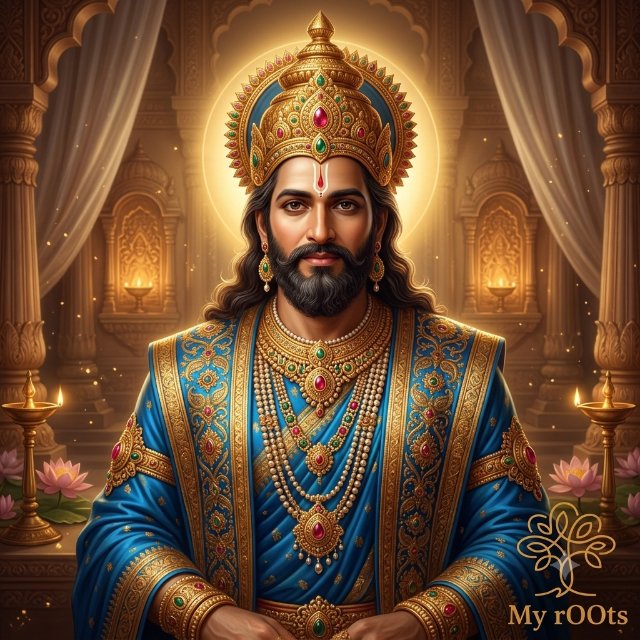
Vasudeva, also known as Anakadundubhi, was a Yadava prince of the Vrishni clan and father of Krishna and Balarama. Son of Shurasena, he married Devaki and Rohini among others. Imprisoned by Kamsa after a prophecy, he secretly carried newborn Krishna to Gokul. He was known for his piety and righteousness.
Photos of Vasudeva
1 photo from the Lord Krishna family album
Have old family photos? Give every relative a profile and a photo gallery in your own family tree.
Start your tree, freeLife Timeline
Legacy
Yadava prince
A defining role in the story of the Lord Krishna family.
Your turn
Map your own family the way Vasudeva's is mapped
Free, with no sign-up to start. Add yourself, then your parents and grandparents, and watch the tree grow.
More people in the Lord Krishna family tree
View all 35 peopleRukmini
Gen 4
Rukmini, the chief queen of Krishna and incarnation of Lakshmi, was the daughter of King Bhishmaka of Vidarbha. She chose Krishna over Shishupala and was abducted by him in the rakshasa style of marriage. Mother of Pradyumna and nine other sons plus daughter Charumati, she is central to Krishna's life in Dwaraka and is worshipped as Rakhumai in Maharashtra.
Aniruddha
Gen 6
Aniruddha was the son of Pradyumna and Rukmavati, and grandson of Krishna. A powerful warrior and one of the four Vyuhas of Vishnu, he was abducted by Usha, daughter of Banasura, leading to a great battle involving Krishna and Shiva. He married Usha and fathered Vajra, the sole survivor of the Yadava destruction.
Vajra
Gen 7
Vajra was the son of Aniruddha and Usha, and great-grandson of Krishna. After the internecine destruction of the Yadavas following Krishna's departure, he was the only male survivor of the main line. Installed as king of Mathura and later associated with Indraprastha by the Pandavas, he continued the Yadava lineage.
Bhishmaka
Gen 1
Bhishmaka was the king of Vidarbha and father of Rukmini and Rukmi. He belonged to the Bhoja dynasty. Though initially inclined toward Rukmini's marriage to Krishna, political pressures led to the planned marriage with Shishupala that Krishna thwarted.
Devaka
Gen 1
Devaka was a Yadava prince of the Andhaka clan and the father of Devaki. He was the brother of Ugrasena and thus the uncle of Kamsa. As maternal grandfather of Krishna, he belongs to the Yadava lineage of Mathura.
Nanda
Gen 1
Nanda Maharaja was the foster father of Krishna and chief of the cowherds of Gokul and Vrindavan. A close friend of Vasudeva, he raised Krishna and Balarama with great affection. He is celebrated in Vaishnava tradition as the ideal devoted parent of the divine child.
Rukmi
Gen 2
Rukmi was the elder brother of Rukmini and son of Bhishmaka. An enemy of Krishna after the abduction of his sister, he was defeated and spared at Rukmini's request. He later arranged the marriages of his daughter Rukmavati to Pradyumna and granddaughter to Aniruddha to please Rukmini.
Usha
Gen 6
Usha was the daughter of the demon king Banasura and wife of Aniruddha. After dreaming of Aniruddha, she had him brought to her palace, leading to his imprisonment and the subsequent war in which Krishna defeated Bana. Their marriage produced Vajra.
Rukmavati
Gen 5
Rukmavati was the daughter of Rukmi and wife of Pradyumna. She chose Pradyumna at her swayamvara despite her father's enmity with Krishna. Mother of Aniruddha, she strengthened the ties between the Vidarbha and Yadava houses.
Yashoda
Gen 1
Yashoda was the foster mother of Krishna and wife of Nanda. She raised Krishna in Gokul with unbounded maternal love, experiencing his childhood miracles including the vision of the universe in his mouth. She is one of the most beloved figures in Krishna bhakti traditions.
Bhadra
Gen 4
Bhadra was one of the eight principal queens of Krishna. A princess of the Madra or related lineage, she married Krishna and is mentioned among his chief consorts in the Puranas. She bore sons to Krishna.
Related Family Stories
Rockefeller Family Tree - America's Oil and Philanthropy Dynasty
The Rockefeller family is an American business and philanthropic dynasty founded on the Standard Oil fortune of John D. Rockefeller, whose descendants have shaped American banking, conservation, medicine, modern art and national politics across five generations. From a modest upstate New York farmhouse the family rose to control the largest industrial enterprise of the Gilded Age, then spent the twentieth century converting that fortune into foundations, museums, parks and public office. ## Origins The line begins with William Avery Rockefeller (1810-1906), a traveling salesman from Granger, New York, and his wife Eliza Davison (1813-1889), who married in 1837 and raised six children in Richford, Moravia and Owego before the family moved to Ohio. Their eldest son, John D. Rockefeller, began as a Cleveland bookkeeper, entered oil refining in 1863 and incorporated the Standard Oil Company in 1870 together with his younger brother William Rockefeller. By the 1880s Standard Oil refined the great majority of American petroleum, until the Supreme Court ordered its dissolution in 1911. ## Notable members John D. Rockefeller and Laura Spelman Rockefeller had four children who reached adulthood, among them the Chicago arts patron Edith Rockefeller McCormick and the family's only son, John D. Rockefeller Jr. With Abby Aldrich Rockefeller, a co-founder of the Museum of Modern Art, John Jr. had six children who defined the family's public face: Abby "Babs" Rockefeller Mauze, the philanthropist John D. Rockefeller III, Nelson Rockefeller, who served four terms as Governor of New York and then as Vice President of the United States, the conservationist and venture capitalist Laurance Rockefeller, Winthrop Rockefeller, Governor of Arkansas, and the banker David Rockefeller of Chase Manhattan. Their children, known within the family as the Cousins, include Senator Jay Rockefeller of West Virginia, the Asmat art collector Michael Rockefeller, Lieutenant Governor Winthrop Paul Rockefeller of Arkansas, the economist Neva Goodwin and the Synergos founder Peggy Dulany. ## Significance The family's lasting mark is institutional rather than dynastic. The Rockefeller Foundation, the University of Chicago, Rockefeller University, the Rockefeller Brothers Fund, Rockefeller Center, the Museum of Modern Art, Colonial Williamsburg, Lincoln Center, the Asia Society and several national parks all trace their founding or their endowment to a Rockefeller. Few American families have moved so completely from industrial fortune to organized philanthropy and elected office within three generations. | Fact | Details | | --- | --- | | Surname | Rockefeller | | Origin | Richford, New York, United States | | Founder | John D. Rockefeller (1839-1937) | | Family business | Standard Oil, later Chase Manhattan Bank | | Known for | Standard Oil, the Rockefeller Foundation, Rockefeller Center, the Museum of Modern Art | | Public offices held | Vice President of the United States, Governor of New York, Governor of Arkansas, United States Senator | | Generations covered | Five, from William Avery Rockefeller to the fourth-generation Cousins |
Glucksburg Family Tree - The Royal House of Denmark, Norway and Greece from Christian IX to Today
The House of Glücksburg is the reigning royal house of Denmark and Norway and the former royal house of Greece, a branch of the ancient House of Oldenburg whose modern members all descend from King Christian IX of Denmark (1818 to 1906) and his wife Louise of Hesse-Kassel. Through the marriages of their six children, a minor ducal family from the Danish-German borderland became the common ancestor of monarchs in Copenhagen, Oslo and Athens, of a British queen consort, of a Russian empress, and of Prince Philip, Duke of Edinburgh. ## Origins The house takes its name from Glücksburg, a small castle town in Schleswig, and belongs to the Schleswig-Holstein-Sonderburg-Glücksburg line of the House of Oldenburg, which had held the Danish throne since 1448. Christian IX was a prince of that cadet branch with no expectation of ruling until the childless Frederik VII made the Danish succession an open European question. Christian succeeded him in 1863, and within months his second son was elected King of the Hellenes as George I, planting the family in Greece for 110 years. In 1905 his grandson Prince Carl of Denmark accepted the Norwegian throne as Haakon VII, giving Norway its own dynasty after centuries of union with Denmark and then Sweden. ## Notable members Christian IX was nicknamed the father-in-law of Europe: his daughter Alexandra married Edward VII of the United Kingdom, and his daughter Dagmar became Empress Maria Feodorovna of Russia, mother of Nicholas II. The Danish line runs through Christian X, Frederik IX and Queen Margrethe II, a trained archaeologist and illustrator who reigned from 1972 until her abdication in 2024, to her son King Frederik X and Queen Mary. The Norwegian line runs from Haakon VII and Queen Maud through Olav V, an Olympic sailing champion, to King Harald V and Crown Prince Haakon. The Greek line produced Constantine I, Paul, Constantine II and Queen Anne-Marie, Queen Sofía of Spain, and Prince Andrew's son Philip, consort to Elizabeth II for 73 years. ## Significance No other western dynasty connects as many surviving monarchies in a single documented lineage. Two of Europe's ten reigning royal families, Denmark and Norway, are Glücksburg in the male line, and the house also sits in the ancestry of the British and Spanish royal families. Its history traces the transformation of European monarchy itself: from the dynastic matchmaking of the 1860s, through the loss of the Russian and Greek thrones, to the constitutional, publicly accountable monarchies of modern Scandinavia. | Fact | Details | | --- | --- | | House name | Schleswig-Holstein-Sonderburg-Glücksburg, a branch of the House of Oldenburg | | Founding figure of the modern house | Christian IX of Denmark (1818 to 1906) | | Ancestral seat | Glücksburg Castle, Schleswig | | Thrones held | Denmark (1863 to present), Greece (1863 to 1973), Norway (1905 to present) | | Current heads of state | Frederik X of Denmark, Harald V of Norway | | Best-known member abroad | Prince Philip, Duke of Edinburgh (1921 to 2021) | | Nickname of its founder | The father-in-law of Europe |
Kennedy Family Tree - America's Political Dynasty
The Kennedy family is an Irish American political dynasty from Boston, Massachusetts, whose members have included the 35th President of the United States, three United States senators, four congressmen, several ambassadors, and the founders of the Peace Corps and the Special Olympics. Across four documented generations the family moved from a County Wexford farm to the White House, and its name became shorthand in American public life for both political ambition and public service. ## Origins The American line begins with Patrick Kennedy, a farmer's son from Dunganstown, near New Ross in County Wexford, who emigrated to East Boston during the Great Famine. His son, Patrick Joseph "P. J." Kennedy (1858 to 1929), built a livelihood in the liquor and banking trades and served in both houses of the Massachusetts legislature, becoming one of the Democratic ward leaders who ran the city's Irish Catholic politics. On the other side stood John Francis "Honey Fitz" Fitzgerald (1863 to 1950), congressman and twice Mayor of Boston. The two families joined in 1914 when P. J.'s son Joseph P. Kennedy Sr. married Honey Fitz's daughter Rose Fitzgerald. Their nine children, raised between Brookline, Bronxville and the compound at Hyannis Port on Cape Cod, form the generation the world knows. ## Notable members John F. Kennedy served as President from 1961 until his death in 1963, having previously represented Massachusetts in the House and Senate. His brother Robert F. Kennedy was Attorney General, then Senator from New York, and a candidate for the presidency in 1968. Their youngest brother Edward "Ted" Kennedy sat in the United States Senate for almost 47 years and was one of the most productive legislators of his era. The eldest son, Joseph P. Kennedy Jr., was a naval aviator killed on a volunteer mission in 1944. Away from elected office, Eunice Kennedy Shriver founded the Special Olympics, her husband Sargent Shriver created the Peace Corps and Head Start, and Jean Kennedy Smith founded the arts and disability organisation VSA before serving as United States Ambassador to Ireland. The following generations have produced congressmen, a lieutenant governor, ambassadors, documentary filmmakers, human rights advocates and journalists. ## Significance No other American family has combined electoral success, philanthropy and public visibility on this scale for so long. The Kennedys shaped the civil rights era, the space programme, immigration reform, health care legislation and the modern understanding of disability rights, and their private losses were mourned publicly in a way usually reserved for royalty. The Kennedy Library in Boston, the Kennedy Center in Washington and dozens of schools and institutions carry the name. | Fact | Details | | --- | --- | | Family name | Kennedy | | Irish origin | Dunganstown, County Wexford, Ireland | | American home | Boston and Hyannis Port, Massachusetts | | Founding couple | Patrick Joseph Kennedy and Mary Augusta Hickey | | Best known member | John F. Kennedy, 35th President of the United States | | Generations covered | Four | | Offices held | Presidency, US Senate, US House, ambassadorships, state office | | Institutions founded | Peace Corps, Special Olympics, Best Buddies, Citizens Energy |
Stuart Family Tree - The House of Stuart from Mary, Queen of Scots to Bonnie Prince Charlie
The House of Stuart was the royal dynasty that ruled Scotland from 1371 and both Scotland and England from 1603 until 1714, giving Britain fourteen monarchs from Robert II to Queen Anne as well as the Jacobite claimants who carried its cause into exile. Spelled Stewart in Scotland and Stuart after Mary, Queen of Scots adopted the French form, the family holds the unusual distinction of having united two crowns by inheritance rather than conquest, and of ending in a disputed succession that reshaped the British constitution. ## Origins The family took its name from its office. The Stewarts were hereditary High Stewards of Scotland, a post granted in the twelfth century to a Breton house settled in Renfrewshire. In 1315 Walter Stewart, 6th High Steward, married Marjorie Bruce, daughter of King Robert the Bruce. Their son became Robert II in 1371 when the direct Bruce line failed, and the stewardship turned into a crown. For more than two centuries afterwards the Stewarts ruled Scotland alone, through a run of reigns cut short by battle, captivity and long royal minorities that left the nobility unusually powerful. ## Notable members James IV, the most cultivated of the Scottish kings, married Margaret Tudor in 1503 and so planted the claim that would carry his descendants to the English throne. His granddaughter Mary, Queen of Scots became queen at six days old, reigned briefly and turbulently, and was deposed in 1567 and executed in England twenty years later. Her son, James VI of Scotland, inherited the English crown in 1603 as James I and became the first monarch to rule both kingdoms. His son Charles I lost the Civil Wars and his throne; Charles II returned at the Restoration in 1660; James II and VII was deposed in the Revolution of 1688, after which his daughters Mary II and Anne reigned in his place. In exile his son James Francis Edward Stuart and grandson Charles Edward Stuart, remembered as Bonnie Prince Charlie, led the Jacobite attempts to recover the throne, ending with the rising of 1745. ## Significance No other British dynasty changed the shape of the state so much. The Stuarts brought Scotland and England under one sovereign, presided over the King James Bible and the theatre of Shakespeare's late career, lost a king to Parliament, and provoked the settlements of 1689 and 1701 that made the monarchy answerable to Parliament and Protestant by statute. When Queen Anne died childless in 1714, the crown passed under the Act of Settlement to the descendants of her cousin Sophia of Hanover, granddaughter of James VI and I, so every British monarch since is still a Stuart descendant. | Fact | Details | | --- | --- | | Founder | Robert II, King of Scots from 1371 | | Ruled | Scotland 1371 to 1714; England and Ireland 1603 to 1714 | | Origin | Renfrewshire, Scotland | | Union of the Crowns | 1603, under James VI of Scotland and I of England | | Last reigning monarch | Anne, Queen of Great Britain, died 1714 | | Jacobite claimants | James Francis Edward, Charles Edward and Henry Benedict Stuart | | Succeeded by | The House of Hanover, through Sophia of Hanover |
Frequently Asked Questions
Who were Vasudeva's parents?+−
Vasudeva's recorded parents are Shurasena, Marisha.
Who were Vasudeva's children?+−
Vasudeva has 3 recorded children: Krishna, Balarama, Subhadra.
Who did Vasudeva marry?+−
Vasudeva was married to Devaki, Rohini.
Who were Vasudeva's siblings?+−
Vasudeva has 1 recorded sibling: Kunti.
What did Vasudeva do?+−
Vasudeva is recorded as Yadava prince in the Lord Krishna family tree.
Where was Vasudeva from?+−
Vasudeva's recorded native place is Mathura.
How many relatives of Vasudeva are recorded?+−
3 ancestors and 12 descendants of Vasudeva are recorded so far, within a tree of 35 people.
What family tree does Vasudeva belong to?+−
Vasudeva is recorded in the Lord Krishna family tree on My rOoOts, alongside 34 other people.
Every family has a story. Start telling yours.
Trace Vasudeva's connections across the Lord Krishnatree, or begin preserving your own family's history today.
Free. Private by default. GEDCOM export any time.