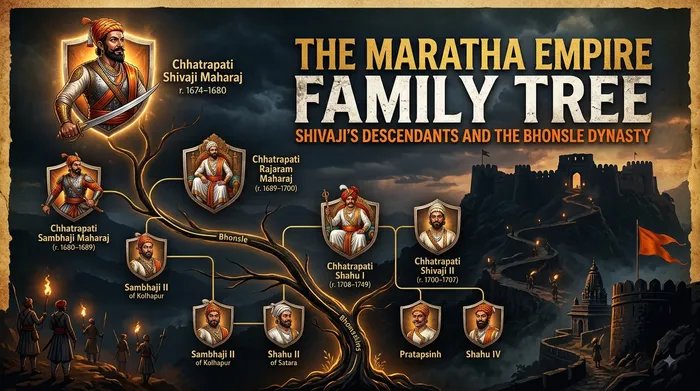
Few figures in Indian history are as widely celebrated as Chhatrapati Shivaji Maharaj, the 17th-century warrior-king who carved the Maratha Empire out of the Deccan plateau and challenged the might of the Mughal empire at its peak. But Shivaji's own family tree, and the Bhonsle dynasty he founded, is far less well known outside Maharashtra than the man himself. This guide traces that lineage, from Shivaji's parents through the succession crisis that split the throne in two, and explains how the empire he built kept expanding for nearly a century after his death.
Shahaji and Jijabai: Shivaji's Parents
Shivaji was born in 1630 to Shahaji Bhonsle, a prominent general who served under the Deccan Sultanates, and Jijabai (also called Jijau), whose influence on her son's upbringing is central to how the Maratha founding story is told. With Shahaji often away on campaign, Jijabai personally oversaw Shivaji's education at Shivneri and Pune, instilling in him the sense of Swarajya, or self-rule, that would define his life's mission. Maratha oral history and folk tradition credit Jijabai as much as Shahaji with shaping the empire that followed.
Shivaji Maharaj: Founder of the Maratha Empire
Shivaji built a kingdom through a combination of guerrilla warfare, a strong navy along the Konkan coast, and a genuinely inclusive administration that recruited talent regardless of caste or religion. In 1674, he was formally crowned Chhatrapati (sovereign) at Raigad Fort, establishing the Maratha Empire as a recognized sovereign power rather than a regional rebellion. He died in 1680, leaving behind two sons who would take the empire in very different directions.
Sambhaji and Rajaram: A Divided Inheritance
Shivaji's elder son, Sambhaji, succeeded him in 1681 and spent almost his entire nine-year reign fighting off the Mughal emperor Aurangzeb, who had personally moved his court to the Deccan to crush the Marathas once and for all. Sambhaji was captured and executed in 1689, a moment still remembered in Maharashtra as an act of defiance rather than defeat.
Leadership then passed to Shivaji's younger son, Rajaram, who ruled from a series of fortified strongholds, including Jinji in the far south, to keep Maratha resistance alive during the darkest years of the Mughal invasion. When Rajaram died in 1700, his widow Tarabai took charge as regent for their young son, Shivaji II, continuing the fight against Aurangzeb with remarkable success.
The Satara-Kolhapur Split
The succession became genuinely complicated when Sambhaji's son, Shahu I, who had spent most of his childhood as a Mughal captive, was released in 1707 following Aurangzeb's death. Shahu returned to claim the Bhonsle throne, putting him in direct conflict with Tarabai's branch of the family. The dispute was eventually resolved by dividing the kingdom: Shahu ruled as Chhatrapati from Satara, while Tarabai's line retained a separate throne at Kolhapur. Both Bhonsle royal lines continued for generations, and the Kolhapur branch in particular remained an important princely state well into the 20th century.
Shahaji Bhonsle & Jijabai
└── Shivaji Maharaj (b. 1630) - founded the Maratha Empire, crowned Chhatrapati in 1674
    ├── Sambhaji (elder son) - succeeded 1681, executed by Aurangzeb in 1689
    │   └── Shahu I (son) - released from Mughal captivity in 1707, ruled from Satara
    └── Rajaram (younger son) - continued the resistance from 1689 to 1700
        └── Shivaji II (son, with regent Tarabai) - rival throne established at Kolhapur
The Peshwas: Power Shifts to a Second Family
During Shahu I's long reign at Satara (1707-1749), day-to-day governance increasingly passed to his chief minister, or Peshwa, Balaji Vishwanath, and this office soon became hereditary within the Bhat family. Balaji Vishwanath's son, Baji Rao I, and later Baji Rao's son, Balaji Baji Rao (Nanasaheb), expanded Maratha territory further than Shivaji himself ever had, at one point controlling territory stretching from the Deccan almost to Delhi and Bengal. The Bhonsle Chhatrapatis remained the empire's ceremonial and symbolic head throughout this period, even as the Peshwas held the real administrative power, a two-family structure that's easy to miss if you're only looking for a single royal bloodline.
Why the Maratha Family Tree Still Matters
For families across Maharashtra and beyond who trace their ancestry to Maratha clans, generals, or the Peshwa administration, this lineage is more than a history lesson: it's a framework for placing an individual ancestor's life against a documented timeline of forts held, battles fought, and territories governed. If an oral family history mentions an ancestor serving "under the Peshwa" or defending a particular fort, knowing where that moment sits in the broader Bhonsle-Peshwa story can help make sense of which generation, and which historical moment, that ancestor actually belonged to.
Frequently Asked Questions
Who founded the Maratha Empire?
Chhatrapati Shivaji Maharaj founded the Maratha Empire, formally crowning himself sovereign at Raigad Fort in 1674 after decades of building a kingdom out of Deccan territory previously controlled by regional sultanates.
Who were Shivaji's sons?
Shivaji had two sons, Sambhaji and Rajaram. Sambhaji succeeded him first and was executed by the Mughal emperor Aurangzeb in 1689; Rajaram then led the resistance until his own death in 1700.
Why did the Maratha throne split into Satara and Kolhapur?
After Sambhaji's son Shahu I was released from Mughal captivity in 1707, he claimed the throne at Satara, while Tarabai (Rajaram's widow) continued to rule on behalf of her own son from Kolhapur. The dispute was resolved by recognizing both as separate seats rather than reuniting them.
What is the difference between the Bhonsle dynasty and the Peshwas?
The Bhonsle dynasty, descended directly from Shivaji, held the ceremonial title of Chhatrapati. The Peshwas were hereditary chief ministers from the Bhat family who, starting under Shahu I, held the real administrative and military power while the Bhonsle line remained the symbolic head of state.
How far did the Maratha Empire eventually expand?
At its height under the Peshwas in the mid-1700s, Maratha influence stretched from the Deccan plateau north to Delhi and east into Bengal, making it briefly the dominant power across most of the Indian subcontinent before the Third Battle of Panipat in 1761 checked its expansion.
Editor's picks
16 August 2026
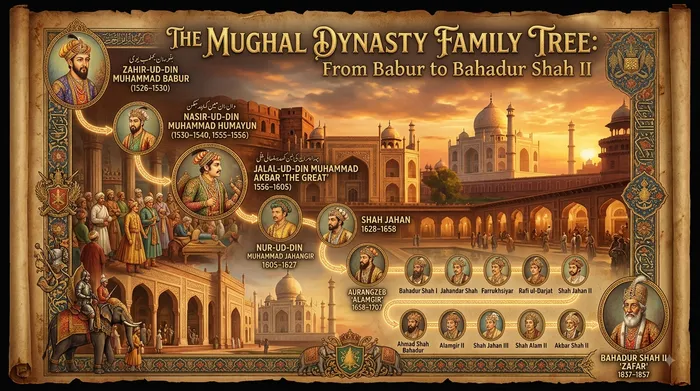
The Mughal Dynasty Family Tree: From Babur to Bahadur Shah II
Trace the Mughal dynasty's family tree across six generations, from founder Babur to the last emperor, Bahadur Shah II, exiled after the 1857 rebellion.
8 August 2026
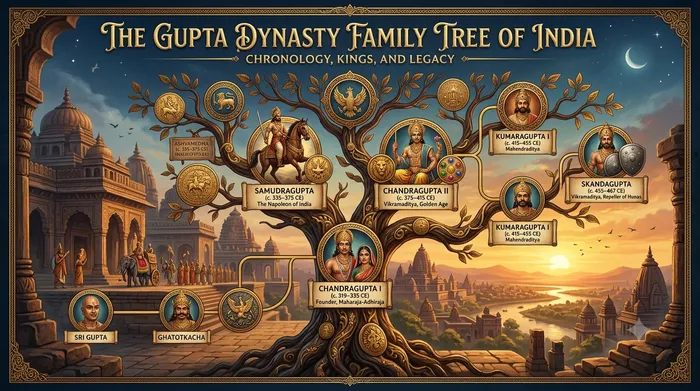
The Gupta Dynasty Family Tree of India
Explore the Gupta Dynasty family tree of India, from Sri Gupta and Chandragupta I to Samudragupta, Chandragupta II Vikramaditya, and the later rulers of India’s Golden Age.
17 August 2026
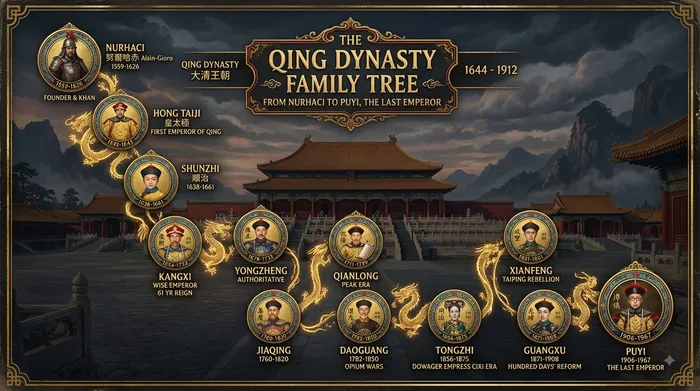
The Qing Dynasty Family Tree: From Nurhaci to Puyi, the Last Emperor
Trace the Qing dynasty's imperial family tree from founder Nurhaci through the High Qing emperors to Puyi, China's last emperor.
8 August 2026
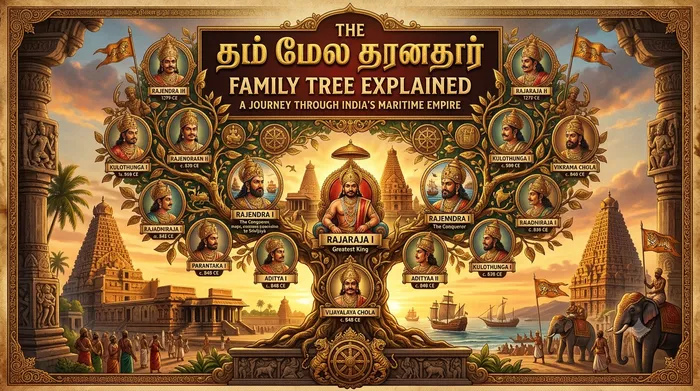
The Chola Dynasty Family Tree Explained
Explore the Chola Dynasty family tree from Vijayalaya to Rajaraja I, Rajendra I, and the later rulers who built one of South India’s greatest empires.
8 August 2026
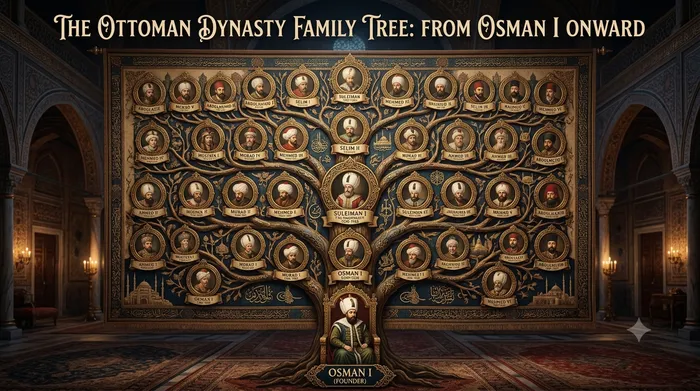
The Ottoman Dynasty Family Tree from Osman I Onward
Explore the Ottoman Dynasty family tree from Osman I to the last sultan Mehmed VI, covering the major sultans who ruled one of history’s longest-lasting empires.
Create Your Family Tree for Free
Start building your family history in minutes with the My rOoOts Free Family Tree Creator. Add parents, grandparents, children, and relatives, organize generations visually, and create a beautiful family tree that you can save and share.
👉 Create your free family tree: Free Family Tree Creator
No design skills required. Simply enter your family details and generate a clear, easy-to-read family tree online for free.
Check Zodiac Compatibility for Any Two People
Curious about how well two people match based on their date of birth? Try the My rOoOts Zodiac Compatibility Tool to compare zodiac signs, explore relationship compatibility, and get a quick compatibility score for couples, friends, or family members.
👉 Check compatibility now: Zodiac Compatibility Calculator
You can enter two dates of birth and even mention the relationship type to get a more personalized compatibility result.
Download a Free Family Tree Template
Want to draw your family tree yourself? The My rOoOts Family Tree Template provides a free printable blank pedigree chart for documenting your family history across multiple generations.
👉 Download a free family tree template: Family Tree Template
Choose a 3-generation, 4-generation, or 5-generation family tree template and save it as a PDF for printing, writing, and documenting your ancestors.
Discover the Meaning and Origin of Your Surname
Ever wondered where your family name came from? Use the My rOoOts Surname Meaning Lookup to explore surname meanings, origins, history, and etymology from different regions and cultures around the world.
👉 Discover your surname meaning: Surname Meaning Lookup
Learn more about your last name and explore the possible linguistic, geographic, cultural, and historical roots behind your family surname.
Start your family tree free
No account needed to begin. Build it in minutes, then save it whenever you're ready.
Build your family tree