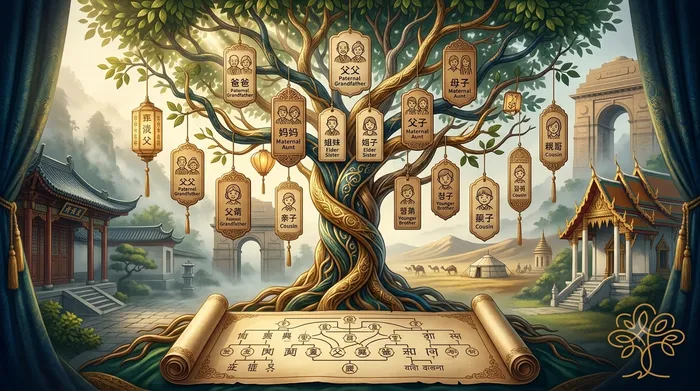
Asian families are known for their deep respect for relationships, traditions, and generations. Unlike many Western cultures where relatives are often grouped simply as "uncle," "aunt," or "cousin," many Asian languages have specific words for different family relationships.
These relationship terms often describe:
- Whether someone is from the mother's or father's side
- Whether they are older or younger
- Whether the relationship is through blood or marriage
- Their position within the family hierarchy
Understanding these terms is essential for anyone researching Asian genealogy, building a family tree, or exploring their cultural heritage.
With MyRooots, you can document family relationships across cultures and preserve your family's story for future generations.
🌳 Start building your family tree today: https://myrooots.app/
Why Asian Family Relationships Are Different
In many Asian cultures, family relationships are more detailed than simple Western terms.
For example, the English word "uncle" may represent several different relationships:
- Father's older brother
- Father's younger brother
- Mother's brother
- Aunt's husband
However, many Asian languages have separate names for each relationship.
This precision helps maintain:
- Family hierarchy
- Respect between generations
- Cultural traditions
- Social identity
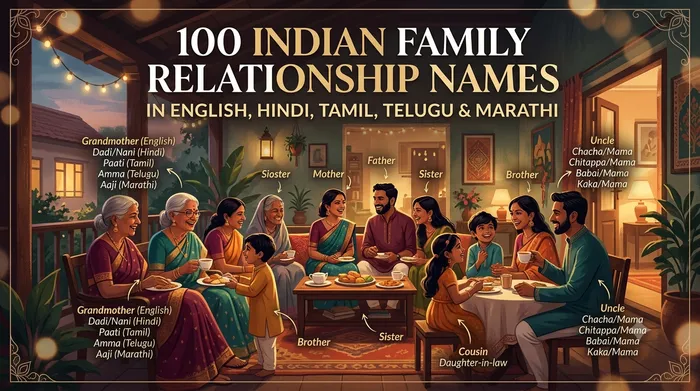
Indian Family Relationship Terms
Indian languages have some of the most detailed family relationship systems in the world.
Chacha (चाचा)
Father's younger brother.
Tau / Taya (ताऊ / ताया)
Father's elder brother.
Mama (मामा)
Mother's brother.
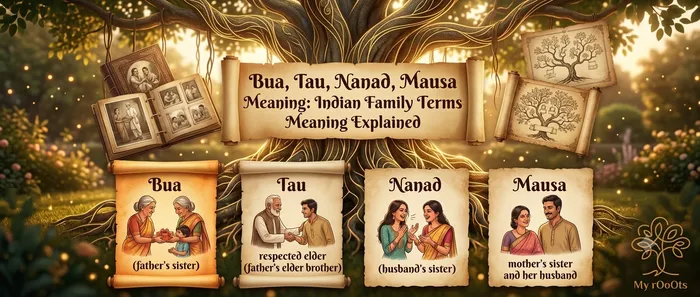
Bua (बुआ)
Father's sister.
Mausi (मौसी)
Mother's sister.
Fufa (फूफा)
Husband of father's sister (Bua).
Mausa (मौसा)
Husband of mother's sister (Mausi).
Jijaji (जीजाजी)
Sister's husband.
Nanad (ननद)
Husband's sister.
Indian family terms often indicate exactly which side of the family a person belongs to.
Chinese Family Relationship Terms
Chinese kinship terminology is highly specific and reflects family hierarchy.
爸爸 (Bàba)
Father.
妈妈 (Māma)
Mother.
爷爷 (Yéye)
Father's father.
奶奶 (Nǎinai)
Father's mother.
外公 (Wàigōng)
Mother's father.
外婆 (Wàipó)
Mother's mother.
The Chinese system distinguishes maternal and paternal relatives clearly.
Chinese Uncle Terms
Chinese has different words for different uncles.
伯伯 (Bóbo)
Father's older brother.
叔叔 (Shūshu)
Father's younger brother.
舅舅 (Jiùjiu)
Mother's brother.
Each relationship has its own identity.
Japanese Family Relationship Terms
Japanese family terms are strongly connected with age and respect.
父 (Chichi)
My father.
母 (Haha)
My mother.
お父さん (Otōsan)
Father (respectful/general use).
お母さん (Okāsan)
Mother (respectful/general use).
Japanese Grandparent Terms
祖父 (Sofu)
Grandfather.
祖母 (Sobo)
Grandmother.
Japanese Sibling Terms
兄 (Ani)
Older brother.
弟 (Otōto)
Younger brother.
姉 (Ane)
Older sister.
妹 (Imōto)
Younger sister.
Japanese relationships often emphasize seniority and respect.
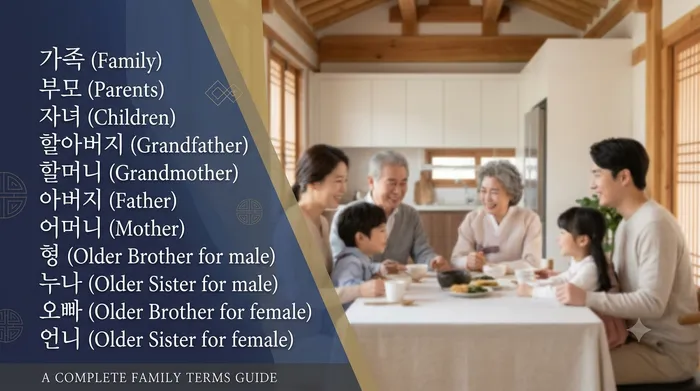
Korean Family Relationship Terms
Korean family language places strong importance on age and family position.
Parents
아버지 (Abeoji)
Father.
어머니 (Eomeoni)
Mother.
Korean Uncle Terms
큰아버지 (Keunabeoji)
Father's older brother.
작은아버지 (Jageunabeoji)
Father's younger brother.
외삼촌 (Oesamchon)
Mother's brother.
Korean terms often specify exactly where someone belongs in the family structure.
Southeast Asian Family Relationship Terms
Southeast Asia includes many cultures with unique family systems.
Countries such as:
- Indonesia
- Malaysia
- Singapore
- Thailand
- Philippines
- Vietnam
have relationship terms influenced by:
- Local traditions
- Religion
- Colonial history
- Language
Indonesian Family Relationship Terms
Common Indonesian family terms include:
| Term | Meaning |
|---|---|
| Ayah | Father |
| Ibu | Mother |
| Kakak | Older sibling |
| Adik | Younger sibling |
| Kakek | Grandfather |
| Nenek | Grandmother |
Indonesian families often use respectful terms even outside direct family relationships.
Malay Family Relationship Terms
Common Malay terms include:
| Term | Meaning |
|---|---|
| Ayah / Bapa | Father |
| Ibu / Emak | Mother |
| Abang | Older brother |
| Kakak | Older sister |
| Adik | Younger sibling |
| Datuk | Grandfather |
Filipino Family Relationship Terms
Filipino family language includes influences from:
- Tagalog
- Spanish
- English
Common terms:
| Term | Meaning |
|---|---|
| Ama | Father |
| Ina | Mother |
| Lolo | Grandfather |
| Lola | Grandmother |
| Kuya | Older brother |
| Ate | Older sister |
| Bunso | Youngest child |
Respectful terms like Kuya and Ate are commonly used even outside immediate family.
Vietnamese Family Relationship Terms
Vietnamese family relationships strongly emphasize age.
Common terms include:
| Term | Meaning |
|---|---|
| Bố / Ba | Father |
| Mẹ | Mother |
| Ông | Grandfather |
| Bà | Grandmother |
| Anh | Older brother |
| Chị | Older sister |
| Em | Younger sibling |
Vietnamese speakers often adjust relationship terms depending on age and social position.
Why Understanding Family Terms Matters in Genealogy
When building a family tree, relationship names provide important cultural context.
They help you understand:
- Family structure
- Ancestor connections
- Regional traditions
- Historical documents
- Oral family stories
A family tree becomes much more meaningful when relationships are recorded accurately.
How Family Relationship Terms Help Build Better Family Trees
When documenting your ancestry, avoid recording relatives only as:
- Uncle
- Aunt
- Cousin
Instead, record the exact relationship.
For example:
Instead of:
"Ravi - Uncle"
Record:
"Ravi - Father's younger brother (Chacha)"
This preserves cultural meaning for future generations.
Create a Multicultural Family Tree With MyRooots
Families today often span multiple countries and cultures.
A single family tree may include relationships from:
- India
- China
- Japan
- Korea
- Southeast Asia
- Europe
- America
MyRooots helps families preserve these connections in one place.
With MyRooots, you can:
- Create detailed family trees
- Record cultural relationships
- Add multiple generations
- Preserve family stories
- Store photographs and memories
- Share your heritage with relatives
🌳 Start building your family tree today: https://myrooots.app/
Frequently Asked Questions
Why do Asian languages have so many family relationship terms?
Many Asian cultures place strong importance on family hierarchy, age, and respect, which created more specific relationship names.
Are Asian family terms different between countries?
Yes. India, China, Japan, Korea, and Southeast Asian countries each have unique kinship systems.
Why is knowing exact family relationships important?
Exact relationship terms help preserve cultural identity and create more accurate family trees.
Can I include different cultural relationship names in my family tree?
Yes. A multicultural family tree can include relationship terms from different languages and traditions.
How can I preserve Asian family history?
You can preserve family history by recording names, relationships, stories, photographs, and important events in a digital family tree.
Final Thoughts
Family relationships are more than names—they represent generations of connection, culture, and shared history.
Across Asia, relationship terms reveal how families understand respect, heritage, and belonging.
Whether your ancestors came from India, China, Japan, Korea, or Southeast Asia, documenting these relationships helps preserve your family's unique story.
🌳 Build and preserve your family history with MyRooots: https://myrooots.app/
Find Any Family Relationship Instantly
Not sure how someone is related to you? Use the MyRooots Relationship Calculator to instantly identify relationships such as cousin, aunt, uncle, nephew, niece, in-laws, and many more. It is a quick and easy tool for understanding complex family connections.
👉 MyRooots Relationship Calculator
Create a Beautiful Family Tree Online
Turn your family information into a clear and organized family tree within minutes. The MyRooots Family Tree Generator helps you add relatives, connect generations, and create a shareable family tree that can grow over time.
👉 MyRooots Family Tree Generator
Visualize Your Family History Through Time
See your ancestors in chronological order with the My rOoOts Ancestor Timeline Generator. It creates a visual timeline of births, marriages, deaths, and important life events, making it easier to understand your family's history across generations.
Editor's picks
20 August 2026
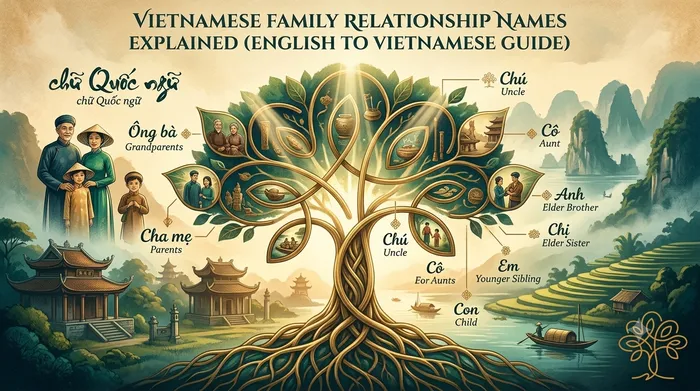
Vietnamese Family Relationship Names Explained (English to Vietnamese Guide)
An English-to-Vietnamese guide to family relationship names, including the paternal-versus-maternal grandparent terms and age-ranked sibling words that make Vietnamese kinship vocabulary so precise.
20 August 2026
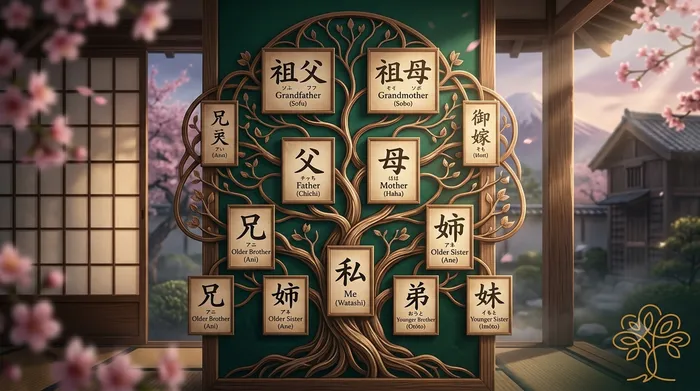
Japanese Family Relationship Names Explained (English to Japanese Guide)
A clear English-to-Japanese guide to family relationship names, including the age-ranked sibling terms and the own-family-vs-other-family rule that trips up most learners.
19 August 2026
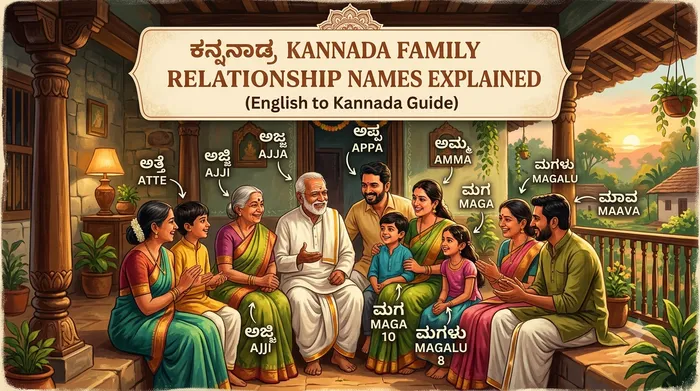
Kannada Family Relationship Names Explained (English to Kannada Guide)
A clear English-to-Kannada guide to family relationship names, covering parents, grandparents, uncles, aunts, in-laws and cousins in Karnataka's family tradition.
20 August 2026
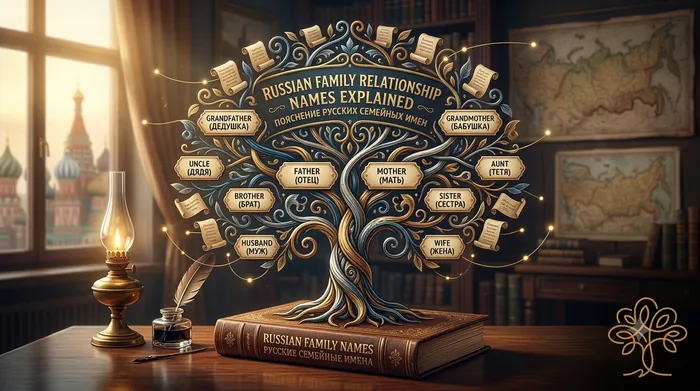
Russian Family Relationship Names Explained (English to Russian Guide)
An English-to-Russian guide to family relationship names, including the distinct in-law terms Russian uses depending on which side of the family you married into.
Check Zodiac Compatibility for Any Two People
Curious about how well two people match based on their date of birth? Try the My rOoOts Zodiac Compatibility Tool to compare zodiac signs, explore relationship compatibility, and get a quick compatibility score for couples, friends, or family members.
👉 Check compatibility now: Zodiac Compatibility Calculator
You can enter two dates of birth and even mention the relationship type to get a more personalized compatibility result.
Create Your Family Tree for Free
Start building your family history in minutes with the My rOoOts Free Family Tree Creator. Add parents, grandparents, children, and relatives, organize generations visually, and create a beautiful family tree that you can save and share.
👉 Create your free family tree: Free Family Tree Creator
No design skills required. Simply enter your family details and generate a clear, easy-to-read family tree online for free.
Download a Free Family Tree Template
Want to draw your family tree yourself? The My rOoOts Family Tree Template provides a free printable blank pedigree chart for documenting your family history across multiple generations.
👉 Download a free family tree template: Family Tree Template
Choose a 3-generation, 4-generation, or 5-generation family tree template and save it as a PDF for printing, writing, and documenting your ancestors.
Discover the Meaning and Origin of Your Surname
Ever wondered where your family name came from? Use the My rOoOts Surname Meaning Lookup to explore surname meanings, origins, history, and etymology from different regions and cultures around the world.
👉 Discover your surname meaning: Surname Meaning Lookup
Learn more about your last name and explore the possible linguistic, geographic, cultural, and historical roots behind your family surname.
Start your family tree free
No account needed to begin. Build it in minutes, then save it whenever you're ready.
Build your family tree