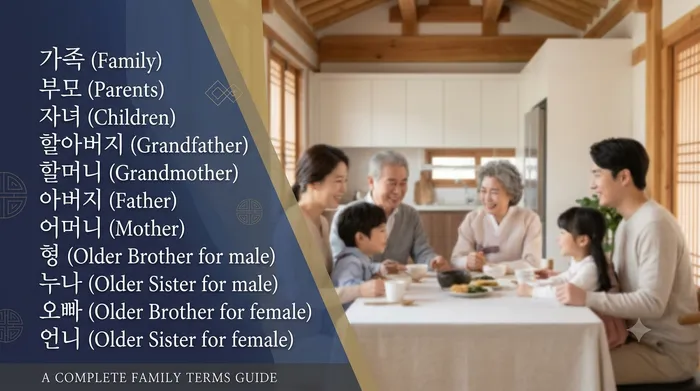
Different Relationship Names in Korean: A Complete Family Terms Guide
Korean family relationships are famous for being detailed and respectful. Unlike English, where many relatives are called simply “uncle,” “aunt,” or “cousin,” Korean uses different terms based on age, gender, and whether the relative is from the father’s or mother’s side of the family.
If you are learning Korean, watching K-dramas, researching Korean ancestry, or connecting with Korean relatives, understanding these relationship names is extremely useful. Korean family terms also reveal important cultural values such as respect for elders, family hierarchy, and closeness between relatives.
This guide explains the most common Korean relationship names in simple English, with pronunciation hints and cultural notes.
Why Korean Family Terms Are So Detailed
Korean society traditionally places strong emphasis on:
- Respect for elders
- Clear family hierarchy
- Distinction between paternal and maternal relatives
- Honorific language in daily life
Because of this, the word you use for a relative often changes depending on:
- Your gender
- The relative’s gender
- Whether the relative is older or younger
- Which side of the family they belong to
This is one reason Korean relationship vocabulary is richer than English family vocabulary.
Immediate Family in Korean
Parents
| English | Korean | Romanization |
|---|---|---|
| Father | 아버지 | Abeoji |
| Mother | 어머니 | Eomeoni |
In casual speech, many Koreans say 아빠 (appa) for dad and 엄마 (eomma) for mom.
Children
| English | Korean | Romanization |
|---|---|---|
| Son | 아들 | Adeul |
| Daughter | 딸 | Ttal |
| Child | 아이 / 자녀 | Ai / Janyeo |
Siblings in Korean
Korean distinguishes siblings by age and the speaker’s gender.
When a male is speaking
| English | Korean | Romanization |
|---|---|---|
| Older brother | 형 | Hyeong |
| Older sister | 누나 | Nuna |
| Younger brother | 남동생 | Namdongsaeng |
| Younger sister | 여동생 | Yeodongsaeng |
When a female is speaking
| English | Korean | Romanization |
|---|---|---|
| Older brother | 오빠 | Oppa |
| Older sister | 언니 | Eonni |
| Younger brother | 남동생 | Namdongsaeng |
| Younger sister | 여동생 | Yeodongsaeng |
This gender-based distinction is one of the first things Korean learners notice.
Grandparents in Korean
| English | Korean | Romanization |
|---|---|---|
| Grandfather | 할아버지 | Harabeoji |
| Grandmother | 할머니 | Halmeoni |
These terms are used for both paternal and maternal grandparents in everyday conversation.
Paternal Relatives
Korean traditionally distinguishes relatives on the father’s side.
Father’s Brothers
| English | Korean | Romanization |
|---|---|---|
| Father’s older brother | 큰아버지 | Keunabeoji |
| Father’s younger brother | 작은아버지 | Jageunabeoji |
Their Wives
| English | Korean | Romanization |
|---|---|---|
| Wife of father’s older brother | 큰어머니 | Keuneomeoni |
| Wife of father’s younger brother | 작은어머니 | Jageuneomeoni |
These distinctions are important in traditional Korean families.
Maternal Relatives
Mother’s Brother
| English | Korean | Romanization |
|---|---|---|
| Maternal uncle | 외삼촌 | Oesamchon |
Mother’s Sister
| English | Korean | Romanization |
|---|---|---|
| Maternal aunt | 이모 | Imo |
Aunt’s Husband
| English | Korean | Romanization |
|---|---|---|
| Husband of maternal aunt | 이모부 | Imobu |
Notice that maternal relatives often include the prefix 외 (oe), meaning “outside,” reflecting traditional lineage distinctions.
Uncle and Aunt in General
In modern conversation, especially among younger Koreans, 삼촌 (samchon) may be used more generally for an uncle, though the traditional terms are still widely understood.
Similarly, 고모 (gomo) refers specifically to a father’s sister.
| English | Korean | Romanization |
|---|---|---|
| Father’s sister | 고모 | Gomo |
| Husband of father’s sister | 고모부 | Gomobu |
Cousins in Korean
Korean has specific cousin terms, but in modern usage many people simply use 사촌 (sachon) for cousin.
| English | Korean | Romanization |
|---|---|---|
| Cousin | 사촌 | Sachon |
Traditional terminology can become much more detailed depending on the exact relationship.
Husband and Wife
| English | Korean | Romanization |
|---|---|---|
| Husband | 남편 | Nampyeon |
| Wife | 아내 | Anae |
Common conversational terms include 신랑 (sinrang) for groom or husband and 부인 (buin) for wife in formal contexts.
Parents-in-Law
Husband’s Parents
| English | Korean | Romanization |
|---|---|---|
| Father-in-law | 시아버지 | Siabeoji |
| Mother-in-law | 시어머니 | Sieomeoni |
Wife’s Parents
| English | Korean | Romanization |
|---|---|---|
| Father-in-law | 장인 | Jangin |
| Mother-in-law | 장모 | Jangmo |
The terms differ depending on whether the speaker is married to a son or a daughter.
Siblings-in-Law
For a married woman
| English | Korean | Romanization |
|---|---|---|
| Husband’s older brother | 아주버님 | Ajubeonim |
| Husband’s younger brother | 도련님 | Doryeonnim |
| Husband’s sister | 시누이 | Sinu-i |
For a married man
| English | Korean | Romanization |
|---|---|---|
| Wife’s brother | 처남 | Cheonam |
| Wife’s sister | 처제 | Cheoje |
These are among the most culturally specific Korean relationship terms.
Children-in-Law
| English | Korean | Romanization |
|---|---|---|
| Son-in-law | 사위 | Sawi |
| Daughter-in-law | 며느리 | Myeoneuri |
Common Family Words in K-Dramas
If you watch Korean dramas, you will frequently hear:
- Oppa (오빠): Older brother, used by females
- Eonni (언니): Older sister, used by females
- Hyeong (형): Older brother, used by males
- Nuna (누나): Older sister, used by males
- Halmeoni (할머니): Grandmother
- Harabeoji (할아버지): Grandfather
These words are often used not only for relatives but also for close friends who are older.
Korean Family Hierarchy and Respect
Korean relationship names are closely tied to honorific speech. Younger family members usually speak more politely to older relatives.
For example:
- Speaking to grandparents requires respectful verb endings.
- Older siblings may be addressed by title rather than by personal name.
- In-laws are often addressed with formal family titles.
Understanding these terms helps learners communicate more naturally and respectfully.
Korean vs. English Family Terms
| Relationship | English | Korean |
|---|---|---|
| Older brother | Brother | 형 / 오빠 |
| Older sister | Sister | 누나 / 언니 |
| Maternal uncle | Uncle | 외삼촌 |
| Father’s older brother | Uncle | 큰아버지 |
| Father’s younger brother | Uncle | 작은아버지 |
English groups several relatives under one word, while Korean often specifies the exact relationship.
Why These Terms Matter in Genealogy
When researching Korean family history, relationship terms can reveal:
- Whether a record refers to the paternal or maternal line
- Relative age within a generation
- Marriage connections
- Household structure
Recording relatives accurately becomes much easier when you understand the original Korean terminology.
A digital family tree can help preserve these relationships across generations. You can start documenting your Korean ancestry with My rOoOts and map connections using the Family Relationship Calculator.
For more genealogy guides and cultural relationship articles, visit the My rOoOts blog.
Easy Memory Tips
Male speaker
- Hyeong = older brother
- Nuna = older sister
Female speaker
- Oppa = older brother
- Eonni = older sister
Maternal side
- Imo = mother’s sister
- Oesamchon = mother’s brother
Paternal side
- Gomo = father’s sister
- Keunabeoji / Jageunabeoji = father’s brothers
Learning these core terms first will help you understand most everyday family conversations.
Conclusion
Korean family relationship names are much more than vocabulary words. They reflect respect, age, gender, and family lineage. From oppa and eonni to gomo and oesamchon, each term tells a story about a person’s place within the family.
Whether you are learning Korean, watching K-dramas, marrying into a Korean family, or researching Korean ancestry, mastering these relationship names will deepen your understanding of Korean culture and family life.
To preserve your own family relationships and ancestry records, explore My rOoOts and create a lasting digital family tree for future generations.
Useful Family History Tools
Understanding Korean relationship names becomes even more meaningful when you can map those connections in a family tree. My rOoOts offers several tools that can help you preserve and explore your family history.
Relationship Calculator
Not sure how two relatives are connected? Use the Relationship Calculator to identify relationships instantly.
Family Tree Generator
Create a visual family tree and organize relatives from both paternal and maternal sides with the Family Tree Generator.
Ancestor Timeline Generator
Build a chronological history of your family and track important life events using the Ancestor Timeline Generator.
Zodiac Compatibility
Explore traditional birthday and zodiac compatibility between family members or couples with the Zodiac Compatibility Tool.
These tools are especially useful for families documenting Korean ancestry, preserving cultural heritage, and sharing family stories across generations.
Check Zodiac Compatibility for Any Two People
Curious about how well two people match based on their date of birth? Try the My rOoOts Zodiac Compatibility Tool to compare zodiac signs, explore relationship compatibility, and get a quick compatibility score for couples, friends, or family members.
👉 Check compatibility now: Zodiac Compatibility Calculator
You can enter two dates of birth and even mention the relationship type to get a more personalized compatibility result.
Create Your Family Tree for Free
Start building your family history in minutes with the My rOoOts Free Family Tree Creator. Add parents, grandparents, children, and relatives, organize generations visually, and create a beautiful family tree that you can save and share.
👉 Create your free family tree: Free Family Tree Creator
No design skills required. Simply enter your family details and generate a clear, easy-to-read family tree online for free.
Download a Free Family Tree Template
Want to draw your family tree yourself? The My rOoOts Family Tree Template provides a free printable blank pedigree chart for documenting your family history across multiple generations.
👉 Download a free family tree template: Family Tree Template
Choose a 3-generation, 4-generation, or 5-generation family tree template and save it as a PDF for printing, writing, and documenting your ancestors.
Discover the Meaning and Origin of Your Surname
Ever wondered where your family name came from? Use the My rOoOts Surname Meaning Lookup to explore surname meanings, origins, history, and etymology from different regions and cultures around the world.
👉 Discover your surname meaning: Surname Meaning Lookup
Learn more about your last name and explore the possible linguistic, geographic, cultural, and historical roots behind your family surname.
Start your family tree free
No account needed to begin. Build it in minutes, then save it whenever you're ready.
Build your family tree