27 August 2026
Morocco's Royal Family Tree: The Alaouite Dynasty Explained
Morocco's Alaouite dynasty has ruled since 1631, claiming descent from the Prophet Muhammad. Here's how the family tree runs from its founding to King Mohammed VI today.
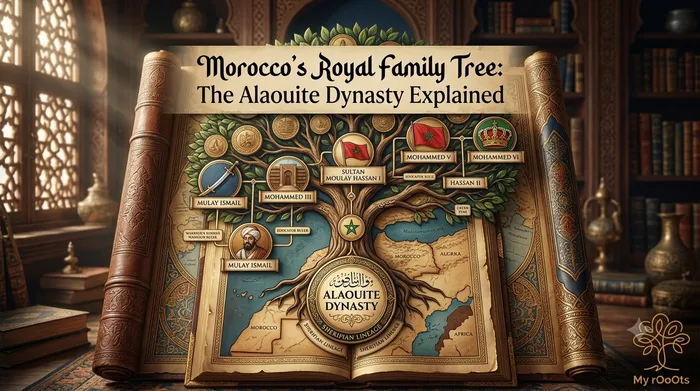
Morocco's Royal Family Tree: The Alaouite Dynasty Explained
Morocco's monarchy is one of the oldest continuously ruling royal families in the world, and its story reaches back centuries before most of Europe's current dynasties existed. The Alaouite dynasty has ruled Morocco since 1631, weathering colonization, independence, and the sweeping political changes of the 20th century while remaining firmly in place. If you've ever wondered how King Mohammed VI fits into this remarkable lineage, here's the Alaouite family tree explained simply.
A Dynasty Nearly 400 Years in the Making
The Alaouite dynasty traces its founding to Moulay Ali Sharif, a religious and political leader from the Tafilalt oasis region in southeastern Morocco. His descendants gradually built political power, and by the mid-1600s the family had positioned itself to rule the country.
Two early rulers cemented the dynasty's future:
- Moulay Rashid (r. 1666-1672) unified much of Morocco under Alaouite control for the first time.
- Moulay Ismail (r. 1672-1727), his brother, is considered the dynasty's true architect. He built the imperial city of Meknes, created a standing army, and negotiated with European powers as an equal, establishing Morocco's independence and stability for generations.
Sharifian Roots: Descent from the Prophet
"Alaouite" comes from Ali, and the family claims descent from Hasan ibn Ali, a grandson of the Prophet Muhammad. This is why Moroccan monarchs carry the title "Amir al-Mu'minin," or Commander of the Faithful, alongside King. That religious lineage matters as much as the political one: it gives the monarchy a form of legitimacy that's separate from, and in many ways more durable than, purely dynastic or military authority.
The Alaouite Family Tree
The line from the dynasty's founder down to today's king runs through several branches, with succession occasionally passing between brothers, uncles, and cousins rather than always father to son. Here's the throughline that connects the dynasty's founding to the present day:
Moulay Ali Sharif (founder, early 1600s)
└── Moulay Rashid (r. 1666-1672) - first Alaouite ruler of a unified Morocco
    └── Moulay Ismail (r. 1672-1727) - brother, builder of the modern Alaouite state
        └── (multiple generations of sultans, 18th-19th century)
            └── Moulay Hassan I (r. 1873-1894)
                └── Moulay Yusef (r. 1912-1927)
                    └── Mohammed V (r. 1927-1961) - led Morocco to independence in 1956
                        └── Hassan II (r. 1961-1999)
                            └── Mohammed VI (r. 1999-present)
                                └── Crown Prince Moulay Hassan (born 2003)
Key Rulers Who Shaped Modern Morocco
| Ruler | Reign | Known For |
|---|---|---|
| Moulay Ismail | 1672-1727 | Built Meknes, formed a standing army, secured Morocco's independence from European powers |
| Moulay Hassan I | 1873-1894 | Modernized the military and administration in the face of European pressure |
| Mohammed V | 1927-1961 | Led Morocco to independence from France and Spain in 1956; revered as a national symbol |
| Hassan II | 1961-1999 | Ruled through decades of political upheaval; survived two coup attempts |
| Mohammed VI | 1999-present | Introduced family law and constitutional reforms; modernized the monarchy's public image |
The Royal Family Today
King Mohammed VI has led Morocco since the death of his father, Hassan II, in 1999. His immediate family includes:
- Crown Prince Moulay Hassan, born in 2003, the heir apparent
- Princess Lalla Khadija, his younger sister, born in 2007
- Princess Lalla Salma, the king's former wife and the crown prince's mother, who has largely stepped back from public royal duties in recent years
The king's brother, Prince Moulay Rachid, and his sisters, including Princess Lalla Meryem, also play visible roles in the country's ceremonial and diplomatic life.
Why the Alaouite Dynasty Has Lasted So Long
A few things set Morocco's monarchy apart from many others that didn't survive the 20th century:
- Religious legitimacy. The claimed descent from the Prophet gives the monarchy a spiritual authority that outlasts any single ruler's popularity.
- Political flexibility. Alaouite sultans and kings have repeatedly adapted, sometimes ceding day-to-day power while retaining the throne, sometimes tightening control when circumstances allowed.
- National identity. Mohammed V's role in securing independence tied the dynasty permanently to Moroccan nationalism rather than positioning it as a colonial-era relic.
For anyone building out their own family tree, Morocco's royal history is also a good reminder that succession doesn't always move in a straight line from father to son. It can pass sideways to a brother or a cousin for generations before returning to direct descent, which is exactly the kind of pattern MyRooots' family tree tools are built to map clearly.
Frequently Asked Questions
How long has the Alaouite dynasty ruled Morocco?
The Alaouite dynasty has ruled Morocco since 1631, making it one of the oldest continuously reigning royal families anywhere in the world, predating most of Europe's current monarchies.
Is the Moroccan royal family really descended from the Prophet Muhammad?
The family's claimed lineage traces back to Hasan ibn Ali, a grandson of the Prophet Muhammad, through the sharifian line. This claim is central to the monarchy's religious title, Commander of the Faithful, and is widely accepted as part of Morocco's national and religious tradition.
Who is next in line to the Moroccan throne?
Crown Prince Moulay Hassan, born in 2003, is the heir apparent and next in the line of succession after his father, King Mohammed VI.
Why did some Alaouite sultans succeed as brothers rather than sons?
Succession within the dynasty hasn't always followed direct father-to-son lines. At various points, brothers, uncles, or cousins took the throne depending on political circumstances, alliances, and who held the strongest claim and support at the time, a pattern common in many long-running monarchies before more rigid succession laws were formalized.
What's the difference between "Sultan" and "King" in Moroccan history?
Moroccan rulers used the title Sultan for most of the Alaouite dynasty's history. Mohammed V adopted the title King in 1957, shortly after independence, to align Morocco with modern nation-state conventions. The underlying dynastic authority didn't change, just the title.
Editor's picks
26 August 2026
Jordan's Royal Family Tree: The Hashemite Dynasty Explained
How the Hashemite dynasty traces its lineage back to the Prophet Muhammad's family and has ruled Jordan since 1921, from King Abdullah I to King Abdullah II.
25 August 2026
Liechtenstein's Princely Family Tree: The House of Liechtenstein Explained
Liechtenstein is one of Europe's last monarchies where the prince genuinely rules. Here's how the House of Liechtenstein's family tree connects centuries of Austrian nobility to a tiny Alpine nation.
23 August 2026
Luxembourg's Grand Ducal Family Tree: The House of Nassau-Weilburg Explained
How a 19th-century succession crisis split Luxembourg's royal family from the Dutch throne, and how the House of Nassau-Weilburg has ruled the Grand Duchy ever since.
21 August 2026
The Belgian Royal Family Tree: The House of Belgium (Saxe-Coburg) Explained
From Leopold I's founding of modern Belgium in 1831 to King Philippe today, trace how a German-born prince's dynasty became the House of Belgium.
25 August 2026
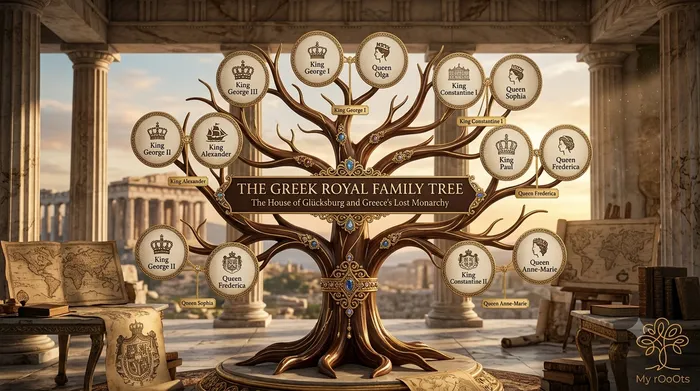
The Greek Royal Family Tree: The House of Glucksburg and Greece's Lost Monarchy
From a Danish prince crowned King of the Hellenes to a monarchy abolished by referendum, here's how the Greek royal family tree connects to Denmark, Britain, and Russia.
23 August 2026
The Norwegian Royal Family Tree: The House of Glücksburg Explained
Trace how a Danish prince became King of Norway in 1905, and how today's Harald V, Crown Prince Haakon and Princess Ingrid Alexandra descend from the House of Glücksburg.
Download a Free Family Tree Template
Want to draw your family tree yourself? The My rOoOts Family Tree Template provides a free printable blank pedigree chart for documenting your family history across multiple generations.
👉 Download a free family tree template: Family Tree Template
Choose a 3-generation, 4-generation, or 5-generation family tree template and save it as a PDF for printing, writing, and documenting your ancestors.
Create Your Family Tree for Free
Start building your family history in minutes with the My rOoOts Free Family Tree Creator. Add parents, grandparents, children, and relatives, organize generations visually, and create a beautiful family tree that you can save and share.
👉 Create your free family tree: Free Family Tree Creator
No design skills required. Simply enter your family details and generate a clear, easy-to-read family tree online for free.
Start your family tree free
No account needed to begin. Build it in minutes, then save it whenever you're ready.
Build your family tree