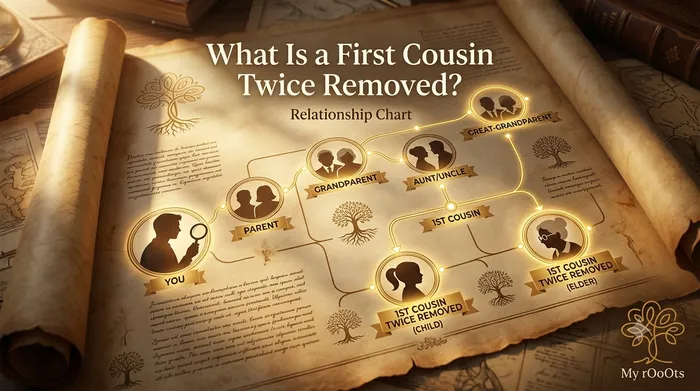
What Is a First Cousin Twice Removed? (With Relationship Chart)
If "second cousin twice removed" and "first cousin once removed" already made your head spin, you're not alone. "Removed" is the single most misunderstood word in family relationship terminology. Once you understand what it actually measures, though, working out any cousin relationship becomes simple arithmetic instead of guesswork. Here's exactly what a first cousin twice removed is, with a chart you can use for your own family.
The Two Parts of the Term
Every cousin term has two components, and they answer two completely different questions:
- "First cousin" tells you how closely related you are by shared ancestry, specifically, that you and this person share a set of grandparents (not parents, which would make you siblings).
- "Twice removed" tells you how many generations separate you from that person. "Removed" simply means you're in different generations. Once removed means one generation apart. Twice removed means two generations apart.
So a first cousin twice removed is someone who shares your first-cousin relationship's ancestry, but sits two generations away from you, either two generations up or two generations down your family tree.
Two Ways to Be First Cousins, Twice Removed
There are always two directions this relationship can run:
- Downward: Your first cousin's grandchild is your first cousin, twice removed.
- Upward: Your grandparent's first cousin is also your first cousin, twice removed.
Both people hold the exact same label. "Twice removed" doesn't specify direction, only distance.
Great-Great-Grandparent
└── Great-Grandparent A
    └── Grandparent
        └── Parent
            └── You
└── Great-Grandparent B (sibling of Great-Grandparent A)
    └── First cousin of your grandparent
        └── Their child (your parent's first cousin, once removed)
            └── Their grandchild (your first cousin, twice removed)
A Quick Reference Chart
If you already know how "cousin" and "removed" combine, this chart covers the relationships people search for most:
| Relationship | What It Means |
|---|---|
| First cousin | Shares your grandparents |
| First cousin, once removed | Your first cousin's child, or your parent's first cousin |
| First cousin, twice removed | Your first cousin's grandchild, or your grandparent's first cousin |
| Second cousin | Shares your great-grandparents |
| Second cousin, once removed | Your second cousin's child, or your parent's second cousin |
| Second cousin, twice removed | Your second cousin's grandchild, or your grandparent's second cousin |
The pattern holds no matter how far out you go: the cousin number depends on the closest shared ancestor's generation, and "removed" just counts the generation gap between the two people being compared.
Why This Relationship Feels So Confusing
Most people never encounter a first cousin twice removed in daily life the way they encounter a sibling or a first cousin, so there's no everyday shorthand for it. It typically only comes up in two situations:
- Family tree research, when you're mapping out how a distant relative from an old record connects to your direct line.
- Family reunions or estate matters, where someone needs to explain exactly how a much-older or much-younger relative fits in.
Because the relationship spans generations, the age gap can be surprisingly large or small. A first cousin twice removed could be your grandmother's age, or your grandchild's age, depending on which direction the "removed" runs and how many children each generation had.
How This Comes Up in Genealogy Research
When you're building out a family tree, especially one that reaches back three or four generations, you'll run into "twice removed" relationships constantly, even if you never use the term out loud. It typically shows up when:
- You find a shared ancestor several generations back and need to describe how a newly discovered relative connects to your own line.
- You're comparing DNA matches, since DNA testing services often label matches using exactly this terminology.
- You're organizing a family reunion and want name tags or a chart that make everyone's connection clear at a glance.
Having a family tree tool that calculates these relationships automatically saves you from doing this math by hand every time a new relative turns up in the records.
Frequently Asked Questions
What is a first cousin twice removed in simple terms?
It's either your first cousin's grandchild, or your grandparent's first cousin. Both relationships carry the same label because "twice removed" only measures the generation gap, not the direction.
Is a first cousin twice removed a blood relative?
Yes. You share a common ancestor, the same great-great-grandparent whose two children eventually led to your grandparent's generation on one side and your own generation on the other, several steps removed.
How is a first cousin twice removed different from a second cousin?
A first cousin twice removed shares your grandparents' generation as the closest common ancestor point but sits two generations apart in age or descent. A second cousin, by contrast, shares great-grandparents with you directly, in the same generation as you.
Can a first cousin twice removed be older or younger than you?
Either. If they're your first cousin's grandchild, they're almost always younger. If they're your grandparent's first cousin, they're almost always older, sometimes by 40 to 60 years, since two full generations separate you.
Do DNA testing sites use this same terminology?
Yes. Services like AncestryDNA and 23andMe label predicted relatives using the same cousin-and-removed system described here, so understanding it makes your DNA match list far easier to read.
Editor's picks
26 August 2026
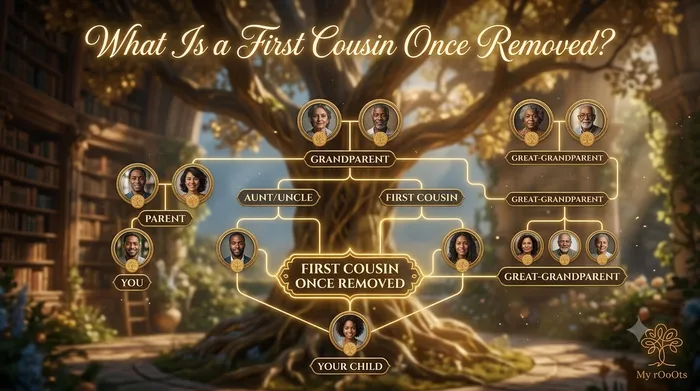
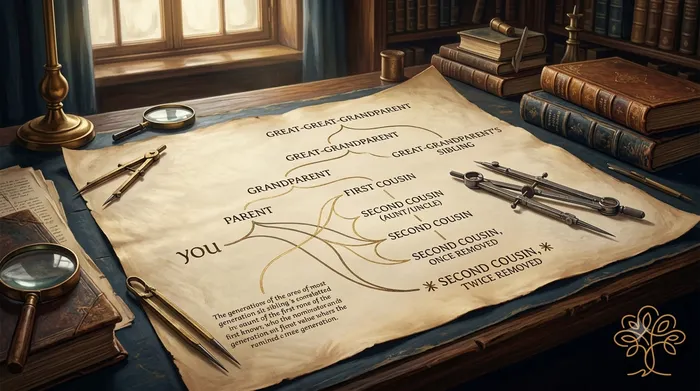
What Is a First Cousin Once Removed? (With Relationship Chart)
A clear, jargon-free explanation of what "once removed" actually means, with a chart to help you work out exactly how a first cousin once removed fits into your family tree.
23 August 2026
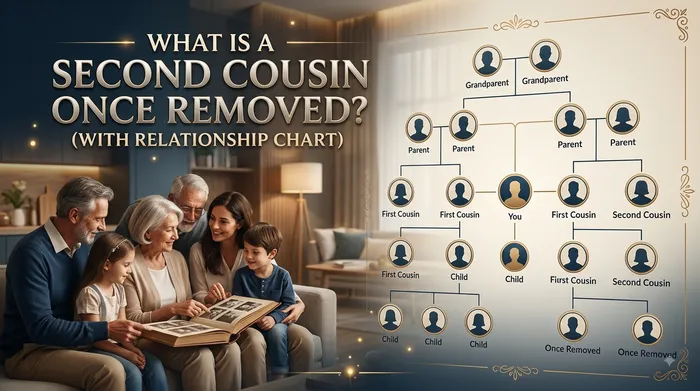
What Is a Second Cousin Twice Removed? (With Relationship Chart)
A plain-language explanation of what 'second cousin twice removed' means, with a relationship chart showing exactly how to count the generations.
17 August 2026
What Is a Second Cousin Once Removed? (With Relationship Chart)
A plain-language explanation of what "second cousin once removed" actually means, with a relationship chart you can use for any cousin connection.
9 August 2026
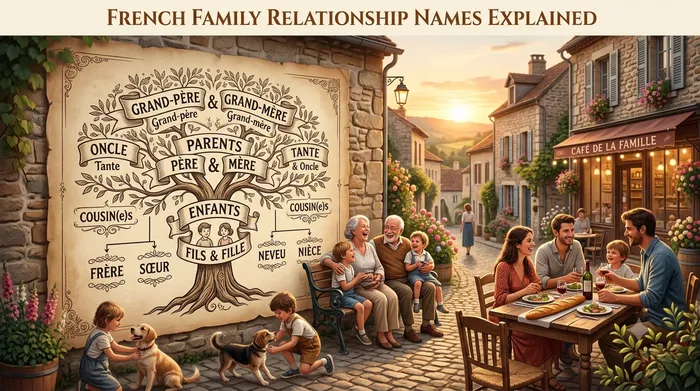
French Family Relationship Names Explained (English to French Guide)
A complete English-to-French guide to family relationship names, covering parents, siblings, grandparents, in-laws, cousins, step-family, and more with clear tables and examples.
9 August 2026
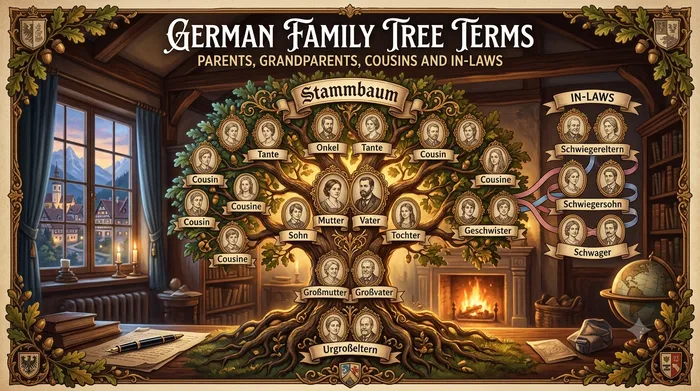
German Family Tree Terms: Parents, Grandparents, Cousins and In-Laws
A clear English-to-German guide to family tree terms, including parents, grandparents, siblings, cousins, uncles, aunts, in-laws, and step-relations with easy tables.
9 August 2026
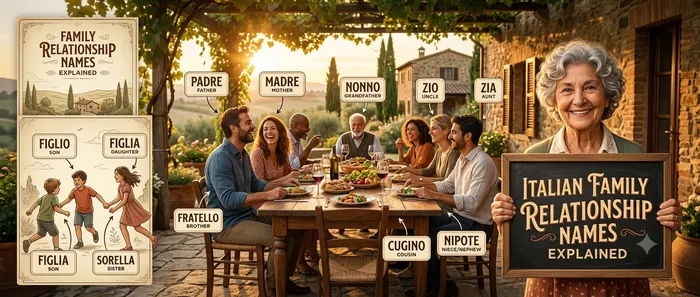
Italian Family Relationship Names Explained
A complete English-to-Italian guide to family relationship names, covering parents, siblings, grandparents, cousins, in-laws, step-family and more with clear tables.
Download a Free Family Tree Template
Want to draw your family tree yourself? The My rOoOts Family Tree Template provides a free printable blank pedigree chart for documenting your family history across multiple generations.
👉 Download a free family tree template: Family Tree Template
Choose a 3-generation, 4-generation, or 5-generation family tree template and save it as a PDF for printing, writing, and documenting your ancestors.
Create Your Family Tree for Free
Start building your family history in minutes with the My rOoOts Free Family Tree Creator. Add parents, grandparents, children, and relatives, organize generations visually, and create a beautiful family tree that you can save and share.
👉 Create your free family tree: Free Family Tree Creator
No design skills required. Simply enter your family details and generate a clear, easy-to-read family tree online for free.
Check Zodiac Compatibility for Any Two People
Curious about how well two people match based on their date of birth? Try the My rOoOts Zodiac Compatibility Tool to compare zodiac signs, explore relationship compatibility, and get a quick compatibility score for couples, friends, or family members.
👉 Check compatibility now: Zodiac Compatibility Calculator
You can enter two dates of birth and even mention the relationship type to get a more personalized compatibility result.
Start your family tree free
No account needed to begin. Build it in minutes, then save it whenever you're ready.
Build your family tree