15 August 2026
The Habsburg Family Tree: How One Family Ruled Europe for 600 Years
The Habsburgs turned marriage into a strategy for building an empire, creating one of history's most famous and most tangled family trees. Here's how the dynasty rose, split in two, and eventually fell.
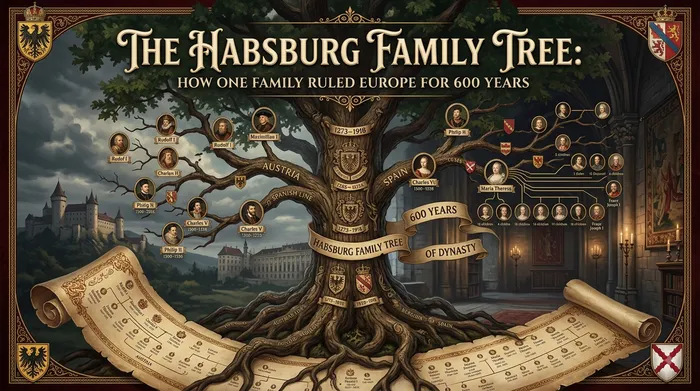
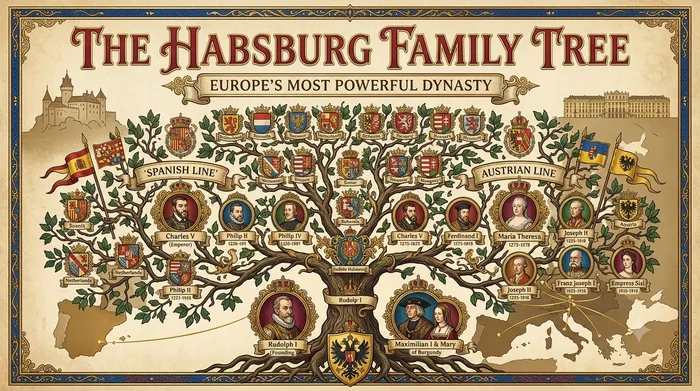
If you've ever built out your own family tree and marveled at how quickly it branches after just three or four generations, imagine doing that across six centuries, a dozen countries, and roughly half of Europe's crowned heads. That's the Habsburg family tree: quite possibly the most famous, most tangled, and most consequential family diagram in Western history.
Where the Habsburgs Started
The family takes its name from Habsburg Castle, a modest fortress built around 1020 in what's now Aargau, Switzerland. For two centuries the Habsburgs were just one of many minor noble families jostling for land and titles within the Holy Roman Empire. Their real break came in 1273, when Rudolf I was elected King of the Romans. From there the family began acquiring territory in Austria, laying the foundation for what would eventually become the Austrian branch of the dynasty.
The Marriage Strategy That Built an Empire
Most medieval dynasties expanded through war. The Habsburgs preferred weddings. Their unofficial family motto, often quoted in Latin as 'Bella gerant alii, tu felix Austria, nube,' translates roughly to 'Let others wage war; you, happy Austria, marry.' It wasn't just a clever saying, it was a genuine strategy, repeated across generations, and it worked spectacularly well.
Through a sequence of carefully arranged marriages, the family picked up Burgundy, the Netherlands, Spain, and Spain's overseas empire in the Americas within just a few generations, largely without going to war. By the early 1500s, Emperor Charles V ruled over a domain so vast that people said the sun never set on it: Spain, Austria, the Netherlands, parts of Italy, and colonies stretching from Mexico to the Philippines.
Two Branches, One Family Tree
In 1556, Charles V split his empire between two branches of the family, a decision that reshaped the Habsburg family tree into two distinct lines worth knowing if you're tracing the genealogy yourself:
- The Spanish Habsburgs ruled Spain and its empire until 1700, when the line ended with Charles II, whose severe health problems are widely attributed to generations of intermarriage.
- The Austrian Habsburgs held the Holy Roman Empire and, later, the Austrian and Austro-Hungarian thrones, all the way until 1918.
Both branches kept marrying within the extended family (uncles to nieces, first cousins to first cousins) to keep territory and alliances consolidated. It worked for a while, but geneticists now point to the Spanish branch's extinction as one of history's clearest documented cases of inbreeding depression.
The Habsburg Jaw
If you've ever seen a portrait of a Habsburg monarch with a strikingly protruding lower jaw, that's not a quirk of painting style, it's mandibular prognathism, informally known as the 'Habsburg jaw.' A 2019 genetic study analyzed portraits of Habsburg family members across generations and found a direct statistical link between the severity of the jaw and the family's degree of inbreeding. It's a genuinely fascinating case study in how genealogy and genetics intersect, and a good reminder of why family trees matter for more than just names and dates.
Names Worth Knowing on the Tree
A few Habsburgs are worth flagging if you're building this branch out for yourself:
- Maria Theresa (1717-1780), the only woman to rule the Habsburg domains in her own right, and mother to sixteen children, including Marie Antoinette, who married into the French Bourbon line.
- Charles V (1500-1558), whose empire spanned Europe and the Americas and who split the dynasty into its Spanish and Austrian branches.
- Franz Joseph I (1830-1916), the longest-reigning Habsburg emperor, whose 68-year rule ended with the outbreak of World War I.
- Charles I, the last reigning Habsburg emperor, who abdicated in 1918 as the Austro-Hungarian Empire dissolved.
How the Dynasty Connects to Other Royal Families
Because the Habsburgs married so widely and so often, their family tree isn't really a standalone tree, it's woven directly into the Bourbons of France and Spain, the Romanovs of Russia, the Wittelsbachs of Bavaria, and, more distantly, the British royal family. Trace almost any European royal line back far enough and you'll eventually run into a Habsburg marriage.
The Family Today
The dynasty formally lost its thrones in 1918, but the family never disappeared. Karl von Habsburg, great-grandson of the last emperor, currently heads the family, and the Habsburg name is still carried by descendants across Austria, Hungary, and beyond. Modern members have gone on to careers in politics, diplomacy, and the European Parliament, a far cry from ruling multiple empires, but a good reminder that family trees don't stop when the history books move on to the next chapter.
Frequently Asked Questions
Are the Habsburgs still alive today?
Yes. The dynasty lost its ruling thrones in 1918, but descendants remain, with Karl von Habsburg as the current head of the family. Many members live in Austria and Hungary today.
Why did the Habsburgs marry within the family so often?
Intermarriage kept territory, titles, and wealth consolidated within the family rather than dispersed through marriage to outside houses. Over generations, this practice concentrated genetic risk, contributing to the health problems seen in later Habsburg monarchs.
What is the Habsburg jaw?
It's a pronounced protruding lower jaw, technically mandibular prognathism, visible in numerous Habsburg portraits across generations. Researchers have linked its severity to the family's degree of inbreeding.
How did the Habsburg dynasty end?
The Spanish line ended in 1700 with the death of the childless Charles II. The Austrian line continued until 1918, when Emperor Charles I abdicated as the Austro-Hungarian Empire collapsed at the end of World War I.
Is the Habsburg family related to the British royal family?
Distantly, yes. Centuries of intermarriage among European royal houses mean that most royal family trees, including the British one, connect back to a Habsburg marriage somewhere in the branches.
Tracing Your Own Family's Story
Few of us are untangling six centuries of royal marriages, but the same instinct that makes the Habsburg family tree so fascinating, watching how one generation connects to the next, is exactly what makes building your own family tree worthwhile. You don't need an empire to have a story worth mapping out.
Editor's picks
9 August 2026
German Family Tree Terms: Parents, Grandparents, Cousins and In-Laws
A clear English-to-German guide to family tree terms, including parents, grandparents, siblings, cousins, uncles, aunts, in-laws, and step-relations with easy tables.
9 August 2026
French Family Relationship Names Explained (English to French Guide)
A complete English-to-French guide to family relationship names, covering parents, siblings, grandparents, in-laws, cousins, step-family, and more with clear tables and examples.
8 August 2026
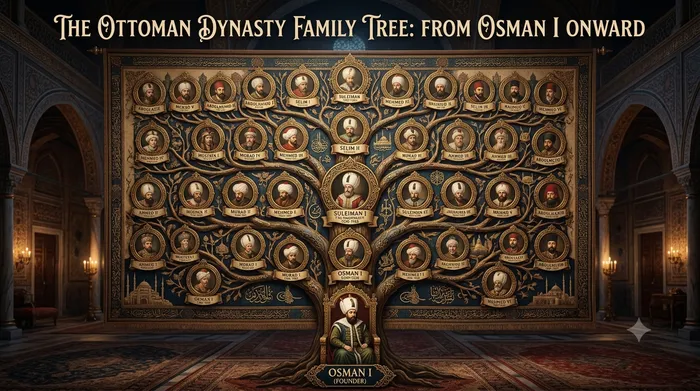
The Ottoman Dynasty Family Tree from Osman I Onward
Explore the Ottoman Dynasty family tree from Osman I to the last sultan Mehmed VI, covering the major sultans who ruled one of history’s longest-lasting empires.
8 August 2026
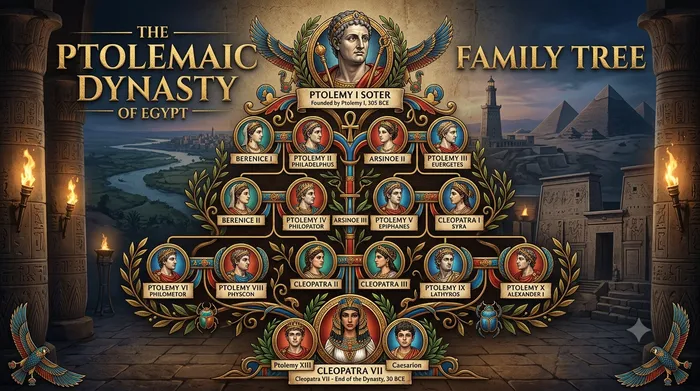
The Ptolemaic Dynasty Family Tree of Egypt
Explore the Ptolemaic Dynasty family tree of Egypt, from Ptolemy I Soter to Cleopatra VII, including the complex royal marriages and the end of pharaonic rule.
8 August 2026
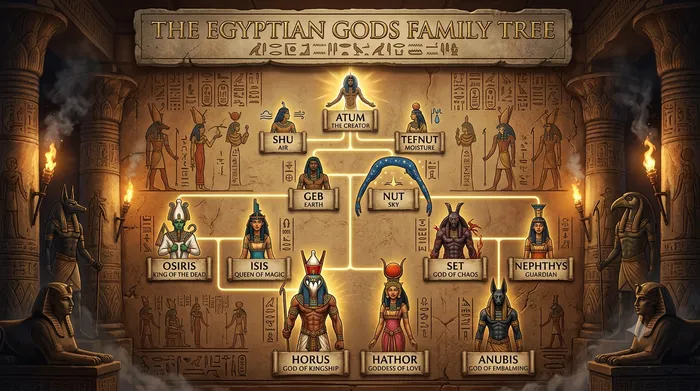
The Egyptian Gods Family Tree for Beginners
A simple beginner’s guide to the Egyptian gods family tree, from Atum and the Ennead of Heliopolis to Osiris, Isis, Horus, and the main divine relationships.
9 August 2026
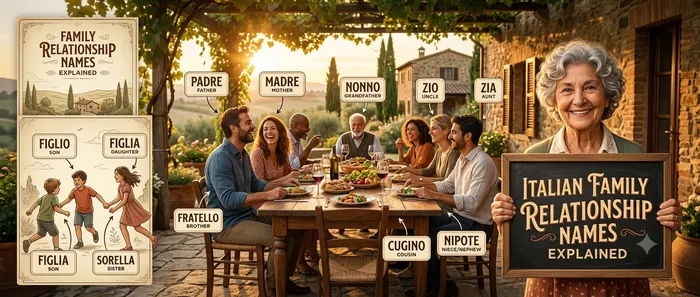
Italian Family Relationship Names Explained
A complete English-to-Italian guide to family relationship names, covering parents, siblings, grandparents, cousins, in-laws, step-family and more with clear tables.
6 August 2026
Polynesian Family Trees: How Oral Genealogy Preserved Ancestors for Centuries
Discover how Polynesian societies used oral genealogy to preserve family trees for centuries, linking people to ancestors, land, and identity across the Pacific.
Create Your Family Tree for Free
Start building your family history in minutes with the My rOoOts Free Family Tree Creator. Add parents, grandparents, children, and relatives, organize generations visually, and create a beautiful family tree that you can save and share.
👉 Create your free family tree: Free Family Tree Creator
No design skills required. Simply enter your family details and generate a clear, easy-to-read family tree online for free.
Start your family tree free
No account needed to begin. Build it in minutes, then save it whenever you're ready.
Build your family tree