Public Family Trees/Moroccan Royal/Moulay Hassan
Moulay Hassan
Born 2003 · Male · Rabat, Morocco
Son of Mohammed VI and Lalla Salma Bennani
13
Generation
16
Ancestors
0
Descendants
0
Children
0
Marriages
Family Snapshot
Expand full treeMoulay Hassan
b. 2003
Biography
Crown Prince Moulay Hassan is the eldest son of King Mohammed VI and heir apparent to Morocco's throne. Since childhood, he has represented Morocco during official ceremonies, diplomatic meetings, military events, and international visits, preparing for future leadership of the Alaouite monarchy. Known For: - Crown Prince of Morocco. - Heir Apparent. - Military training. - Diplomatic representation. - Future Alaoui…
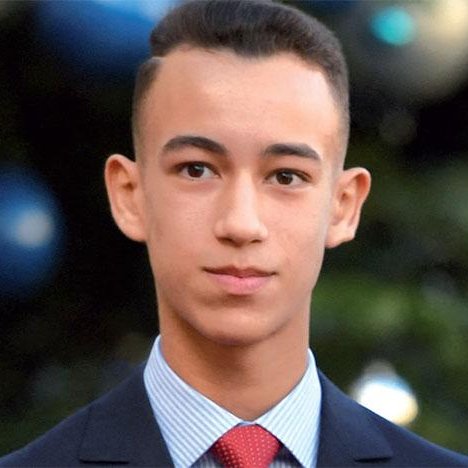
Photos of Moulay Hassan
1 photo from the Moroccan Royal family album
Have old family photos? Give every relative a profile and a photo gallery in your own family tree.
Start your tree, freeLife Timeline
Legacy
Crown Prince of Morocco
A defining role in the story of the Moroccan Royal family.
Your turn
Map your own family the way Moulay's is mapped
Free, with no sign-up to start. Add yourself, then your parents and grandparents, and watch the tree grow.
More people in the Moroccan Royal family tree
View all 32 peopleMoulay Ali Sharif
Gen 1 · 1589 - 1659
Moulay Ali Sharif founded the Alaouite dynasty in the Tafilalt region in 1631. Revered as a Sharif claiming descent from Prophet Muhammad through Hasan ibn Ali, he laid the religious and political foundation for Morocco's current ruling dynasty, which has governed the country for nearly four centuries. Known For - Founder of the Alaouite dynasty. - Emir of Tafilalt. - Established Sharifian legitimacy.
Moulay al-Rashid
Gen 2 · 1631 - 1672
Moulay Rashid unified Morocco between 1666 and 1672 after defeating rival dynasties and tribal confederations. He became the first Alaouite Sultan of a united Morocco and transformed a regional family into Morocco's ruling royal house, creating the modern Alaouite state.
Moulay Ismail ibn Sharif
Gen 2 · 1645 - 1727
Moulay Ismail ruled Morocco from 1672 to 1727 during one of the longest reigns in Moroccan history. Known as the "Warrior Sultan," he built Meknes as an imperial capital, created the elite Black Guard army, strengthened royal authority, and expanded Morocco's diplomatic influence.
Moulay Abdallah
Gen 3 · 1694 - 1757
Moulay Abdallah ruled Morocco multiple times between 1729 and 1757 because of repeated rebellions and military coups. Despite instability, he preserved Alaouite rule until the emergence of a more stable monarchy under his son Mohammed III.
Sidi Mohammed ben Abdallah (Mohammed III)
Gen 4 · 1710 - 1790
Mohammed III ruled from 1757 to 1790 and restored stability after decades of succession disputes. He founded the port city of Essaouira, expanded international trade, recognized the United States in 1777, and modernized Morocco's diplomatic and commercial relations.
Moulay Abd al-Rahman
Gen 6 · 1778 - 1859
Moulay Abd al-Rahman ruled Morocco between 1822 and 1859 during increasing European pressure. He modernized parts of the military, navigated conflicts involving Algeria and France, and worked to preserve Moroccan sovereignty despite growing colonial ambitions.
Mohammed IV
Gen 7 · 1802 - 1873
Mohammed IV ruled Morocco from 1859 to 1873 during a period of rapid European influence. He introduced military and administrative reforms after Morocco's defeat in the Hispano-Moroccan War and expanded diplomatic engagement with European powers.
Moulay Hassan I
Gen 8 · 1836 - 1894
Hassan I ruled Morocco from 1873 until 1894 and is remembered as one of the last powerful independent sultans before colonial rule. He traveled extensively across Morocco to strengthen central authority, modernized the army, improved administration, and resisted growing European political influence.
Moulay Yusef
Gen 9 · 1882 - 1927
Moulay Youssef served as Sultan under the French Protectorate from 1912 until 1927. Although political authority was limited, he preserved the Alaouite monarchy's religious legitimacy while navigating French colonial administration and maintaining Morocco's royal institutions.
Mohammed V
Gen 10 · 1909 - 1961
Mohammed V became Sultan in 1927 and led Morocco's struggle for independence from France. Exiled in 1953 for supporting nationalism, he returned triumphantly in 1955 and became Morocco's first king in 1957. He is celebrated as the Father of Modern Independent Morocco.
Lalla Aicha
Gen 11 · 1930 - 2011
Daughter of Mohammed V and Lalla Abla. Sister of Hassan II.
Related Family Stories
Hohenzollern Family Tree - Prussia's Royal House from Frederick the Great to Kaiser Wilhelm II
The House of Hohenzollern is the German dynasty that ruled Brandenburg from 1415, held the Prussian crown from 1701, and gave Germany its three emperors between 1871 and the fall of the monarchy in 1918. This tree follows the senior Prussian line in one unbroken descent, from Frederick William the Great Elector, through the kings of Prussia and the German Emperors, down to Georg Friedrich, Prince of Prussia, the present head of the house. ## Origins The family takes its name from Hohenzollern Castle on a hill in the Swabian Alb, where a line of counts is recorded from the eleventh century. A Swabian Zollern married into the burgraviate of Nuremberg in 1192, and the Franconian branch that grew from it spent two centuries accumulating lands and credit with the Holy Roman Emperors. The decisive moment came in 1415, when Emperor Sigismund invested Frederick VI of Nuremberg as Elector of Brandenburg in return for his political and financial support. The Duchy of Prussia, a separate inheritance lying outside the Empire, passed to the Brandenburg electors in 1618, and Frederick William, the Great Elector, welded the two into a single functioning state after the devastation of the Thirty Years' War. ## Notable members Frederick I turned the electorate into a kingdom in 1701. His son Frederick William I, the Soldier King, built the army and the treasury that his own son, **Frederick the Great**, used to seize Silesia and to make Prussia a European power, while also composing music, building Sanssouci and corresponding with Voltaire. **Queen Louise** became the emotional centre of Prussian resistance to Napoleon. **Wilhelm I**, with Otto von Bismarck as his minister president, was proclaimed German Emperor at Versailles in 1871. His son **Frederick III** and the liberal English princess he married, Victoria, daughter of Queen Victoria, reigned for only ninety nine days. **Wilhelm II**, the last Kaiser, abdicated in 1918 and died in Dutch exile in 1941. ## Significance No other German family shaped the modern state so directly. Hohenzollern rulers created the Prussian civil service, compulsory schooling and the general staff, sponsored the Berlin academies and the Humboldt university model, and then used Prussian power to unify Germany around themselves. The monarchy ended with the revolution of November 1918, but the house continues as a private family: the headship passed from Wilhelm II to his eldest son, then to Louis Ferdinand, and in 1994 to Georg Friedrich, whose own father and uncles are part of the succession story told in this tree. ## Quick facts | Fact | Details | |---|---| | Family name | Hohenzollern | | Place of origin | Hohenzollern Castle, Swabia, southern Germany | | Ruled | Brandenburg from 1415, Prussia from 1618, Germany from 1871 | | Royal title | King in Prussia from 1701, King of Prussia from 1772 | | Imperial title | German Emperor, 1871 to 1918 | | German Emperors | Wilhelm I, Frederick III, Wilhelm II | | Monarchy ended | 9 November 1918 | | Present head of the house | Georg Friedrich, Prince of Prussia, since 1994 | | Principal residences | Berlin City Palace, Sanssouci and Cecilienhof at Potsdam, Charlottenburg | | Branch shown here | The senior Prussian line only, not Hohenzollern-Sigmaringen |
Rothschild Family Tree - The European Banking Dynasty from Mayer Amschel to Today
The Rothschilds are a European banking dynasty founded in Frankfurt am Main by Mayer Amschel Rothschild (1744-1812), whose five sons established banking houses in Frankfurt, Vienna, Naples, London and Paris and together built the most powerful private financial network of the nineteenth century. ## Origins Mayer Amschel Rothschild was born in 1744 in the Judengasse, the walled Jewish street of Frankfurt am Main, where the family took its name from the red shield that had marked an ancestor's house. He began as a dealer in rare coins and medals, became court factor to Crown Prince Wilhelm of Hesse-Kassel in 1769, and turned that position into a banking business handling loans, bullion and government paper. With his wife Gutle Schnapper he had ten children who reached adulthood, five sons and five daughters. ## The five houses Mayer Amschel's decisive act was to place his sons in five cities so that the family could move money and news across borders as a single firm. Amschel Mayer stayed in Frankfurt, Salomon went to Vienna, Nathan to London, Carl to Naples and James to Paris. The brothers financed the allied campaigns against Napoleon, then the governments, railways and industries of nineteenth century Europe. The Naples house closed in 1860 with Italian unification, Frankfurt in 1901 for want of an heir, and Vienna in 1938 after the Anschluss. London and Paris survived, and their successors trade today as Rothschild and Co and the Edmond de Rothschild Group. ## Notable members Nathan Mayer Rothschild founded N M Rothschild and Sons and made London the centre of international lending. His son Lionel broke the bar on Jews sitting in Parliament, taking his Commons seat in 1858, and his grandson Nathan Mayer became the first Jewish member of the House of Lords in 1885. James Mayer de Rothschild dominated French finance under three regimes and bought Chateau Lafite, while his son Edmond funded the first Jewish agricultural settlements in Palestine. The family also produced naturalists and collectors rather than only bankers: Walter, 2nd Baron Rothschild, the zoologist to whom the Balfour Declaration was addressed in 1917; his brother Charles, the flea specialist who founded British nature conservation; Charles's daughter Dame Miriam Rothschild, a Fellow of the Royal Society; and another daughter, Nica, the patron of Thelonious Monk. Jacob, 4th Baron Rothschild, built RIT Capital Partners and chaired the trustees of the National Gallery. ## Significance The Rothschilds were the first banking family to operate as a genuinely international partnership, and for much of the nineteenth century they were the principal lenders to European states. Their name is attached to railways, mines, hospitals, museums, nature reserves, Bordeaux first growths and a long tradition of Jewish philanthropy. Repeated marriages between first cousins kept capital and control inside the family, which is why the branches of this tree cross back into one another so often. | Fact | Details | | --- | --- | | Founder | Mayer Amschel Rothschild (1744-1812) | | Matriarch | Gutle Schnapper (1753-1849) | | Origin | The Judengasse, Frankfurt am Main | | Children of the founder | Ten, five sons and five daughters | | The five houses | Frankfurt, Vienna, Naples, London, Paris | | Motto | Concordia, Integritas, Industria | | Principal firms | N M Rothschild and Sons, de Rothschild Freres, S. M. von Rothschild | | Still active today | Rothschild and Co, Edmond de Rothschild Group | | Known for | Government finance, railways, wine estates, natural history, art collections, philanthropy |
Glucksburg Family Tree - The Royal House of Denmark, Norway and Greece from Christian IX to Today
The House of Glücksburg is the reigning royal house of Denmark and Norway and the former royal house of Greece, a branch of the ancient House of Oldenburg whose modern members all descend from King Christian IX of Denmark (1818 to 1906) and his wife Louise of Hesse-Kassel. Through the marriages of their six children, a minor ducal family from the Danish-German borderland became the common ancestor of monarchs in Copenhagen, Oslo and Athens, of a British queen consort, of a Russian empress, and of Prince Philip, Duke of Edinburgh. ## Origins The house takes its name from Glücksburg, a small castle town in Schleswig, and belongs to the Schleswig-Holstein-Sonderburg-Glücksburg line of the House of Oldenburg, which had held the Danish throne since 1448. Christian IX was a prince of that cadet branch with no expectation of ruling until the childless Frederik VII made the Danish succession an open European question. Christian succeeded him in 1863, and within months his second son was elected King of the Hellenes as George I, planting the family in Greece for 110 years. In 1905 his grandson Prince Carl of Denmark accepted the Norwegian throne as Haakon VII, giving Norway its own dynasty after centuries of union with Denmark and then Sweden. ## Notable members Christian IX was nicknamed the father-in-law of Europe: his daughter Alexandra married Edward VII of the United Kingdom, and his daughter Dagmar became Empress Maria Feodorovna of Russia, mother of Nicholas II. The Danish line runs through Christian X, Frederik IX and Queen Margrethe II, a trained archaeologist and illustrator who reigned from 1972 until her abdication in 2024, to her son King Frederik X and Queen Mary. The Norwegian line runs from Haakon VII and Queen Maud through Olav V, an Olympic sailing champion, to King Harald V and Crown Prince Haakon. The Greek line produced Constantine I, Paul, Constantine II and Queen Anne-Marie, Queen Sofía of Spain, and Prince Andrew's son Philip, consort to Elizabeth II for 73 years. ## Significance No other western dynasty connects as many surviving monarchies in a single documented lineage. Two of Europe's ten reigning royal families, Denmark and Norway, are Glücksburg in the male line, and the house also sits in the ancestry of the British and Spanish royal families. Its history traces the transformation of European monarchy itself: from the dynastic matchmaking of the 1860s, through the loss of the Russian and Greek thrones, to the constitutional, publicly accountable monarchies of modern Scandinavia. | Fact | Details | | --- | --- | | House name | Schleswig-Holstein-Sonderburg-Glücksburg, a branch of the House of Oldenburg | | Founding figure of the modern house | Christian IX of Denmark (1818 to 1906) | | Ancestral seat | Glücksburg Castle, Schleswig | | Thrones held | Denmark (1863 to present), Greece (1863 to 1973), Norway (1905 to present) | | Current heads of state | Frederik X of Denmark, Harald V of Norway | | Best-known member abroad | Prince Philip, Duke of Edinburgh (1921 to 2021) | | Nickname of its founder | The father-in-law of Europe |
The Jackson Family Tree - Michael Jackson
Frequently Asked Questions
Who were Moulay Hassan's parents?+−
Moulay Hassan's recorded parents are Mohammed VI, Lalla Salma Bennani.
Who were Moulay Hassan's siblings?+−
Moulay Hassan has 1 recorded sibling: Lalla Khadija.
What did Moulay Hassan do?+−
Moulay Hassan is recorded as Crown Prince of Morocco in the Moroccan Royal family tree.
Where was Moulay Hassan from?+−
Moulay Hassan's recorded native place is Rabat, Morocco.
How many relatives of Moulay Hassan are recorded?+−
16 ancestors and 0 descendants of Moulay Hassan are recorded so far, within a tree of 32 people.
What family tree does Moulay Hassan belong to?+−
Moulay Hassan is recorded in the Moroccan Royal family tree on My rOoOts, alongside 31 other people.
Every family has a story. Start telling yours.
Trace Moulay Hassan's connections across the Moroccan Royaltree, or begin preserving your own family's history today.
Free. Private by default. GEDCOM export any time.