Family Snapshot
Expand full treeLakshmana
Biography
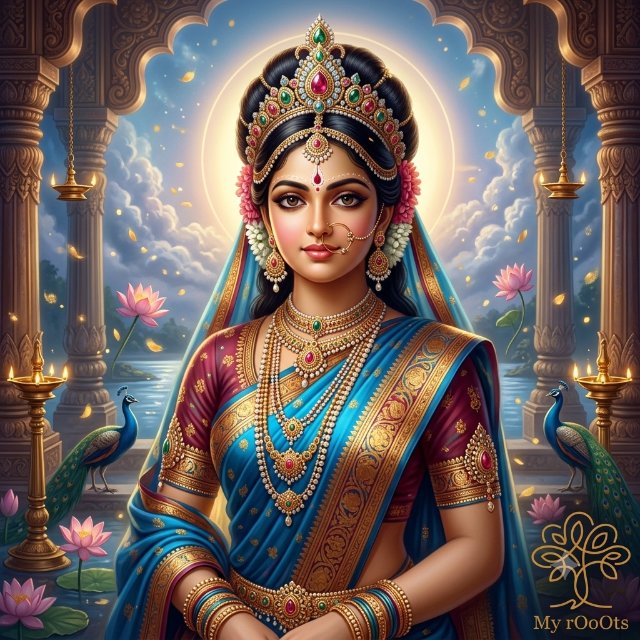
Lakshmana (or Lakshana) was one of the eight principal queens of Krishna and a princess of the Madras region. She married Krishna and bore ten sons including Praghosha. She is listed among the chief queens in the Bhagavata Purana.
Photos of Lakshmana
1 photo from the Lord Krishna family album
Have old family photos? Give every relative a profile and a photo gallery in your own family tree.
Start your tree, freeLife Timeline
Legacy
Queen
A defining role in the story of the Lord Krishna family.
Your turn
Map your own family the way Lakshmana's is mapped
Free, with no sign-up to start. Add yourself, then your parents and grandparents, and watch the tree grow.
More people in the Lord Krishna family tree
View all 35 peopleBalarama
Gen 4
Balarama, the elder brother of Krishna, is an incarnation of Shesha. Transferred from Devaki's womb to Rohini's, he grew up in Gokul. Known for his immense strength, plough weapon, and role as Krishna's constant companion, he participated in many adventures and the Mahabharata war as a neutral observer who taught Duryodhana and Bhima.
Pradyumna
Gen 5
Pradyumna was the eldest son of Krishna and Rukmini and an incarnation of Kamadeva. Abducted as an infant by the demon Shambara and raised by Mayavati, he later returned to Dwaraka. He married Rukmavati and fathered Aniruddha. A great warrior equal to his father, he played a major role in Yadava affairs.
Aniruddha
Gen 6
Aniruddha was the son of Pradyumna and Rukmavati, and grandson of Krishna. A powerful warrior and one of the four Vyuhas of Vishnu, he was abducted by Usha, daughter of Banasura, leading to a great battle involving Krishna and Shiva. He married Usha and fathered Vajra, the sole survivor of the Yadava destruction.
Bhanu
Gen 5
Bhanu was the eldest son of Krishna and Satyabhama. One of the ten sons of Satyabhama listed in the Bhagavata Purana, he was a prominent Yadava prince.
Devaki
Gen 3
Devaki was the daughter of Devaka and mother of Krishna. Married to Vasudeva, she was imprisoned by her cousin Kamsa after a divine prophecy that her eighth child would kill him. Six of her sons were killed by Kamsa; the seventh (Balarama) was transferred to Rohini and the eighth was Krishna. She is revered as the mother of the divine avatar.
Kunti
Gen 3
Kunti, originally named Pritha, was the daughter of Shurasena and sister of Vasudeva. Adopted by King Kuntibhoja, she became the mother of the Pandavas through divine boons and wife of Pandu. She is a central figure in the Mahabharata, known for her wisdom, devotion, and strength in adversity.
Vajra
Gen 7
Vajra was the son of Aniruddha and Usha, and great-grandson of Krishna. After the internecine destruction of the Yadavas following Krishna's departure, he was the only male survivor of the main line. Installed as king of Mathura and later associated with Indraprastha by the Pandavas, he continued the Yadava lineage.
Bhishmaka
Gen 1
Bhishmaka was the king of Vidarbha and father of Rukmini and Rukmi. He belonged to the Bhoja dynasty. Though initially inclined toward Rukmini's marriage to Krishna, political pressures led to the planned marriage with Shishupala that Krishna thwarted.
Devaka
Gen 1
Devaka was a Yadava prince of the Andhaka clan and the father of Devaki. He was the brother of Ugrasena and thus the uncle of Kamsa. As maternal grandfather of Krishna, he belongs to the Yadava lineage of Mathura.
Rukmi
Gen 2
Rukmi was the elder brother of Rukmini and son of Bhishmaka. An enemy of Krishna after the abduction of his sister, he was defeated and spared at Rukmini's request. He later arranged the marriages of his daughter Rukmavati to Pradyumna and granddaughter to Aniruddha to please Rukmini.
Shurasena
Gen 2
Shurasena was a powerful Yadava king after whom the Surasena kingdom was named. He was the father of Vasudeva and Kunti. Married to Marisha, he ruled Mathura and established the Surasena branch of the Yadavas. His descendants include Krishna and the Pandavas through Kunti.
Related Family Stories
Kennedy Family Tree - America's Political Dynasty
The Kennedy family is an Irish American political dynasty from Boston, Massachusetts, whose members have included the 35th President of the United States, three United States senators, four congressmen, several ambassadors, and the founders of the Peace Corps and the Special Olympics. Across four documented generations the family moved from a County Wexford farm to the White House, and its name became shorthand in American public life for both political ambition and public service. ## Origins The American line begins with Patrick Kennedy, a farmer's son from Dunganstown, near New Ross in County Wexford, who emigrated to East Boston during the Great Famine. His son, Patrick Joseph "P. J." Kennedy (1858 to 1929), built a livelihood in the liquor and banking trades and served in both houses of the Massachusetts legislature, becoming one of the Democratic ward leaders who ran the city's Irish Catholic politics. On the other side stood John Francis "Honey Fitz" Fitzgerald (1863 to 1950), congressman and twice Mayor of Boston. The two families joined in 1914 when P. J.'s son Joseph P. Kennedy Sr. married Honey Fitz's daughter Rose Fitzgerald. Their nine children, raised between Brookline, Bronxville and the compound at Hyannis Port on Cape Cod, form the generation the world knows. ## Notable members John F. Kennedy served as President from 1961 until his death in 1963, having previously represented Massachusetts in the House and Senate. His brother Robert F. Kennedy was Attorney General, then Senator from New York, and a candidate for the presidency in 1968. Their youngest brother Edward "Ted" Kennedy sat in the United States Senate for almost 47 years and was one of the most productive legislators of his era. The eldest son, Joseph P. Kennedy Jr., was a naval aviator killed on a volunteer mission in 1944. Away from elected office, Eunice Kennedy Shriver founded the Special Olympics, her husband Sargent Shriver created the Peace Corps and Head Start, and Jean Kennedy Smith founded the arts and disability organisation VSA before serving as United States Ambassador to Ireland. The following generations have produced congressmen, a lieutenant governor, ambassadors, documentary filmmakers, human rights advocates and journalists. ## Significance No other American family has combined electoral success, philanthropy and public visibility on this scale for so long. The Kennedys shaped the civil rights era, the space programme, immigration reform, health care legislation and the modern understanding of disability rights, and their private losses were mourned publicly in a way usually reserved for royalty. The Kennedy Library in Boston, the Kennedy Center in Washington and dozens of schools and institutions carry the name. | Fact | Details | | --- | --- | | Family name | Kennedy | | Irish origin | Dunganstown, County Wexford, Ireland | | American home | Boston and Hyannis Port, Massachusetts | | Founding couple | Patrick Joseph Kennedy and Mary Augusta Hickey | | Best known member | John F. Kennedy, 35th President of the United States | | Generations covered | Four | | Offices held | Presidency, US Senate, US House, ambassadorships, state office | | Institutions founded | Peace Corps, Special Olympics, Best Buddies, Citizens Energy |
Hohenzollern Family Tree - Prussia's Royal House from Frederick the Great to Kaiser Wilhelm II
The House of Hohenzollern is the German dynasty that ruled Brandenburg from 1415, held the Prussian crown from 1701, and gave Germany its three emperors between 1871 and the fall of the monarchy in 1918. This tree follows the senior Prussian line in one unbroken descent, from Frederick William the Great Elector, through the kings of Prussia and the German Emperors, down to Georg Friedrich, Prince of Prussia, the present head of the house. ## Origins The family takes its name from Hohenzollern Castle on a hill in the Swabian Alb, where a line of counts is recorded from the eleventh century. A Swabian Zollern married into the burgraviate of Nuremberg in 1192, and the Franconian branch that grew from it spent two centuries accumulating lands and credit with the Holy Roman Emperors. The decisive moment came in 1415, when Emperor Sigismund invested Frederick VI of Nuremberg as Elector of Brandenburg in return for his political and financial support. The Duchy of Prussia, a separate inheritance lying outside the Empire, passed to the Brandenburg electors in 1618, and Frederick William, the Great Elector, welded the two into a single functioning state after the devastation of the Thirty Years' War. ## Notable members Frederick I turned the electorate into a kingdom in 1701. His son Frederick William I, the Soldier King, built the army and the treasury that his own son, **Frederick the Great**, used to seize Silesia and to make Prussia a European power, while also composing music, building Sanssouci and corresponding with Voltaire. **Queen Louise** became the emotional centre of Prussian resistance to Napoleon. **Wilhelm I**, with Otto von Bismarck as his minister president, was proclaimed German Emperor at Versailles in 1871. His son **Frederick III** and the liberal English princess he married, Victoria, daughter of Queen Victoria, reigned for only ninety nine days. **Wilhelm II**, the last Kaiser, abdicated in 1918 and died in Dutch exile in 1941. ## Significance No other German family shaped the modern state so directly. Hohenzollern rulers created the Prussian civil service, compulsory schooling and the general staff, sponsored the Berlin academies and the Humboldt university model, and then used Prussian power to unify Germany around themselves. The monarchy ended with the revolution of November 1918, but the house continues as a private family: the headship passed from Wilhelm II to his eldest son, then to Louis Ferdinand, and in 1994 to Georg Friedrich, whose own father and uncles are part of the succession story told in this tree. ## Quick facts | Fact | Details | |---|---| | Family name | Hohenzollern | | Place of origin | Hohenzollern Castle, Swabia, southern Germany | | Ruled | Brandenburg from 1415, Prussia from 1618, Germany from 1871 | | Royal title | King in Prussia from 1701, King of Prussia from 1772 | | Imperial title | German Emperor, 1871 to 1918 | | German Emperors | Wilhelm I, Frederick III, Wilhelm II | | Monarchy ended | 9 November 1918 | | Present head of the house | Georg Friedrich, Prince of Prussia, since 1994 | | Principal residences | Berlin City Palace, Sanssouci and Cecilienhof at Potsdam, Charlottenburg | | Branch shown here | The senior Prussian line only, not Hohenzollern-Sigmaringen |
Plantagenet Family Tree - The House of Plantagenet from Henry II to Richard III
The House of Plantagenet was the royal dynasty that ruled England for 331 years, from the accession of Henry II in 1154 to the death of Richard III at the Battle of Bosworth in 1485, making it the longest-reigning royal house in English history. Fourteen Plantagenet kings held the throne in unbroken succession, and in the fifteenth century the family's two junior branches, the houses of Lancaster and York, fought each other for the crown in the civil wars later known as the Wars of the Roses. ## Origins The dynasty came from Anjou in western France. Geoffrey V, Count of Anjou, is said to have worn a sprig of broom, *planta genista*, in his cap, and from that nickname the family eventually took its name, although it was not used as an actual surname until Richard, 3rd Duke of York, adopted it in the 1440s. Geoffrey's marriage in 1128 to Empress Matilda, daughter and designated heir of Henry I of England, gave their son a claim to the English throne that he made good in 1154. With Normandy and Anjou behind him, and Aquitaine gained through his marriage to Eleanor of Aquitaine, Henry II ruled lands reaching from the Scottish border to the Pyrenees, the assemblage historians call the Angevin Empire. ## Notable members The early, or Angevin, kings are among the most familiar names in English history: Henry II, whose itinerant justices and sworn juries laid the foundations of the common law; Richard the Lionheart, a leading commander of the Third Crusade; and King John, who sealed Magna Carta at Runnymede in 1215. Henry III rebuilt Westminster Abbey, Edward I conquered Wales and summoned the Model Parliament, and Edward III opened the Hundred Years' War and founded the Order of the Garter. Later generations produced Edward the Black Prince, the victor of Poitiers, Henry V of Agincourt, and Richard III, whose lost grave was rediscovered in Leicester in 2012. ## Lancaster and York Edward III's many sons divided the dynasty. From his third surviving son, John of Gaunt, Duke of Lancaster, came Henry IV, Henry V and Henry VI, and, through Gaunt's Beaufort children, Margaret Beaufort and her son Henry VII. From his fourth son, Edmund of Langley, Duke of York, combined with the senior Mortimer descent from his second son, Lionel of Antwerp, came Richard, 3rd Duke of York, and his sons Edward IV and Richard III. The rivalry of those branches produced thirty years of intermittent civil war, ending when Henry Tudor defeated Richard III at Bosworth and married Elizabeth of York, uniting the red and white roses. ## Significance No other family has shaped English institutions so deeply. Under the Plantagenets, Magna Carta became a settled principle, parliament grew from an occasional royal council into a body whose consent was needed for taxation, the common law took its enduring form, and English displaced French as the language of the court. Their castles, abbeys and cathedrals still define the medieval landscape of England and Wales. | Fact | Details | | --- | --- | | Ruled | England, 1154 to 1485 | | Founder | Henry II, son of Geoffrey V of Anjou and Empress Matilda | | Place of origin | Anjou, France | | Kings | Fourteen, from Henry II to Richard III | | Branches | Angevin, Lancaster, York | | Emblems | The broom flower, the red rose of Lancaster, the white rose of York | | Last king | Richard III, killed at Bosworth in 1485 | | Legacy | Magna Carta, English common law, the growth of parliament |
Rockefeller Family Tree - America's Oil and Philanthropy Dynasty
The Rockefeller family is an American business and philanthropic dynasty founded on the Standard Oil fortune of John D. Rockefeller, whose descendants have shaped American banking, conservation, medicine, modern art and national politics across five generations. From a modest upstate New York farmhouse the family rose to control the largest industrial enterprise of the Gilded Age, then spent the twentieth century converting that fortune into foundations, museums, parks and public office. ## Origins The line begins with William Avery Rockefeller (1810-1906), a traveling salesman from Granger, New York, and his wife Eliza Davison (1813-1889), who married in 1837 and raised six children in Richford, Moravia and Owego before the family moved to Ohio. Their eldest son, John D. Rockefeller, began as a Cleveland bookkeeper, entered oil refining in 1863 and incorporated the Standard Oil Company in 1870 together with his younger brother William Rockefeller. By the 1880s Standard Oil refined the great majority of American petroleum, until the Supreme Court ordered its dissolution in 1911. ## Notable members John D. Rockefeller and Laura Spelman Rockefeller had four children who reached adulthood, among them the Chicago arts patron Edith Rockefeller McCormick and the family's only son, John D. Rockefeller Jr. With Abby Aldrich Rockefeller, a co-founder of the Museum of Modern Art, John Jr. had six children who defined the family's public face: Abby "Babs" Rockefeller Mauze, the philanthropist John D. Rockefeller III, Nelson Rockefeller, who served four terms as Governor of New York and then as Vice President of the United States, the conservationist and venture capitalist Laurance Rockefeller, Winthrop Rockefeller, Governor of Arkansas, and the banker David Rockefeller of Chase Manhattan. Their children, known within the family as the Cousins, include Senator Jay Rockefeller of West Virginia, the Asmat art collector Michael Rockefeller, Lieutenant Governor Winthrop Paul Rockefeller of Arkansas, the economist Neva Goodwin and the Synergos founder Peggy Dulany. ## Significance The family's lasting mark is institutional rather than dynastic. The Rockefeller Foundation, the University of Chicago, Rockefeller University, the Rockefeller Brothers Fund, Rockefeller Center, the Museum of Modern Art, Colonial Williamsburg, Lincoln Center, the Asia Society and several national parks all trace their founding or their endowment to a Rockefeller. Few American families have moved so completely from industrial fortune to organized philanthropy and elected office within three generations. | Fact | Details | | --- | --- | | Surname | Rockefeller | | Origin | Richford, New York, United States | | Founder | John D. Rockefeller (1839-1937) | | Family business | Standard Oil, later Chase Manhattan Bank | | Known for | Standard Oil, the Rockefeller Foundation, Rockefeller Center, the Museum of Modern Art | | Public offices held | Vice President of the United States, Governor of New York, Governor of Arkansas, United States Senator | | Generations covered | Five, from William Avery Rockefeller to the fourth-generation Cousins |
Frequently Asked Questions
Who did Lakshmana marry?+−
Lakshmana married Krishna.
What did Lakshmana do?+−
Lakshmana is recorded as Queen in the Lord Krishna family tree.
Where was Lakshmana from?+−
Lakshmana's recorded native place is Madras.
What family tree does Lakshmana belong to?+−
Lakshmana is recorded in the Lord Krishna family tree on My rOoOts, alongside 34 other people.
Every family has a story. Start telling yours.
Trace Lakshmana's connections across the Lord Krishnatree, or begin preserving your own family's history today.
Free. Private by default. GEDCOM export any time.