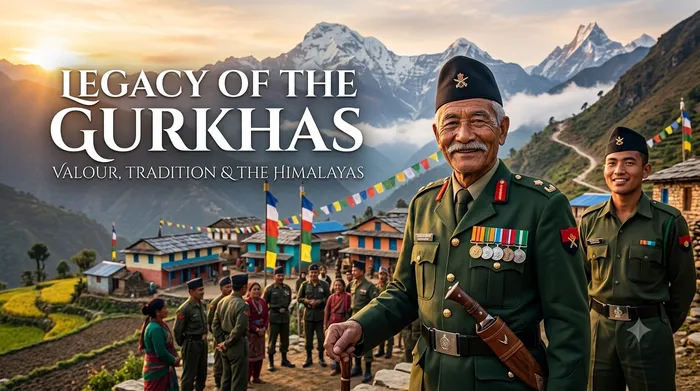
Who Are the Gurkhas? History, Ethnicity, and Ancestry Explained for Beginners
The Gurkhas are among the most respected soldiers in modern military history. Known for their courage, loyalty, and distinctive curved kukri knife, they have served with distinction in the British Army, the Indian Army, and other forces for more than two centuries. Yet “Gurkha” is not the name of a single ethnic group. It is a martial and historical identity rooted in the hills of Nepal. This guide explains the origins, ethnicity, ancestry, and history of the Gurkhas in clear terms for beginners.
What Does “Gurkha” Mean?
The word “Gurkha” (also spelled Gorkha) comes from the former Kingdom of Gorkha in central Nepal. In the mid-18th century, Prithvi Narayan Shah of Gorkha began the unification of the many small kingdoms and principalities that make up modern Nepal. The soldiers of this expanding Gorkha state became known for their fighting ability. When the British encountered them during the Anglo-Nepalese War (1814–1816), they were so impressed that they began recruiting these hill soldiers into their own army.
Today “Gurkha” generally refers to soldiers of Nepali origin who serve, or whose ancestors served, in specific regiments of the British or Indian armies. It is a professional and historical identity rather than a strict ethnic label.
Major Ethnic Groups Among the Gurkhas
Gurkha recruits have traditionally come from several hill communities of Nepal. The most prominent groups include both Tibeto-Burman and some Indo-Aryan speaking peoples.
| Ethnic Group | Language Family | Traditional Regions in Nepal | Notes |
|---|---|---|---|
| Gurung | Tibeto-Burman | Central hills (Annapurna region) | One of the core recruiting groups |
| Magar | Tibeto-Burman | Mid-western and central hills | Large and historically important group |
| Rai | Tibeto-Burman | Eastern hills | Known for strong martial tradition |
| Limbu | Tibeto-Burman | Far-eastern hills | Closely related to Rai in many contexts |
| Tamang | Tibeto-Burman | Central and eastern hills | Significant contribution to Gurkha ranks |
| Chhetri | Indo-Aryan | Widespread | Kshatriya group; historically recruited |
| Others | Mixed | Various | Includes smaller hill communities |
These groups are not identical in language, customs, or origin stories, yet they have shared the Gurkha military tradition for generations.
A simplified view of the main recruiting communities looks like this:
Gurkha martial identity
├── Tibeto-Burman hill groups
│   ├── Gurung
│   ├── Magar
│   ├── Rai
│   ├── Limbu
│   └── Tamang
└── Indo-Aryan and other contributors
├── Chhetri
└── Smaller hill communities
Historical Outline
The story of the Gurkhas as a military force can be traced through several key phases:
- 18th century: Rise of the Gorkha kingdom and unification of Nepal under the Shah dynasty.
- 1814–1816: Anglo-Nepalese War. British forces respect the fighting quality of Gorkhali soldiers. The Treaty of Sugauli ends the war and opens the door to recruitment.
- 19th century: Formal recruitment into the British Indian Army begins. Gurkha regiments distinguish themselves in campaigns across Asia and beyond.
- Both World Wars: Gurkha units serve in large numbers and earn numerous gallantry awards, including Victoria Crosses.
- 1947: After Indian independence, Gurkha regiments are divided between the British Army and the new Indian Army under the Tripartite Agreement between Britain, India, and Nepal.
- Present day: The British Brigade of Gurkhas continues to serve, while India maintains several Gorkha regiments. Gurkhas have also served in the forces of Singapore and other countries.
Throughout this history the reputation for bravery, discipline, and loyalty has remained remarkably consistent.
Ancestry and Genetic Background
Nepal sits at a genetic and cultural crossroads between the Indian subcontinent and the Tibetan plateau. As a result, the ancestral profile of most Gurkha recruiting groups reflects a mixture of:
- Tibeto-Burman / East Asian-related ancestry linked to populations of the Himalayas and beyond
- South Asian / Indo-Aryan-related ancestry from the southern slopes and the plains
- Smaller contributions from other regional sources acquired over centuries
Different ethnic groups within Nepal show different balances of these components. Broadly, many of the classic Gurkha hill groups carry a substantial Tibeto-Burman genetic signal alongside South Asian ancestry. This mixed heritage is visible both in physical anthropology and in modern population-genetic studies.
DNA tests taken by people of Gurkha family background often reflect this dual heritage, typically showing combinations of South Asian and East Asian or Himalayan components. As with all such results, percentages vary by individual and by the reference panels used by testing companies.
Culture, Identity, and the Kukri
Beyond military service, Gurkha identity is tied to strong traditions of community, honour, and resilience. The kukri (or khukuri), the distinctive forward-curved knife, remains a powerful cultural symbol. It is both a practical tool and a ceremonial object, and it features prominently in Gurkha military tradition.
Family and clan ties are important in the hill communities of Nepal. Service in the Gurkhas has often been a multi-generational pattern, with sons following fathers and uncles into the same regiments. This creates rich family histories that combine Nepali hill roots with service in far-flung parts of the world.
Modern Gurkhas and Diaspora
Today the British Brigade of Gurkhas is based in the United Kingdom, with recruitment still conducted in Nepal. Indian Gorkha regiments remain an important part of the Indian Army. Over the decades, significant Gurkha communities have formed in the UK, India, Hong Kong (historically), and elsewhere.
Questions of citizenship, pensions, and settlement rights for former British Gurkhas and their families have been the subject of public campaigns and legal cases in recent decades. Many families now live transnational lives, maintaining strong links to villages in Nepal while building new roots abroad.
Preserving Gurkha Family Histories
Because Gurkha service has so often been a family tradition, many households possess detailed oral histories, photographs, medals, and service records that span generations. Capturing these stories before they fade is an important task for younger family members.
A clear digital family tree helps organize names, service details, places of origin in Nepal, and later places of settlement. It also makes it easier to share information with relatives living in different countries. You can start building such a record for free, with no sign-up required, at the My rOoOts create-tree page.
The family tree generator offers a simple way to begin with known names and relationships. An ancestor timeline generator can place service generations and migration events against historical periods. When relatives from different branches contribute, a relationship calculator can help clarify kinship terms across languages and traditions.
Conclusion
The Gurkhas are soldiers of Nepali hill origin whose military reputation was forged in the unification of Nepal and then carried into British and Indian service for more than two hundred years. They are not a single ethnic group but are drawn mainly from communities such as the Gurung, Magar, Rai, Limbu, and Tamang, among others. Their ancestry reflects Nepal’s position between South Asia and the Tibetan world, combining Tibeto-Burman and South Asian genetic heritage.
For beginners, the essential points are these: “Gurkha” is a historical and martial identity rooted in the Gorkha kingdom; the soldiers come from specific hill ethnic groups of Nepal; and their story is one of remarkable continuity of service and reputation. Families who carry this heritage often possess multi-generational records of courage and migration. Preserving those records in a clear, shareable family tree ensures that both the military legacy and the deeper ancestral roots remain visible for future generations.
Create Your Family Tree for Free
Start building your family history in minutes with the My rOoOts Free Family Tree Creator. Add parents, grandparents, children, and relatives, organize generations visually, and create a beautiful family tree that you can save and share.
👉 Create your free family tree: Free Family Tree Creator
No design skills required. Simply enter your family details and generate a clear, easy-to-read family tree online for free.
Check Zodiac Compatibility for Any Two People
Curious about how well two people match based on their date of birth? Try the My rOoOts Zodiac Compatibility Tool to compare zodiac signs, explore relationship compatibility, and get a quick compatibility score for couples, friends, or family members.
👉 Check compatibility now: Zodiac Compatibility Calculator
You can enter two dates of birth and even mention the relationship type to get a more personalized compatibility result.
Download a Free Family Tree Template
Want to draw your family tree yourself? The My rOoOts Family Tree Template provides a free printable blank pedigree chart for documenting your family history across multiple generations.
👉 Download a free family tree template: Family Tree Template
Choose a 3-generation, 4-generation, or 5-generation family tree template and save it as a PDF for printing, writing, and documenting your ancestors.
Discover the Meaning and Origin of Your Surname
Ever wondered where your family name came from? Use the My rOoOts Surname Meaning Lookup to explore surname meanings, origins, history, and etymology from different regions and cultures around the world.
👉 Discover your surname meaning: Surname Meaning Lookup
Learn more about your last name and explore the possible linguistic, geographic, cultural, and historical roots behind your family surname.
Start your family tree free
No account needed to begin. Build it in minutes, then save it whenever you're ready.
Build your family tree