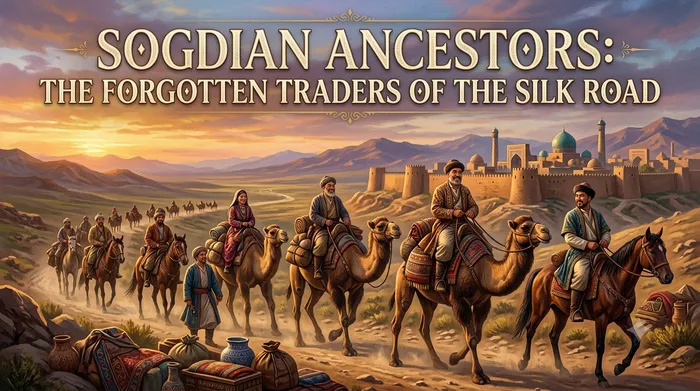
Sogdian Ancestors: The Forgotten Traders of the Silk Road
Between China and the Mediterranean lay a network of routes that carried silk, spices, ideas, and religions for centuries. At the heart of that network lived the Sogdians — an Iranian people whose merchants, translators, and settlers became the essential middlemen of the Silk Road. Although their political power faded long ago, their cultural and commercial influence was immense. This guide explains who the Sogdians were, why they mattered, and how their story connects to questions of ancestry today.
Who Were the Sogdians?
The Sogdians were an Eastern Iranian people whose homeland, Sogdiana, lay in the river valleys of what is now eastern Uzbekistan and western Tajikistan. Major centers included Samarkand, Bukhara, and Panjikent. They spoke Sogdian, an Eastern Iranian language related to other Iranian tongues of Central Asia.
From roughly the 4th to the 8th centuries CE, Sogdian merchants built one of the most extensive trading diasporas of the pre-modern world. They established communities across Central Asia, in Chinese cities such as Chang’an and Luoyang, and along routes leading west toward Persia and the Byzantine world.
The Sogdian Role on the Silk Road
Sogdians excelled as long-distance traders and cultural brokers. Their success rested on several strengths:
- Mastery of multiple languages
- Extensive family and commercial networks
- Willingness to travel and settle far from home
- Skill in finance, translation, and negotiation
They moved silk, horses, precious metals, glass, spices, and paper. Just as importantly, they carried religions and ideas. Sogdian merchants helped spread Buddhism, Manichaeism, Zoroastrianism, and Nestorian Christianity along the routes they traveled.
| Contribution | Description |
|---|---|
| Trade networks | Linked China, Central Asia, India, Persia, and beyond |
| Cultural transmission | Spread religions, scripts, and artistic styles |
| Linguistic influence | Sogdian used as a lingua franca in many regions |
| Urban settlement | Created merchant colonies in major Chinese cities |
Society, Religion, and Culture
Sogdian society was organized around city-states and merchant families rather than a single large empire. Wealthy trading houses often held significant local power.
Religious life was diverse. Many Sogdians practiced a form of Zoroastrianism adapted to local conditions. Others adopted Buddhism, Manichaeism, or Christianity. This openness reflected their role as intermediaries between different civilizations.
Sogdian art is especially well known from the wall paintings of Panjikent and the Afrasiab murals in Samarkand. These works show banquets, religious scenes, ambassadors, and daily life, offering rare visual evidence of a vibrant urban culture.
Sogdian cultural world
├── Language: Sogdian (Eastern Iranian)
├── Economy: Long-distance trade and finance
├── Religion: Zoroastrianism, Buddhism, Manichaeism, Christianity
├── Art: Murals, metalwork, textiles
└── Social base: Merchant families and city-states
Expansion and Presence in China
During the Tang dynasty, Sogdians became especially prominent in China. They served as traders, interpreters, soldiers, and officials. Large Sogdian communities lived in the two Tang capitals and in oasis towns along the northern Silk Road.
Chinese sources sometimes describe them as skilled but foreign. Over time many Sogdian families in China adopted local customs and intermarried, while still maintaining aspects of their identity for generations.
Decline and Absorption
Several forces reduced Sogdian prominence:
- Arab-Muslim conquests of Central Asia in the 7th and 8th centuries
- The destruction of key cities during later conflicts
- The rise of Turkic political power in the region
- Gradual linguistic and cultural assimilation
By the later medieval period, Sogdian as a living language had largely disappeared. The people themselves were absorbed into emerging Persian-speaking, Turkic-speaking, and other populations of Central Asia. Their commercial role was taken over by other groups.
Legacy and Traces Today
Although the Sogdians ceased to exist as a distinct political and linguistic community, their legacy remains visible:
- Place names and archaeological sites in Uzbekistan and Tajikistan
- Artistic and religious influences across the Silk Road
- Loanwords and cultural patterns that entered neighboring traditions
- Genetic and historical traces within modern Central Asian populations
Some families and local traditions in Central Asia preserve memories of ancient merchant ancestors. In a broader sense, anyone whose roots reach into the oasis cities of the region may carry partial heritage linked to this once-flourishing people.
Researching Possible Sogdian Ancestry
Direct documentation of Sogdian ancestors is rare because the community was gradually absorbed and left relatively few continuous genealogical records. Research usually combines:
- Family oral history linking to Samarkand, Bukhara, or other historic Sogdian centers
- Historical and archaeological context
- Careful study of regional surname and clan traditions
- DNA results that show Central Asian or broader Iranian-related ancestry components (interpreted cautiously)
No modern population is purely “Sogdian,” but the historical contribution of Sogdian traders forms one layer in the complex ancestry of Central Asia and parts of the surrounding regions.
Preserving Deep Ancestral Stories
Stories of ancient trading peoples, forgotten languages, and long migration routes often survive only in fragments. Organizing those fragments — family traditions, regional origins, and historical notes — into a clear digital record helps keep them from disappearing entirely.
A digital family tree can hold places of origin, migration notes, and generational links in one private, shareable space. You can begin building that record for free, with no sign-up required, at the My rOoOts create-tree page.
The family tree generator offers a simple way to start with known names and locations. An ancestor timeline generator can place family generations against the centuries when Sogdian traders flourished. When relatives contribute information from different branches, a relationship calculator helps clarify kinship connections across time and distance.
Conclusion
The Sogdians were the great merchant intermediaries of the Silk Road. From their homeland in the heart of Central Asia they built networks that stretched from China to the West, carrying goods, religions, and ideas. Their language and independent political structures eventually disappeared, but their influence on the history of Eurasia remains profound.
For those exploring Central Asian or broader Iranian-related ancestry, the Sogdians represent one of the most fascinating “forgotten” layers of the past. Recording family traditions, regional origins, and historical context in a well-organized digital family tree helps ensure that even distant ancestral connections remain visible for future generations.
Create Your Family Tree for Free
Start building your family history in minutes with the My rOoOts Free Family Tree Creator. Add parents, grandparents, children, and relatives, organize generations visually, and create a beautiful family tree that you can save and share.
👉 Create your free family tree: Free Family Tree Creator
No design skills required. Simply enter your family details and generate a clear, easy-to-read family tree online for free.
Check Zodiac Compatibility for Any Two People
Curious about how well two people match based on their date of birth? Try the My rOoOts Zodiac Compatibility Tool to compare zodiac signs, explore relationship compatibility, and get a quick compatibility score for couples, friends, or family members.
👉 Check compatibility now: Zodiac Compatibility Calculator
You can enter two dates of birth and even mention the relationship type to get a more personalized compatibility result.
Download a Free Family Tree Template
Want to draw your family tree yourself? The My rOoOts Family Tree Template provides a free printable blank pedigree chart for documenting your family history across multiple generations.
👉 Download a free family tree template: Family Tree Template
Choose a 3-generation, 4-generation, or 5-generation family tree template and save it as a PDF for printing, writing, and documenting your ancestors.
Discover the Meaning and Origin of Your Surname
Ever wondered where your family name came from? Use the My rOoOts Surname Meaning Lookup to explore surname meanings, origins, history, and etymology from different regions and cultures around the world.
👉 Discover your surname meaning: Surname Meaning Lookup
Learn more about your last name and explore the possible linguistic, geographic, cultural, and historical roots behind your family surname.
Start your family tree free
No account needed to begin. Build it in minutes, then save it whenever you're ready.
Build your family tree