If you've landed here typing something like "bua's husband is called" or "jiju meaning in relationship" into Google, you don't want a long essay. You want the answer, fast, and maybe a little context so it sticks. This guide is built exactly for that: short, direct answers to the specific Indian kinship terms people search for most, all in one place.
We've written a longer, broader glossary of Indian family terms before (see Bua, Tau, Nanad, Mausa Meaning: Indian Family Terms Meaning Explained if you want the full picture). This post is different on purpose: it's a fast-lookup companion for the handful of terms that keep tripping people up, especially the ones around in-laws, where English simply doesn't have a matching word.
Why English Doesn't Have These Words
English lumps a lot of relatives under one label. "Aunt" covers your mother's sister and your father's sister equally, even though Hindi treats them as completely different relationships (mausi vs. bua) with different terms for their spouses too. This is exactly why so many people search for these terms individually: there's no direct English translation to fall back on, only a description like "my father's sister's husband," which is clunky and doesn't tell you how that person actually fits into the family.
So let's answer the specific ones, one at a time.
Bua's Husband is Called
Bua's husband is called fufa (also spelled phupha or fufaji in some regions). Bua is your father's sister, so fufa is your father's brother-in-law by marriage, essentially your father's sister's husband. In Punjabi households you may also hear him addressed as fufar or fufar ji. There's no single-word English equivalent; the closest description is "uncle by marriage on your father's side."
Who is Bua in Relation
Bua is your father's sister, full stop. She's on your father's side of the family (not your mother's), which is the detail that trips people up, since English "aunt" doesn't make that distinction. Your mother's sister is a separate relative entirely, called mausi. Bua's own children are your cousins, and depending on the region, you might call them by name plus an honorific, or simply "cousin brother"/"cousin sister" in everyday English-Hindi conversation.
Jiju, Jijaji, and Nanad: The Sibling's-Spouse Terms
These three come up constantly in searches, and they're all connected to your siblings' marriages.
Jijaji Meaning
Jijaji (often shortened to jiju) is the term for your sister's husband, your brother-in-law through your sister, not through your spouse. It's a warm, familiar term, often used with genuine affection since jiju is typically seen as a fun, informal elder-brother-like figure in Indian families, especially by younger siblings.
Jiju Meaning in Relationship
Same person as jijaji, above: jiju is just the shorter, more casual version. Both refer to your sister's husband. Some families use jiju for a younger or more informally-addressed brother-in-law and jijaji as the slightly more respectful version, but in most households the two are used interchangeably.
Who is Nanad in Relation
Nanad is a relationship that exists specifically from a wife's point of view: nanad is your husband's sister, meaning she becomes your sister-in-law once you marry into the family. If you're a man, you wouldn't call anyone nanad; that term is used only by the wife referring to her husband's sister. Nanad's husband, in turn, is usually called nandoi.
Taya Ji and the Paternal Uncle Terms
Taya Ji in Punjabi
Taya ji refers to your father's elder brother, specifically the elder one, which is an important distinction Hindi and Punjabi make that English simply skips over. Your father's younger brother is a different person entirely, called chacha (or chachaji). This elder/younger split also applies to their wives: tayi is taya's wife, while chachi is chacha's wife. In Punjabi families the terms are used the same way, sometimes softened affectionately to "taya" or "tayaji" without much variation.
Quick Reference Table
Here's all of it side by side, since that's usually the fastest way to double-check a term you already half-know:
| Term | Who They Are | Relationship Type |
|---|---|---|
| Fufa | Bua's husband (father's sister's husband) | In-law, father's side |
| Bua | Father's sister | Blood relative, father's side |
| Jiju / Jijaji | Sister's husband | In-law |
| Nanad | Husband's sister (used by the wife) | In-law, husband's side |
| Nandoi | Nanad's husband | In-law |
| Taya ji | Father's elder brother | Blood relative, father's side |
| Tayi | Taya's wife | In-law |
| Chacha | Father's younger brother | Blood relative, father's side |
| Chachi | Chacha's wife | In-law |
Why These Terms Matter Beyond Small Talk
Getting these right isn't just about avoiding an awkward moment at a family gathering. When you're building out a family tree, whether on paper, in a notebook passed down from a grandparent, or in a tool like My rOoOts, precise relationship terms are what keep the tree accurate. "Uncle" attached to the wrong branch can quietly erase the distinction between your father's side and your mother's side for future generations looking back at it. Knowing that fufa sits on your father's side and nanad only applies from a wife's perspective isn't trivia, it's the difference between a family tree that reads clearly in twenty years and one that needs a phone call to untangle.
If you're documenting your own family and want to see how these relationships map out visually, connecting bua, fufa, taya ji, and everyone else correctly, that's exactly the kind of structure a proper family tree tool is built to hold onto.
Frequently Asked Questions
What is bua's husband called in Hindi?
Bua's husband is called fufa (also written phupha). He's your father's sister's husband, making him an in-law on your father's side of the family.
Is jiju the same as jijaji?
Yes, jiju and jijaji refer to the exact same person: your sister's husband. Jiju is simply the shorter, more casual version of jijaji, and most families use both interchangeably.
Can a man be called someone's nanad?
No. Nanad specifically describes a husband's sister from his wife's perspective, so only a wife refers to someone as her nanad. A man wouldn't use this term for any of his own relatives.
What's the difference between taya ji and chacha?
Taya ji is your father's elder brother, while chacha is your father's younger brother. The distinction is about birth order relative to your father, something English's single word "uncle" doesn't capture at all.
Why doesn't English have words for these relationships?
English kinship terms are far less specific than Hindi, Punjabi, or most other Indian languages, which distinguish relatives by which side of the family they're on and, often, by birth order. Terms like fufa, taya ji, and nanad exist precisely to capture distinctions English simply merges into broader words like "uncle" or "in-law."
Editor's picks
26 July 2026
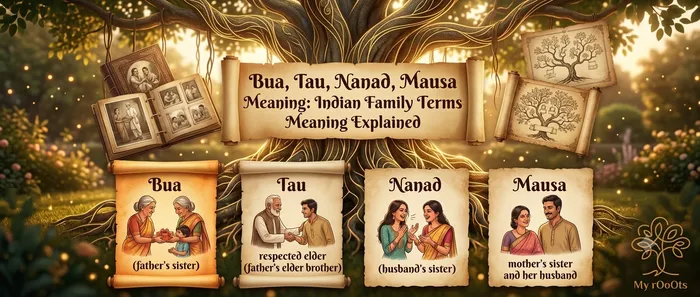
Bua, Tau, Nanad, Mausa Meaning: Indian Family Terms Meaning Explained
A plain-English guide to Indian family relationship names: what bua's husband is called (fufa), what mausa, tau, jija ji and nanad mean, and how Hindi kinship terms map to English relatives like aunt, uncle and in-law.
19 August 2026
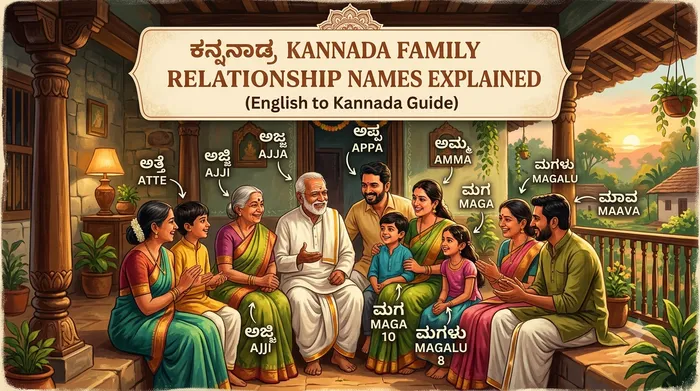
Kannada Family Relationship Names Explained (English to Kannada Guide)
A clear English-to-Kannada guide to family relationship names, covering parents, grandparents, uncles, aunts, in-laws and cousins in Karnataka's family tradition.

18 August 2026
Gujarati Family Relationship Names Explained (English to Gujarati Guide)
A clear English-to-Gujarati guide to family relationship names, from kaka and foi to sasu and nanand, with tables you can actually use.
17 August 2026
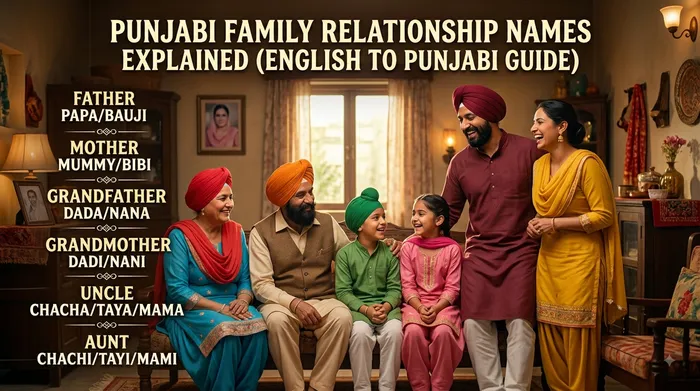
Punjabi Family Relationship Names Explained (English to Punjabi Guide)
Learn the core Punjabi family relationship names, from Dada ji and Nani ji to Chacha, Bhua, and Mama ji, with the cultural context behind each term.

19 August 2026
Marathi Family Relationship Names Explained (English to Marathi Guide)
A complete English-to-Marathi guide to family relationship names, from parents and grandparents to in-laws and cousins, rooted in Maharashtra's family traditions.
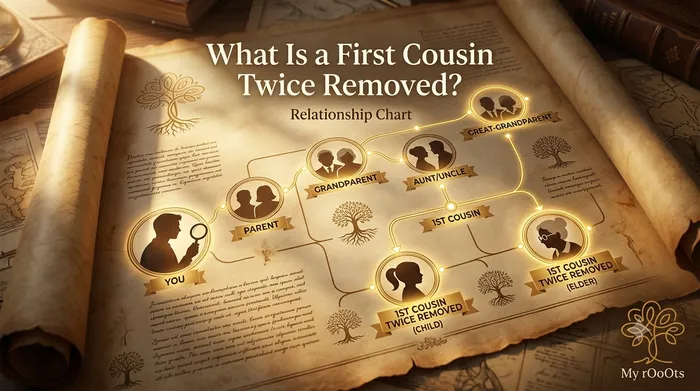
27 August 2026
What Is a First Cousin Twice Removed? (With Relationship Chart)
First cousin once removed and second cousin twice removed are common searches. Here's the one that ties them together, explained with a simple chart and diagram.
Start your family tree free
No account needed to begin. Build it in minutes, then save it whenever you're ready.
Build your family tree