Understanding the American Political Hierarchy: A Simple Guide to the U.S. Government Structure
The United States has one of the world’s most influential democratic systems, yet many people find its political hierarchy confusing. Terms such as federal government, Congress, state government, and local government are often used interchangeably, even though they represent different levels of authority.
This guide explains the American political hierarchy in plain English. Whether you are a student, a researcher, an immigrant, or simply curious about how the U.S. government works, understanding this structure will help you follow elections, public policy, and civic life more confidently.
For families interested in preserving historical records and understanding their ancestors’ roles in public life, documenting political service can also become an important part of a family history. Tools such as MyRooots can help organize family records, stories, and historical connections in one place.
What Is the American Political Hierarchy?
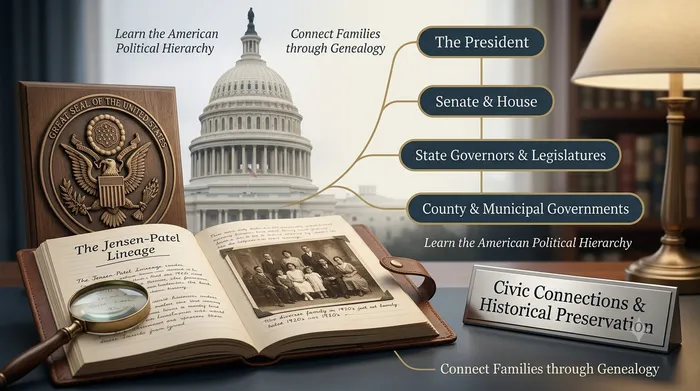
The American political hierarchy is the chain of authority within the U.S. government. Power is divided across multiple levels so that no single person or institution controls the entire system.
At the highest level, the U.S. Constitution creates three branches of government:
- Executive Branch: Carries out laws.
- Legislative Branch: Makes laws.
- Judicial Branch: Interprets laws.
In addition, power is shared between the federal government and the 50 state governments, creating a federal system.
The Overall Structure at a Glance
| Level | Main Authority |
|---|---|
| Federal | President, Congress, Supreme Court |
| State | Governor, State Legislature, State Courts |
| County | County commissioners or executives |
| City or Town | Mayor and city council |
| Special Districts | School boards, utility districts, transit authorities |
This layered structure allows decisions to be made at the level closest to the people whenever possible.
The Federal Government: The Highest National Level
The President
The President of the United States is the head of state and head of government.
Key responsibilities
- Enforces federal laws.
- Commands the armed forces.
- Conducts foreign policy.
- Signs or vetoes legislation.
- Appoints federal judges and cabinet officials.
The President is elected nationally for a four year term and may serve a maximum of two terms.
The Vice President
The Vice President is second in the executive hierarchy.
Main roles
- Succeeds the President if necessary.
- Presides over the Senate.
- Casts tie breaking votes in the Senate.
The Cabinet
The President is assisted by the Cabinet, which includes leaders of major federal departments such as:
- State
- Treasury
- Defense
- Justice
- Education
- Health and Human Services
Cabinet secretaries are appointed by the President and confirmed by the Senate.
Congress: The Legislative Branch
Congress is responsible for creating federal laws and consists of two chambers.
The Senate
- 100 senators total.
- 2 senators per state.
- Six year terms.
Powers
- Confirms presidential appointments.
- Approves treaties.
- Conducts impeachment trials.
The House of Representatives
- 435 voting members.
- Representation based on state population.
- Two year terms.
Powers
- Initiates revenue bills.
- Brings impeachment charges.
- Represents local congressional districts.
Congressional Leadership
Important leadership positions include:
- Speaker of the House
- Senate Majority Leader
- Senate Minority Leader
- Committee chairs
These leaders influence which bills receive attention and votes.
The Supreme Court: The Highest Judicial Authority
The Supreme Court sits at the top of the judicial hierarchy.
Composition
- 9 justices, including one Chief Justice and eight Associate Justices.
Responsibilities
- Reviews laws for constitutionality.
- Resolves disputes between states.
- Interprets the Constitution.
Federal judges are appointed by the President and serve for life unless they resign, retire, or are removed through impeachment.
The Federal Judicial Hierarchy
Below the Supreme Court are:
- U.S. Courts of Appeals: Intermediate appellate courts.
- U.S. District Courts: Trial courts where most federal cases begin.
This three tier federal court structure handles criminal, civil, constitutional, and administrative disputes.
State Governments: Parallel Centers of Power
Each state has its own government that mirrors the federal structure.
Governor
The Governor is the chief executive of a state.
Duties
- Enforces state laws.
- Proposes state budgets.
- Appoints officials.
- May veto state legislation.
State Legislature
Most states have two chambers:
- State Senate
- State House or Assembly
They pass state laws on education, transportation, public safety, health, and many other issues.
State Courts
State court systems usually include:
- Trial courts
- Intermediate appellate courts
- State supreme court
Most legal cases in the United States are handled by state courts rather than federal courts.
County Government
Counties are administrative divisions within states.
Common officials
- County commissioners or supervisors
- Sheriff
- Clerk
- Treasurer
- Assessor
Typical responsibilities
- Property records
- Local courts
- Jails
- Elections
- Public health services
- Roads in unincorporated areas
For genealogists, county offices are often the most valuable source of birth, marriage, land, and probate records.
City and Municipal Government
Cities, towns, and villages manage local services.
Mayor
The mayor may be elected directly by residents or selected by the council, depending on the city’s charter.
City Council
The council passes local ordinances, approves budgets, and oversees municipal services.
Local services include
- Police
- Fire protection
- Water and sanitation
- Parks
- Zoning
- Local transportation
Because local governments interact with residents daily, they are often the most visible part of the political hierarchy.
School Districts and Special Districts
The United States also has many special purpose governments.
Examples
- School districts
- Transit authorities
- Water districts
- Library districts
- Fire districts
These entities usually have elected or appointed boards and can levy taxes or fees for specific services.
How Power Flows Through the System
A useful way to visualize the hierarchy is:
President → Federal agencies → State governments → Counties → Cities and Towns → Neighborhood services
However, this is not a strict command chain. States possess constitutional powers of their own, and local governments derive authority primarily from state law.
Checks and Balances
A defining feature of the American system is that each branch can limit the others.
Examples
- Congress can override a presidential veto.
- The President can veto legislation.
- The Supreme Court can strike down laws.
- The Senate confirms judges and cabinet officials.
- Congress controls federal spending.
These checks are designed to prevent concentration of power.
Political Parties Within the Hierarchy
Political parties are not part of the constitutional structure, but they strongly influence it.
Major parties
- Democratic Party
- Republican Party
Party organization exists at federal, state, county, and local levels and helps recruit candidates, organize campaigns, and shape policy agendas.
Elections at Different Levels
| Office | Typical Election Level |
|---|---|
| President | National |
| Senator | Statewide |
| Representative | Congressional district |
| Governor | Statewide |
| State legislator | State district |
| Mayor | Citywide |
| County sheriff | Countywide |
| School board member | District or local |
Understanding the election level helps explain why campaigns focus on different issues.
Why This Hierarchy Matters
The level of government determines which issues it can address.
Federal issues
- Immigration
- National defense
- International trade
- Currency
State issues
- Driver licensing
- Public universities
- State taxes
- Criminal law
Local issues
- Garbage collection
- Local roads
- Zoning
- Community policing
Knowing the hierarchy helps citizens contact the correct official when seeking assistance.
Historical and Family Connections
Many Americans have ancestors who served as:
- Soldiers
- County clerks
- Sheriffs
- Mayors
- State legislators
- Judges
- Members of Congress
Preserving these records can reveal fascinating stories about a family’s civic contributions. A digital family tree can connect documents, photographs, newspaper clippings, and oral histories across generations.
You can start documenting your family history with MyRooots and explore relationship tools such as the Family Relationship Calculator. Additional genealogy articles and research tips are available on the MyRooots blog.
Common Misconceptions
“The President controls all government.”
False. Congress and the courts are independent branches, and states retain significant authority.
“Federal law always replaces state law.”
Only when federal authority constitutionally applies or federal law preempts state law.
“Local governments are created by the Constitution.”
Most local governments are created by state law, not directly by the U.S. Constitution.
A Simple Memory Trick
Think of the system as F-S-C-C:
- Federal
- State
- County
- City
At each level, there is usually an executive leader, a legislative body, and some form of court or administrative authority.
Conclusion
The American political hierarchy is a layered system designed to balance power between national, state, and local governments. At the top are the President, Congress, and the Supreme Court, followed by state governments, counties, municipalities, and specialized local districts. This structure allows citizens to participate in government at multiple levels while preventing excessive concentration of authority.
Understanding this hierarchy makes news, elections, public policy, and civic participation far easier to follow. It also provides valuable context for family historians researching ancestors who lived, voted, worked, or served in public office. By preserving those records through a modern family history platform such as MyRooots, families can keep their civic heritage accessible for future generations.
Find Any Family Relationship Instantly
Not sure how someone is related to you? Use the MyRooots Relationship Calculator to instantly identify relationships such as cousin, aunt, uncle, nephew, niece, in-laws, and many more. It is a quick and easy tool for understanding complex family connections.
👉 MyRooots Relationship Calculator
Create a Beautiful Family Tree Online
Turn your family information into a clear and organized family tree within minutes. The MyRooots Family Tree Generator helps you add relatives, connect generations, and create a shareable family tree that can grow over time.
👉 MyRooots Family Tree Generator
Visualize Your Family History Through Time
See your ancestors in chronological order with the My rOoOts Ancestor Timeline Generator. It creates a visual timeline of births, marriages, deaths, and important life events, making it easier to understand your family's history across generations.
Check Zodiac Compatibility for Any Two People
Curious about how well two people match based on their date of birth? Try the My rOoOts Zodiac Compatibility Tool to compare zodiac signs, explore relationship compatibility, and get a quick compatibility score for couples, friends, or family members.
👉 Check compatibility now: Zodiac Compatibility Calculator
You can enter two dates of birth and even mention the relationship type to get a more personalized compatibility result.
Create Your Family Tree for Free
Start building your family history in minutes with the My rOoOts Free Family Tree Creator. Add parents, grandparents, children, and relatives, organize generations visually, and create a beautiful family tree that you can save and share.
👉 Create your free family tree: Free Family Tree Creator
No design skills required. Simply enter your family details and generate a clear, easy-to-read family tree online for free.
Download a Free Family Tree Template
Want to draw your family tree yourself? The My rOoOts Family Tree Template provides a free printable blank pedigree chart for documenting your family history across multiple generations.
👉 Download a free family tree template: Family Tree Template
Choose a 3-generation, 4-generation, or 5-generation family tree template and save it as a PDF for printing, writing, and documenting your ancestors.
Discover the Meaning and Origin of Your Surname
Ever wondered where your family name came from? Use the My rOoOts Surname Meaning Lookup to explore surname meanings, origins, history, and etymology from different regions and cultures around the world.
👉 Discover your surname meaning: Surname Meaning Lookup
Learn more about your last name and explore the possible linguistic, geographic, cultural, and historical roots behind your family surname.
Start your family tree free
No account needed to begin. Build it in minutes, then save it whenever you're ready.
Build your family tree