Public Family Trees/Kennedy/Patrick Joseph Kennedy II
Patrick Joseph Kennedy II
Born 1967 · Male · Boston, Massachusetts, United States
Son of Edward Moore Kennedy and Virginia Joan Bennett Kennedy
4
Generation
8
Ancestors
0
Descendants
0
Children
0
Marriages
Family Snapshot
Expand full treeEdward Moore Kennedy
1932 - 2009
Virginia Joan Bennett Kennedy
b. 1936
Patrick Joseph Kennedy II
b. 1967
Biography
Patrick J. Kennedy is an American politician and mental health advocate who represented Rhode Island in the United States House of Representatives from 1995 to 2011. The youngest child of Senator Edward M. Kennedy and Joan Bennett Kennedy, he was born in 1967 and elected to the Rhode Island House of Representatives at twenty-one while still a student at Providence College. In Congress he was a lead author of the Ment…
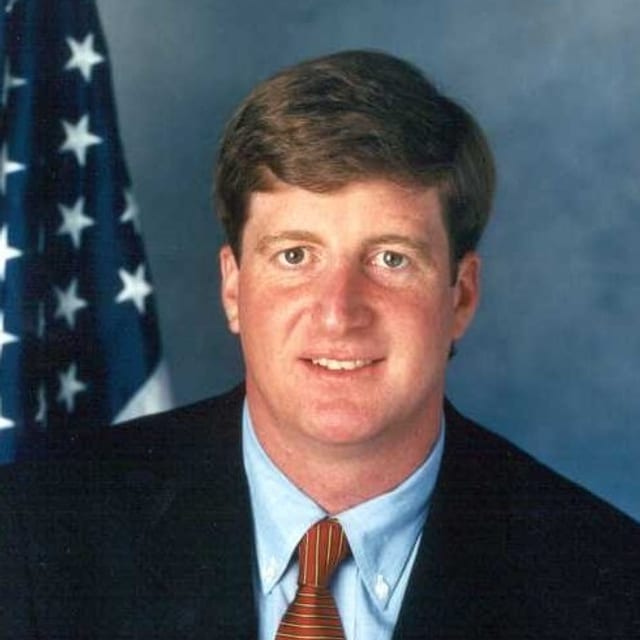
Photos of Patrick Joseph Kennedy II
1 photo from the Kennedy family album
Have old family photos? Give every relative a profile and a photo gallery in your own family tree.
Start your tree, freeLife Timeline
Born1967
Born
Born to Edward Moore Kennedy, Virginia Joan Bennett Kennedy.
Legacy
US congressman and mental health advocate
A defining role in the story of the Kennedy family.
Your turn
Map your own family the way Patrick's is mapped
Free, with no sign-up to start. Add yourself, then your parents and grandparents, and watch the tree grow.
More people in the Kennedy family tree
View all 56 peoplePatrick Joseph Kennedy
Gen 1 · 1858 - 1929
Patrick Joseph Kennedy, known as P. J., was a Boston businessman and Democratic ward leader who established the family's place in Massachusetts politics. Born in East Boston in 1858, he was the son of Irish immigrants from Dunganstown, County Wexford, and worked the docks before building interests in the liquor trade and later in banking. He was elected to the Massachusetts House of Representatives and afterwards to the state Senate, and as one of the ward bosses who ran Democratic Boston at the turn of the century he was both colleague and rival of John F. Fitzgerald. With his wife, Mary Augusta Hickey, he was the father of Joseph P. Kennedy Sr. and the grandfather of President John F. Kennedy.
John Francis Fitzgerald
Gen 1 · 1863 - 1950
John Francis Fitzgerald, universally known as Honey Fitz, was a congressman and twice Mayor of Boston, and the maternal grandfather of President John F. Kennedy. Born in the North End of Boston in 1863 to Irish immigrant parents, he rose through the city's Democratic organisation, served in the Massachusetts Senate and the United States House of Representatives, and was elected mayor in 1905 and again in 1910. A famously gregarious campaigner and singer of "Sweet Adeline", he was the rival and eventual in-law of P. J. Kennedy. His daughter Rose married Joseph P. Kennedy Sr. in 1914. He lived to see his grandson elected to Congress in 1946.
John Fitzgerald Kennedy
Gen 3 · 1917 - 1963
John F. Kennedy was the 35th President of the United States, serving from January 1961 until his death in November 1963. The second son of Joseph P. Kennedy Sr. and Rose Fitzgerald Kennedy, he was born in Brookline, Massachusetts, in 1917, graduated from Harvard in 1940, and commanded the patrol torpedo boat PT-109 in the Pacific, receiving the Navy and Marine Corps Medal after its sinking. He represented Massachusetts in the House of Representatives from 1947 and in the Senate from 1953, won the Pulitzer Prize for "Profiles in Courage", and married Jacqueline Bouvier in 1953. As president he faced the Bay of Pigs and the Cuban Missile Crisis, founded the Peace Corps, committed the nation to the Moon landing and sent Congress the civil rights bill enacted in 1964. He was assassinated in Dallas, Texas, at the age of forty-six.
Eunice Kennedy Shriver
Gen 3 · 1921 - 2009
Eunice Kennedy Shriver was an American philanthropist and the founder of the Special Olympics, the international sports movement for people with intellectual disabilities. The fifth child of Joseph P. Kennedy Sr. and Rose Fitzgerald Kennedy, she was born in Brookline, Massachusetts, in 1921 and educated at Stanford. She worked for the State Department and in juvenile justice before taking over the Joseph P. Kennedy Jr. Foundation, where she pressed her brother's administration to create the President's Panel on Mental Retardation. In 1962 she opened Camp Shriver at her Maryland home, which grew into the first International Special Olympics Games in Chicago in 1968. She married Sargent Shriver in 1953, had five children including Maria Shriver, and received the Presidential Medal of Freedom in 1984.
Jean Kennedy Smith
Gen 3 · 1928 - 2020
Jean Kennedy Smith was United States Ambassador to Ireland from 1993 to 1998 and the founder of the arts and disability organisation VSA. The eighth child of Joseph P. Kennedy Sr. and Rose Fitzgerald Kennedy, she was born in Brookline, Massachusetts, in 1928 and educated at Manhattanville College. She married the businessman and campaign manager Stephen Edward Smith in 1956 and in 1974 founded Very Special Arts, which created arts programmes for people with disabilities in dozens of countries. Appointed ambassador by President Bill Clinton, she played a public part in the diplomacy surrounding the Northern Ireland peace process and was later granted honorary Irish citizenship. She received the Presidential Medal of Freedom in 2011 and was the last surviving sibling of President John F. Kennedy.
Joseph Patrick Kennedy Jr.
Gen 3 · 1915 - 1944
Joseph P. Kennedy Jr. was the eldest of the nine children of Joseph P. Kennedy Sr. and Rose Fitzgerald Kennedy, and the brother on whom the family's political hopes first rested. Born in Hull, Massachusetts, in 1915, he was educated at Choate, Harvard and briefly the London School of Economics, served as a Massachusetts delegate to the 1940 Democratic National Convention, and entered Harvard Law School before enlisting as a naval aviator after the outbreak of the Second World War. He flew anti-submarine patrols from England and volunteered for a hazardous experimental bombing mission over the Channel in August 1944, on which he was killed at the age of twenty-nine. The Joseph P. Kennedy Jr. Foundation was established in his memory.
Kathleen Kennedy Townsend
Gen 4 · b. 1951
Kathleen Kennedy Townsend is an American politician and author who served as Lieutenant Governor of Maryland from 1995 to 2003, the first woman to hold the office. The eldest child of Senator Robert F. Kennedy and Ethel Skakel Kennedy, she was born in Greenwich, Connecticut, in 1951, graduated from Harvard and the University of New Mexico School of Law, and taught before entering public life. As lieutenant governor she led Maryland's crime prevention and juvenile justice work and created one of the first state requirements for student community service. She was the Democratic nominee for governor of Maryland in 2002 and has since worked on retirement security policy and written "Failing America's Faithful". She is a sister of Robert F. Kennedy Jr. and Rory Kennedy.
Joseph Patrick Kennedy II
Gen 4 · b. 1952
Joseph P. Kennedy II is an American businessman and former congressman who represented Massachusetts in the United States House of Representatives from 1987 to 1999, holding the Boston seat once occupied by his uncle President John F. Kennedy. The eldest son of Senator Robert F. Kennedy and Ethel Skakel Kennedy, he was born in Boston in 1952 and educated at the University of Massachusetts Boston. In 1979 he founded Citizens Energy Corporation, a non-profit that used the proceeds of oil trading to supply discounted heating fuel to low income households, and he returned to lead it after leaving Congress. He is the father of the congressman Joseph P. Kennedy III.
Robert Francis Kennedy Jr.
Gen 4 · b. 1954
Robert F. Kennedy Jr. is an American lawyer and politician who became United States Secretary of Health and Human Services in 2025. The third child of Senator Robert F. Kennedy and Ethel Skakel Kennedy, he was born in Washington in 1954 and educated at Harvard, the London School of Economics, the University of Virginia School of Law and Pace University, where he later taught environmental law. For decades he practised as an environmental lawyer, serving as chief prosecuting attorney for Riverkeeper and founding the Waterkeeper Alliance, and he wrote books including "Crimes Against Nature". He entered the 2024 presidential race as a Democrat and then as an independent before ending his campaign, and was subsequently nominated and confirmed to the federal cabinet. He is the father of Conor Kennedy.
Joseph Patrick Kennedy III
Gen 5 · b. 1980
Joe Kennedy III is an American politician and diplomat who represented Massachusetts in the United States House of Representatives from 2013 to 2021. Born in Boston in 1980, the son of the congressman Joseph P. Kennedy II and a grandson of Senator Robert F. Kennedy, he graduated from Stanford and Harvard Law School and served in the Peace Corps in the Dominican Republic before working as an assistant district attorney in Massachusetts. In Congress he focused on health care, mental health parity and manufacturing, and he delivered the Democratic response to the State of the Union address in 2018. He ran for the Senate in 2020 and was later appointed United States Special Envoy to Northern Ireland for Economic Affairs.
Katherine Eunice Schwarzenegger
Gen 5 · b. 1989
Katherine Schwarzenegger is an American author, the eldest child of the journalist Maria Shriver and the actor and former governor Arnold Schwarzenegger, and a great-granddaughter of Joseph P. Kennedy Sr. and Rose Fitzgerald Kennedy. Born in Los Angeles in 1989, she graduated from the University of Southern California and published her first book, "Rock What You've Got", on body image while still a student. She has since written "I Just Graduated, Now What?" and "The Gift of Forgiveness", a collection of interviews about forgiveness, as well as children's books, and she is a longtime advocate for animal rescue and adoption. She married the actor Chris Pratt in 2019.
Related Family Stories
Hohenzollern Family Tree - Prussia's Royal House from Frederick the Great to Kaiser Wilhelm II
The House of Hohenzollern is the German dynasty that ruled Brandenburg from 1415, held the Prussian crown from 1701, and gave Germany its three emperors between 1871 and the fall of the monarchy in 1918. This tree follows the senior Prussian line in one unbroken descent, from Frederick William the Great Elector, through the kings of Prussia and the German Emperors, down to Georg Friedrich, Prince of Prussia, the present head of the house. ## Origins The family takes its name from Hohenzollern Castle on a hill in the Swabian Alb, where a line of counts is recorded from the eleventh century. A Swabian Zollern married into the burgraviate of Nuremberg in 1192, and the Franconian branch that grew from it spent two centuries accumulating lands and credit with the Holy Roman Emperors. The decisive moment came in 1415, when Emperor Sigismund invested Frederick VI of Nuremberg as Elector of Brandenburg in return for his political and financial support. The Duchy of Prussia, a separate inheritance lying outside the Empire, passed to the Brandenburg electors in 1618, and Frederick William, the Great Elector, welded the two into a single functioning state after the devastation of the Thirty Years' War. ## Notable members Frederick I turned the electorate into a kingdom in 1701. His son Frederick William I, the Soldier King, built the army and the treasury that his own son, **Frederick the Great**, used to seize Silesia and to make Prussia a European power, while also composing music, building Sanssouci and corresponding with Voltaire. **Queen Louise** became the emotional centre of Prussian resistance to Napoleon. **Wilhelm I**, with Otto von Bismarck as his minister president, was proclaimed German Emperor at Versailles in 1871. His son **Frederick III** and the liberal English princess he married, Victoria, daughter of Queen Victoria, reigned for only ninety nine days. **Wilhelm II**, the last Kaiser, abdicated in 1918 and died in Dutch exile in 1941. ## Significance No other German family shaped the modern state so directly. Hohenzollern rulers created the Prussian civil service, compulsory schooling and the general staff, sponsored the Berlin academies and the Humboldt university model, and then used Prussian power to unify Germany around themselves. The monarchy ended with the revolution of November 1918, but the house continues as a private family: the headship passed from Wilhelm II to his eldest son, then to Louis Ferdinand, and in 1994 to Georg Friedrich, whose own father and uncles are part of the succession story told in this tree. ## Quick facts | Fact | Details | |---|---| | Family name | Hohenzollern | | Place of origin | Hohenzollern Castle, Swabia, southern Germany | | Ruled | Brandenburg from 1415, Prussia from 1618, Germany from 1871 | | Royal title | King in Prussia from 1701, King of Prussia from 1772 | | Imperial title | German Emperor, 1871 to 1918 | | German Emperors | Wilhelm I, Frederick III, Wilhelm II | | Monarchy ended | 9 November 1918 | | Present head of the house | Georg Friedrich, Prince of Prussia, since 1994 | | Principal residences | Berlin City Palace, Sanssouci and Cecilienhof at Potsdam, Charlottenburg | | Branch shown here | The senior Prussian line only, not Hohenzollern-Sigmaringen |
Bourbon Family Tree - The House of Bourbon in France and Spain
The House of Bourbon is a European royal dynasty, descended in the male line from the Capetian kings of France, that ruled France from 1589 to 1792 and again from 1814 to 1848, and that still reigns in Spain today under King Felipe VI. Over four centuries its members also held the thrones of Navarre, Naples and Sicily, Parma and Etruria, which makes it one of the most widely established royal houses in European history. ## Origins The family takes its name from the lordship of Bourbon in the Auvergne, centred on Bourbon-l'Archambault. Its royal line descends from Robert, Count of Clermont, a younger son of King Louis IX of France, whose marriage to Beatrice of Burgundy, heiress of Bourbon, carried the name into the Capetian house in 1272. For three centuries afterwards the Bourbons were powerful French princes of the blood rather than kings. That changed with Antoine de Bourbon, Duke of Vendome, whose marriage to Jeanne d'Albret, queen regnant of Navarre, produced Henry of Navarre. When the Valois line died out in 1589, Henry was the senior Capetian heir, and he took the French throne as Henry IV. ## Notable members Henry IV ended the French Wars of Religion and issued the Edict of Nantes in 1598. His son Louis XIII, guided by Cardinal Richelieu, built the centralised state that Louis XIV, the Sun King, carried to its height across a reign of seventy-two years, the longest of any European sovereign, and to the palace of Versailles. Louis XV and then Louis XVI inherited that system, and Louis XVI and his queen, Marie Antoinette, were swept away by the French Revolution in 1792. The dynasty returned with Louis XVIII in 1814 and Charles X in 1824, and in 1830 the crown passed to Louis Philippe I of the cadet House of Orleans, the last king to rule in France. ## The Spanish branch In 1700 the childless Charles II of Spain left his crown to Philip, Duke of Anjou, a grandson of Louis XIV. Philip became Philip V, the first Bourbon king of Spain, at the cost of the War of the Spanish Succession, which ended with his renunciation of any claim to the French throne. His descendants include the reforming Charles III, Ferdinand VII, Isabella II, Alfonso XII and Alfonso XIII, who left Spain in 1931. The monarchy was restored in 1975 under Juan Carlos I, grandson of Alfonso XIII, who presided over Spain's transition to democracy and abdicated in 2014 in favour of his son Felipe VI. Felipe's elder daughter Leonor, Princess of Asturias, is heir to the throne. ## Significance No other family links the absolute monarchy of Versailles to a working constitutional monarchy in twenty-first century Madrid. Bourbon marriages tied the house to the Habsburgs of Austria and Spain, the dukes of Savoy, the Medici of Florence and the British royal family, so a Bourbon family tree doubles as a map of European dynastic politics from the Reformation to the present day. | Fact | Details | | --- | --- | | Family name | House of Bourbon (Maison de Bourbon, Casa de Borbon) | | Place of origin | Bourbon-l'Archambault, Auvergne, France | | Founder of the line | Robert, Count of Clermont (1256-1317), son of Louis IX | | First king of France | Henry IV, reigned 1589 to 1610 | | Last king to rule France | Louis Philippe I, reigned 1830 to 1848 | | First king of Spain | Philip V, reigned 1700 to 1746 | | Head of the house in Spain | King Felipe VI, since 2014 | | Heir in Spain | Leonor, Princess of Asturias | | Principal seats | Versailles, Fontainebleau, the Louvre, the Royal Palace of Madrid |
Bernadotte Family Tree - The Swedish Royal House from Charles XIV John to Princess Estelle
The House of Bernadotte is the royal family of Sweden, founded by the French marshal Jean-Baptiste Bernadotte, who was elected Swedish crown prince in 1810 and reigned from 1818 as King Charles XIV John, and it has held the throne in an unbroken line ever since, down to King Carl XVI Gustaf, Crown Princess Victoria and Princess Estelle. ## Origins The dynasty began far from Sweden, in the Gascon town of Pau, where Jean-Baptiste Bernadotte was born in 1763 as the son of a provincial lawyer. He rose through the revolutionary French army to become a Marshal of the Empire and Prince of Pontecorvo. In 1810 the Swedish Riksdag, left without an heir after the deposition of Gustav IV Adolf and the accession of the childless Charles XIII, unexpectedly offered the succession to the French marshal. He accepted, converted to Lutheranism, took the name Charles John and in 1818 became king of both Sweden and Norway. His marriage to Desiree Clary, a Marseille merchant's daughter once engaged to Napoleon, produced the dynasty's second king, Oscar I. ## Notable members Oscar I's marriage to Josephine of Leuchtenberg, a granddaughter of the Empress Josephine, brought a descent from Sweden's older royal houses into the line, and Gustaf V's marriage to Victoria of Baden, a great granddaughter of the deposed Gustav IV Adolf, reinforced it. Later generations produced an unusual number of figures known for work outside the court: Prince Eugen, one of Sweden's foremost landscape painters; Gustaf VI Adolf, a working archaeologist and botanist; and Sigvard Bernadotte, an industrial designer. The family's daughters carried the name into the other Scandinavian monarchies and into Belgium: Ingrid became queen of Denmark, Astrid queen of the Belgians and Martha crown princess of Norway, which makes this tree a close relative of the Glucksburg line. ## Significance Under the Bernadottes the Swedish monarchy moved from real political power to a purely ceremonial role, settled by the constitution of 1974. In 1980 Sweden became the first monarchy to adopt full absolute primogeniture, making the infant Crown Princess Victoria heir ahead of her younger brother. Carl XVI Gustaf, who became heir at nine months old and king in 1973, is the longest reigning monarch in Swedish history. Several princes of the house lost their royal titles by marrying commoners and were created Counts of Wisborg by the Grand Duke of Luxembourg, a kinsman through Queen Sophia of Nassau, which is why the Bernadotte name is borne today both by a reigning royal house and by a line of counts. | Fact | Details | | --- | --- | | Family name | House of Bernadotte | | Country | Sweden, and Norway until 1905 | | Founder | Charles XIV John, born Jean-Baptiste Bernadotte (1763 to 1844) | | Reigning since | 1818 | | Monarchs | Charles XIV John, Oscar I, Charles XV, Oscar II, Gustaf V, Gustaf VI Adolf, Carl XVI Gustaf | | Current head | King Carl XVI Gustaf, reigning since 1973 | | Heir apparent | Crown Princess Victoria, Duchess of Vastergotland | | Principal residences | Stockholm Palace, Drottningholm Palace, Haga Palace | | Royal motto | "For Sweden, with the times" (Carl XVI Gustaf) |
Rothschild Family Tree - The European Banking Dynasty from Mayer Amschel to Today
The Rothschilds are a European banking dynasty founded in Frankfurt am Main by Mayer Amschel Rothschild (1744-1812), whose five sons established banking houses in Frankfurt, Vienna, Naples, London and Paris and together built the most powerful private financial network of the nineteenth century. ## Origins Mayer Amschel Rothschild was born in 1744 in the Judengasse, the walled Jewish street of Frankfurt am Main, where the family took its name from the red shield that had marked an ancestor's house. He began as a dealer in rare coins and medals, became court factor to Crown Prince Wilhelm of Hesse-Kassel in 1769, and turned that position into a banking business handling loans, bullion and government paper. With his wife Gutle Schnapper he had ten children who reached adulthood, five sons and five daughters. ## The five houses Mayer Amschel's decisive act was to place his sons in five cities so that the family could move money and news across borders as a single firm. Amschel Mayer stayed in Frankfurt, Salomon went to Vienna, Nathan to London, Carl to Naples and James to Paris. The brothers financed the allied campaigns against Napoleon, then the governments, railways and industries of nineteenth century Europe. The Naples house closed in 1860 with Italian unification, Frankfurt in 1901 for want of an heir, and Vienna in 1938 after the Anschluss. London and Paris survived, and their successors trade today as Rothschild and Co and the Edmond de Rothschild Group. ## Notable members Nathan Mayer Rothschild founded N M Rothschild and Sons and made London the centre of international lending. His son Lionel broke the bar on Jews sitting in Parliament, taking his Commons seat in 1858, and his grandson Nathan Mayer became the first Jewish member of the House of Lords in 1885. James Mayer de Rothschild dominated French finance under three regimes and bought Chateau Lafite, while his son Edmond funded the first Jewish agricultural settlements in Palestine. The family also produced naturalists and collectors rather than only bankers: Walter, 2nd Baron Rothschild, the zoologist to whom the Balfour Declaration was addressed in 1917; his brother Charles, the flea specialist who founded British nature conservation; Charles's daughter Dame Miriam Rothschild, a Fellow of the Royal Society; and another daughter, Nica, the patron of Thelonious Monk. Jacob, 4th Baron Rothschild, built RIT Capital Partners and chaired the trustees of the National Gallery. ## Significance The Rothschilds were the first banking family to operate as a genuinely international partnership, and for much of the nineteenth century they were the principal lenders to European states. Their name is attached to railways, mines, hospitals, museums, nature reserves, Bordeaux first growths and a long tradition of Jewish philanthropy. Repeated marriages between first cousins kept capital and control inside the family, which is why the branches of this tree cross back into one another so often. | Fact | Details | | --- | --- | | Founder | Mayer Amschel Rothschild (1744-1812) | | Matriarch | Gutle Schnapper (1753-1849) | | Origin | The Judengasse, Frankfurt am Main | | Children of the founder | Ten, five sons and five daughters | | The five houses | Frankfurt, Vienna, Naples, London, Paris | | Motto | Concordia, Integritas, Industria | | Principal firms | N M Rothschild and Sons, de Rothschild Freres, S. M. von Rothschild | | Still active today | Rothschild and Co, Edmond de Rothschild Group | | Known for | Government finance, railways, wine estates, natural history, art collections, philanthropy |
Frequently Asked Questions
Who were Patrick Joseph Kennedy II's parents?+−
Patrick Joseph Kennedy II's recorded parents are Edward Moore Kennedy, Virginia Joan Bennett Kennedy.
Who were Patrick Joseph Kennedy II's siblings?+−
Patrick Joseph Kennedy II has 2 recorded siblings: Kara Anne Kennedy, Edward Moore Kennedy Jr..
What did Patrick Joseph Kennedy II do?+−
Patrick Joseph Kennedy II is recorded as US congressman and mental health advocate in the Kennedy family tree.
Where was Patrick Joseph Kennedy II from?+−
Patrick Joseph Kennedy II's recorded native place is Boston, Massachusetts, United States.
How many relatives of Patrick Joseph Kennedy II are recorded?+−
8 ancestors and 0 descendants of Patrick Joseph Kennedy II are recorded so far, within a tree of 56 people.
What family tree does Patrick Joseph Kennedy II belong to?+−
Patrick Joseph Kennedy II is recorded in the Kennedy family tree on My rOoOts, alongside 55 other people.
Every family has a story. Start telling yours.
Trace Patrick Joseph Kennedy II's connections across the Kennedytree, or begin preserving your own family's history today.
Free. Private by default. GEDCOM export any time.