One of the most common family relationship questions is:
“What is my cousin’s child to me?”
Many people simply say “my cousin’s son” or “my cousin’s daughter,” but genealogy has a more precise term. Understanding this relationship becomes especially useful when creating a family tree, explaining family connections to children, or documenting ancestry.
In this guide, we’ll explain the correct relationship term, show a simple relationship chart, provide easy examples, and clarify how Indian family relationships fit into this concept.
🌳 Create and explore your family tree with My rOoOts: https://myrooots.app/
The Short Answer
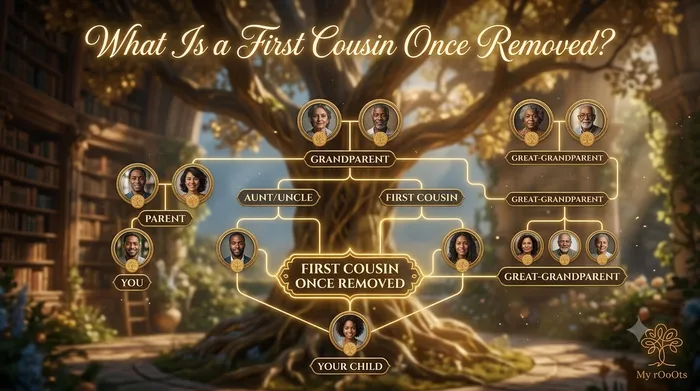
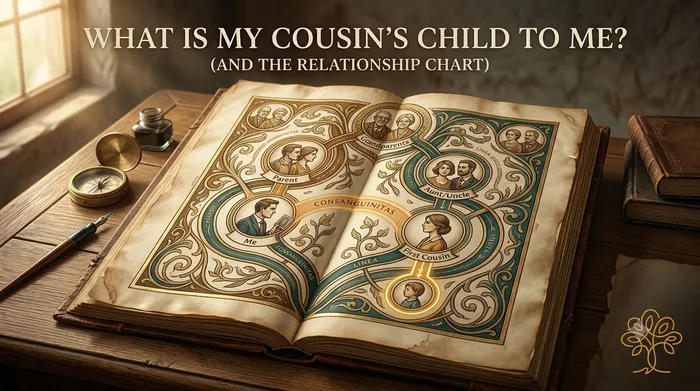
Your cousin’s child is your first cousin once removed.
- If your cousin has a son, he is your first cousin once removed.
- If your cousin has a daughter, she is your first cousin once removed.
The term is the same regardless of gender.
Why Isn’t It Just “Cousin”?
The word cousin usually refers to people in the same generation.
For example:
- You and your cousin are in the same generation because you share grandparents.
- Your cousin’s child is one generation below you.
That one-generation difference is what the phrase “once removed” describes.
Simple Relationship Chart
| Person | Relationship to You |
|---|---|
| Your grandparent | Grandparent |
| Your parent | Parent |
| Your aunt/uncle | Aunt/Uncle |
| Your cousin | First Cousin |
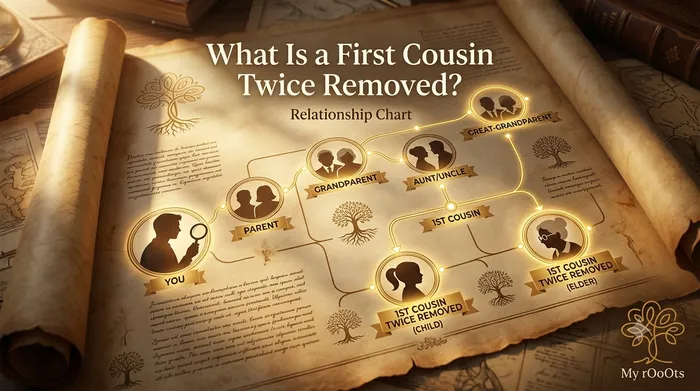
| Your cousin’s child | First Cousin Once Removed |
| Your cousin’s grandchild | First Cousin Twice Removed |
Think of it as moving down one generation from your cousin.
Visual Family Tree
Here is an easy way to see the relationship:
Grandparents
│
├── Your Parent
│   └── You
│
└── Aunt/Uncle
    └── Your Cousin
        └── Cousin’s Child
- You ↔ Your Cousin = First Cousins
- You ↔ Cousin’s Child = First Cousins Once Removed
What Does “Once Removed” Mean?
In genealogy, removed means a difference in generations.
- Once removed = 1 generation apart
- Twice removed = 2 generations apart
- Three times removed = 3 generations apart
Examples
| Relationship | Generation Difference |
|---|---|
| You and your cousin | 0 |
| You and your cousin’s child | 1 |
| You and your cousin’s grandchild | 2 |
So “removed” does not mean distant emotionally—it only measures generations.
Easy Example
Suppose:
- Your grandfather is Ramesh.
- Ramesh has two children: Anil and Sunita.
- You are Anil’s child.
- Ravi is Sunita’s child.
- Ravi has a daughter named Meera.
Then:
- You and Ravi are first cousins.
- Meera is your first cousin once removed.
What Does My Cousin’s Child Call Me?
Your cousin’s child would also call you first cousin once removed.
Genealogical relationships work both ways.
However, in everyday conversation, many families use simpler terms such as:
- Uncle
- Aunty
- Bhaiya
- Didi
These are social or cultural terms rather than genealogical ones.
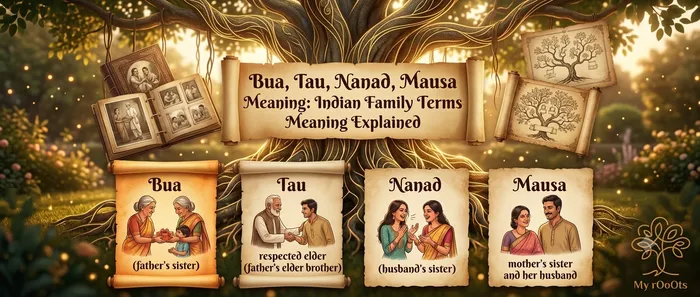
Indian Family Context
Indian families often use relationship terms based on age and respect rather than strict genealogy.
Your cousin’s child may call you:
- Mama / Mami
- Chacha / Chachi
- Bua / Fufa
- Didi / Bhaiya
- Uncle / Aunty
depending on the family branch, language, and age difference.
Even if a child calls you “Mama,” the genealogical relationship may still be first cousin once removed.
Common Confusions
Is my cousin’s child my niece or nephew?
No.
A niece or nephew is the child of your brother or sister, not your cousin.
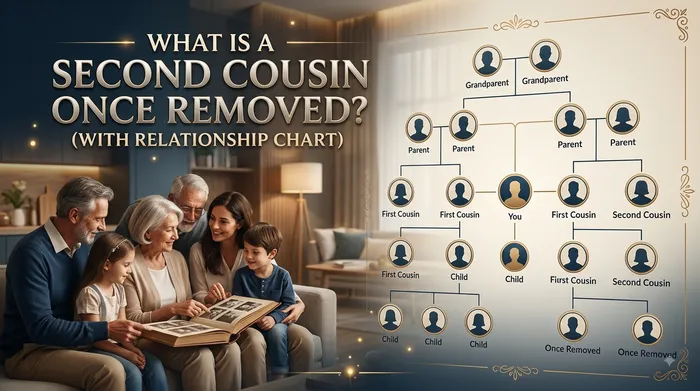
Is my cousin’s child my second cousin?
No.
A second cousin is the child of your parent’s cousin. Your cousin’s child is first cousin once removed.
Is my child related to my cousin’s child?
Yes. Your child and your cousin’s child are second cousins because they are in the same generation and share great-grandparents.
Quick Comparison Table
| Person | Correct Term |
|---|---|
| Sibling’s child | Niece / Nephew |
| Cousin | First Cousin |
| Cousin’s child | First Cousin Once Removed |
| Parent’s cousin | First Cousin Once Removed |
| Cousin’s grandchild | First Cousin Twice Removed |
Notice that your parent’s cousin and your cousin’s child are both first cousins once removed—they are simply one generation above and below you.
Why This Matters When Building a Family Tree
Accurate relationships help avoid confusion in large families.
When documenting your family tree, recording the correct relationship:
- preserves family history accurately,
- helps future generations understand connections,
- prevents duplicate or incorrect branches,
- and makes genealogy research much easier.
With My rOoOts, you can add relatives once and let the family tree automatically show their relationships.
👉 Start building your family tree: https://myrooots.app/
Relationship Calculator Trick
Ask two questions:
-
Do we share grandparents?
- Yes → first cousins (same generation)
-
Is one person one generation below the other?
- Yes → add once removed
For a cousin’s child:
- Shared grandparents? Yes
- One generation apart? Yes
Answer: First cousin once removed.
Frequently Asked Questions
What is my cousin’s son to me?
Your cousin’s son is your first cousin once removed.
What is my cousin’s daughter to me?
Your cousin’s daughter is your first cousin once removed.
What is my child to my cousin?
Your child is your cousin’s first cousin once removed.
What is my child to my cousin’s child?
They are second cousins.
Can I simply say “cousin’s child”?
Yes. In everyday conversation, “cousin’s child” is perfectly acceptable. “First cousin once removed” is the precise genealogical term.
Final Thoughts
Family relationships can seem complicated, especially in large Indian families where cultural terms and genealogy often overlap. The easiest rule to remember is:
Your cousin’s child = your first cousin once removed.
Understanding these relationships becomes much simpler when you can see them visually in a family tree.
Preserve your family connections, explore your ancestry, and keep every relationship clearly documented with My rOoOts.
🌳 Create your family tree today: https://myrooots.app/
Find Any Family Relationship Instantly
Not sure how someone is related to you? Use the MyRooots Relationship Calculator to instantly identify relationships such as cousin, aunt, uncle, nephew, niece, in-laws, and many more. It is a quick and easy tool for understanding complex family connections.
👉 MyRooots Relationship Calculator
Create a Beautiful Family Tree Online
Turn your family information into a clear and organized family tree within minutes. The MyRooots Family Tree Generator helps you add relatives, connect generations, and create a shareable family tree that can grow over time.
👉 MyRooots Family Tree Generator
Visualize Your Family History Through Time
See your ancestors in chronological order with the My rOoOts Ancestor Timeline Generator. It creates a visual timeline of births, marriages, deaths, and important life events, making it easier to understand your family's history across generations.
Check Zodiac Compatibility for Any Two People
Curious about how well two people match based on their date of birth? Try the My rOoOts Zodiac Compatibility Tool to compare zodiac signs, explore relationship compatibility, and get a quick compatibility score for couples, friends, or family members.
👉 Check compatibility now: Zodiac Compatibility Calculator
You can enter two dates of birth and even mention the relationship type to get a more personalized compatibility result.
Create Your Family Tree for Free
Start building your family history in minutes with the My rOoOts Free Family Tree Creator. Add parents, grandparents, children, and relatives, organize generations visually, and create a beautiful family tree that you can save and share.
👉 Create your free family tree: Free Family Tree Creator
No design skills required. Simply enter your family details and generate a clear, easy-to-read family tree online for free.
Download a Free Family Tree Template
Want to draw your family tree yourself? The My rOoOts Family Tree Template provides a free printable blank pedigree chart for documenting your family history across multiple generations.
👉 Download a free family tree template: Family Tree Template
Choose a 3-generation, 4-generation, or 5-generation family tree template and save it as a PDF for printing, writing, and documenting your ancestors.
Discover the Meaning and Origin of Your Surname
Ever wondered where your family name came from? Use the My rOoOts Surname Meaning Lookup to explore surname meanings, origins, history, and etymology from different regions and cultures around the world.
👉 Discover your surname meaning: Surname Meaning Lookup
Learn more about your last name and explore the possible linguistic, geographic, cultural, and historical roots behind your family surname.
Start your family tree free
No account needed to begin. Build it in minutes, then save it whenever you're ready.
Build your family tree