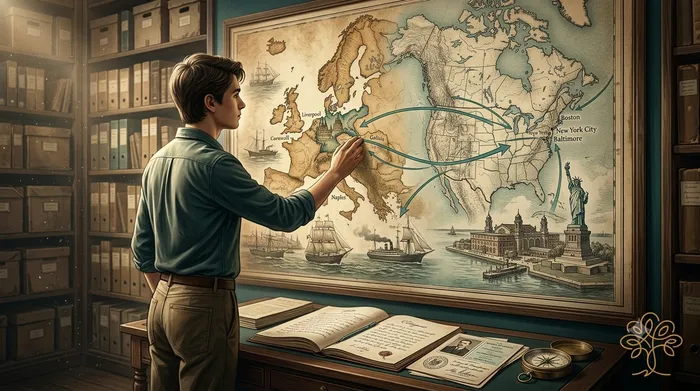
Millions of Americans, Canadians, Australians, and people around the world descend from Europeans who crossed the Atlantic in search of land, work, safety, or a better future. Whether your ancestors came from Ireland, Germany, Italy, Poland, Scandinavia, or another European country, tracing their journey to America is one of the most exciting genealogy discoveries you can make.
The challenge is that immigration records are often only the beginning. The real breakthrough usually comes when you identify the exact town or parish in Europe where your ancestor was born.
This guide explains how to find European ancestors who emigrated to America, which records to search, and how to connect American records with European family history.
🌳 Build and preserve your immigrant family tree with My rOoOts: https://myrooots.app/
Why Immigrant Research Is So Popular
Interest in immigrant ancestry is especially strong in:
- United States
- Canada
- Australia
- New Zealand
- Latin America
Many descendants know only that their family was “Irish,” “German,” or “Italian.” Genealogy research can often narrow that broad identity to a specific village, parish, or even a family home.
The Golden Rule: Work Backward
Start with the most recent known ancestor and move backward step by step.
*Yourself *Parents *Grandparents *Great-grandparents *Immigrant ancestor
Do not begin by searching European records. First gather all available information in America.
Step 1: Collect Family Information
Ask relatives for:
- Full names
- Maiden names
- Nicknames
- Birth dates
- Marriage dates
- Death dates
- Family stories
- Old photographs
- Letters
- Passports
- Naturalization papers
- Cemetery information
Even a partial village name can be invaluable.
Step 2: Search U.S. Census Records
Federal censuses are often the best starting point.
Key Census Years
| Census | Useful Immigration Information |
|---|---|
| 1900 | Year of immigration |
| 1910 | Immigration year & naturalization status |
| 1920 | Immigration year & citizenship status |
| 1930 | Immigration year |
Look for columns labeled Immigration Year, Naturalized, Alien, or First Papers.
Example
- Immigration year: 1887
- Naturalization status: Pa
- Birthplace: Germany
This narrows the search considerably.
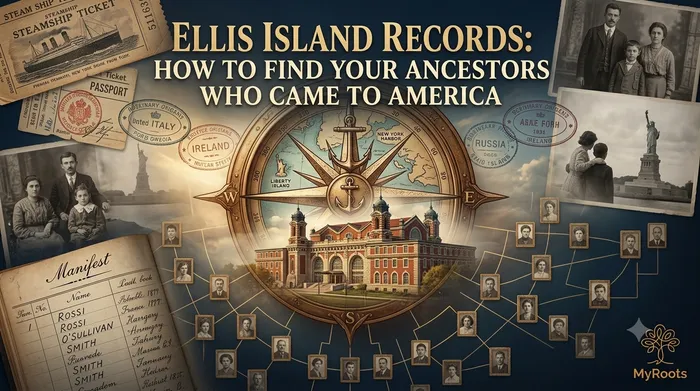
Step 3: Find Passenger Lists
Passenger manifests often provide the critical link to Europe.
Major U.S. Ports
- New York (Ellis Island)
- Boston
- Philadelphia
- Baltimore
- New Orleans
Information Commonly Found
- Name
- Age
- Occupation
- Last residence
- Nearest relative in Europe
- Destination in America
- Name of person joining in America
The last residence field is often the most important clue.
Ellis Island vs. Castle Garden
- Castle Garden: New York arrivals before 1892.
- Ellis Island: New York arrivals from 1892 onward.
Search both if the arrival date is uncertain.
Step 4: Search Naturalization Records
Naturalization files are among the richest immigrant sources.
Look For
- Petition for Naturalization
- Declaration of Intention
- Certificate of Naturalization
Often Includes
- Exact birth date
- Exact birthplace
- Arrival date
- Arrival ship
- Current residence
- Spouse and children
A naturalization petition may be the first record naming the ancestral village.
Step 5: Obtain Death Certificates
Many death certificates include:
- Birthplace
- Parents’ names
- Informant’s name
- Burial location
Accuracy varies, but these records can provide valuable leads.
Step 6: Check Obituaries
Newspaper obituaries frequently mention:
- County or town in Europe
- Year of immigration
- Ship name
- Surviving relatives abroad
Local ethnic newspapers are especially useful for immigrant communities.
Step 7: Visit the Cemetery
Tombstones may record:
- Native county
- Native village
- Original surname spelling
- Religious affiliation
Photograph nearby graves; relatives were often buried together.
Step 8: Identify the Exact European Place
This is the turning point in immigrant research.
Why It Matters
European records are usually organized by:
- Town
- Parish
- Municipality
- Civil district
Searching an entire country is rarely effective.
Example
- “Germany” = too broad.
- “Bavaria, Würzburg district, Randersacker” = searchable.
Country-Specific Clues
Irish Ancestors
Look for:
- County name
- Catholic parish
- Townland
- Griffith’s Valuation references
German Ancestors
Look for:
- Kingdom/state (Bavaria, Prussia, Saxony)
- Parish name
- Village spelling variants
Italian Ancestors
Look for:
- Comune (town)
- Province
- Region
Scandinavian Ancestors
Look for:
- Parish
- Farm name
- Patronymic surname
Common Surname Problems
Immigrant names were often changed or simplified.
| Original | Americanized |
|---|---|
| Müller | Miller |
| Schmidt | Smith |
| Schneider | Snyder |
| Johansson | Johnson |
| Ó Murchadha | Murphy |
Always search for spelling variations.
Use Cluster Research
Research relatives, neighbors, and traveling companions.
Immigrants often:
- came from the same village,
- traveled together,
- settled in the same community,
- married within the same ethnic group.
Finding a sibling’s birthplace may reveal your ancestor’s birthplace.
Church Records in America
Immigrant churches frequently recorded the home parish in Europe.
Especially Valuable
- Catholic sacramental registers
- Lutheran church books
- Orthodox parish records
- Ethnic parish registers
Sponsors and witnesses were often relatives from the same village.
Military Records
World War I and World War II draft registrations may include:
- Exact birth date
- Birthplace
- Citizenship status
These records are particularly useful for immigrants who never naturalized.
European Records to Search Next
Once the birthplace is known, move to European sources.
Key Records
- Baptism registers
- Marriage registers
- Burial registers
- Civil birth records
- Census records
- Military records
- Emigration permissions
- Population registers
Search the local parish or civil archive first.
Example Research Path
Suppose your great-grandfather was John Miller in Pennsylvania.
Step-by-Step
- 1900 census: born Germany, immigrated 1888.
- Passenger list: “Johann Müller, Württemberg.”
- Naturalization petition: born in “Ulm, Württemberg.”
- German parish register in Ulm: baptism of Johann Müller, 1865.
- Parents identified; family traced into earlier generations.
Notice how American records led directly to the European parish.
Mistakes to Avoid
Assuming the First Match Is Correct
Common names require multiple confirming records.
Ignoring Original Spellings
Search both Americanized and native forms.
Searching Europe Too Soon
Exhaust American records first.
Forgetting Historical Borders
An ancestor listed as “Austria” may have been born in territory that is now Poland, Ukraine, or the Czech Republic.
Best Free Resources
- FamilySearch
- Ellis Island
- National Archives (U.S.)
- IrishGenealogy.ie
- Antenati (Italy)
- Archion (Germany, subscription for many records)
- ScotlandsPeople (Scotland)
- Digitalarkivet (Norway)
Organize Everything in a Family Tree
Immigrant research quickly produces dozens of documents. Keep them organized by attaching each record to the correct person.
With My rOoOts, you can:
- build multi-country family trees,
- upload passenger lists and naturalization papers,
- preserve original surname spellings,
- connect American and European generations,
- and share discoveries with relatives worldwide.
👉 Start your immigrant family tree today: https://myrooots.app/
Frequently Asked Questions
What is the most important record for finding a European birthplace?
Naturalization records are often the single most valuable source.
What if I only know the country?
Use census, passenger, church, and death records to narrow the location before searching European archives.
Did Ellis Island change immigrants’ names?
In most cases, names were recorded from passenger manifests created before arrival; many name changes occurred later.
How can I find ancestors who arrived before Ellis Island?
Search Castle Garden records, early port records, and naturalization files.
Can DNA testing help?
Yes. DNA matches can identify relatives from the ancestral region and provide clues when records are scarce.
Final Thoughts
Finding a European ancestor who emigrated to America is often like solving a historical puzzle. Passenger lists, census records, naturalization papers, church registers, and cemetery records each provide one piece. The ultimate goal is to identify the exact European town where your ancestor began life before crossing the Atlantic.
Once that place is known, an entirely new world of European records becomes available, allowing you to trace your family back for centuries.
🌳 Preserve your transatlantic family story with My rOoOts: https://myrooots.app/
Find Any Family Relationship Instantly
Not sure how someone is related to you? Use the MyRooots Relationship Calculator to instantly identify relationships such as cousin, aunt, uncle, nephew, niece, in-laws, and many more. It is a quick and easy tool for understanding complex family connections.
👉 MyRooots Relationship Calculator
Create a Beautiful Family Tree Online
Turn your family information into a clear and organized family tree within minutes. The MyRooots Family Tree Generator helps you add relatives, connect generations, and create a shareable family tree that can grow over time.
👉 MyRooots Family Tree Generator
Visualize Your Family History Through Time
See your ancestors in chronological order with the My rOoOts Ancestor Timeline Generator. It creates a visual timeline of births, marriages, deaths, and important life events, making it easier to understand your family's history across generations.
Check Zodiac Compatibility for Any Two People
Curious about how well two people match based on their date of birth? Try the My rOoOts Zodiac Compatibility Tool to compare zodiac signs, explore relationship compatibility, and get a quick compatibility score for couples, friends, or family members.
👉 Check compatibility now: Zodiac Compatibility Calculator
You can enter two dates of birth and even mention the relationship type to get a more personalized compatibility result.
Create Your Family Tree for Free
Start building your family history in minutes with the My rOoOts Free Family Tree Creator. Add parents, grandparents, children, and relatives, organize generations visually, and create a beautiful family tree that you can save and share.
👉 Create your free family tree: Free Family Tree Creator
No design skills required. Simply enter your family details and generate a clear, easy-to-read family tree online for free.
Download a Free Family Tree Template
Want to draw your family tree yourself? The My rOoOts Family Tree Template provides a free printable blank pedigree chart for documenting your family history across multiple generations.
👉 Download a free family tree template: Family Tree Template
Choose a 3-generation, 4-generation, or 5-generation family tree template and save it as a PDF for printing, writing, and documenting your ancestors.
Discover the Meaning and Origin of Your Surname
Ever wondered where your family name came from? Use the My rOoOts Surname Meaning Lookup to explore surname meanings, origins, history, and etymology from different regions and cultures around the world.
👉 Discover your surname meaning: Surname Meaning Lookup
Learn more about your last name and explore the possible linguistic, geographic, cultural, and historical roots behind your family surname.
Start your family tree free
No account needed to begin. Build it in minutes, then save it whenever you're ready.
Build your family tree