Family Tree vs Genealogy: What's the Difference?
If you've recently started exploring your family's history, you've probably come across the terms family tree and genealogy.
They're often used as if they mean the same thing, but they actually describe two different aspects of discovering your family's past.
Understanding the difference can help you organize your research more effectively and preserve your family's story for future generations.
What Is a Family Tree?
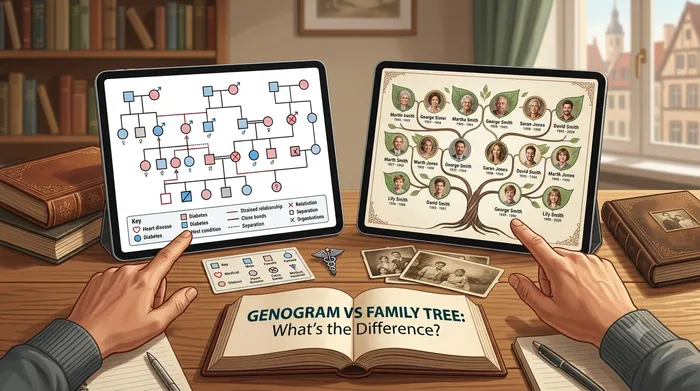
A family tree is a visual representation of your family relationships.
It shows how people are connected across generations, usually starting with you or a common ancestor.
A typical family tree includes:
- Parents
- Children
- Grandparents
- Great-grandparents
- Siblings
- Aunts and uncles
- Cousins
Its primary purpose is to help you understand your family's structure at a glance.
What Is Genealogy?
Genealogy is the process of researching your family's history.
Instead of simply showing relationships, genealogy involves discovering information about the people in your family.
Genealogical research may include:
- Birth records
- Marriage records
- Death records
- Census records
- Immigration documents
- Military service records
- Family stories
- Old photographs
- Newspaper articles
In simple terms:
- A family tree is the result.
- Genealogy is the journey that creates it.
How They Work Together
Imagine you're solving a puzzle.
Every document, photograph, or family story is a puzzle piece.
Genealogy helps you find those pieces.
Your family tree is where those pieces come together to reveal the complete picture.
Without research, a family tree may only include names.
Without a family tree, years of research can become difficult to organize.
Why Both Matter
A well-maintained family tree helps your family:
- Understand relationships
- Discover shared ancestors
- Preserve family memories
- Pass knowledge to future generations
- Avoid losing important historical information
Genealogy adds depth by explaining who these people were, how they lived, and the experiences that shaped your family.
Start With What You Already Know
Many people think they need hundreds of historical documents before creating a family tree.
That's not true.
Start with information you already have:
- Your parents
- Grandparents
- Siblings
- Aunts and uncles
- Birthplaces
- Important family events
As you learn more, your tree can grow naturally.
Talk to Your Relatives
One of the best genealogy resources is still your own family.
Older relatives often remember details that aren't recorded anywhere else.
Ask about:
- Family traditions
- Childhood memories
- Previous generations
- Migration stories
- Occupations
- Old family homes
Even a short conversation can reveal information that would otherwise be lost forever.
Keep Everything Organized
As your research grows, you'll collect names, dates, photographs, and stories.
Keeping everything in one place makes it much easier to:
- Update family information
- Correct mistakes
- Add newly discovered relatives
- Share your family history with others
A digital family tree also allows future generations to continue building on your work.
Create Your Family Tree for Free
Whether you're just beginning your genealogy journey or already have years of research, organizing everything into a family tree is one of the most rewarding steps.
You can create, edit, and grow your family tree for free using My rOoOts.
Start here:
https://myrooots.app/create-tree
Discover Family Connections with the My rOoOts Relationship Calculator
Have you ever wondered how two people in a family are connected? Whether someone is your second cousin, great-grandparent's sibling, or a distant relative through marriage, understanding family relationships can sometimes become confusing as your family tree grows.
The My rOoOts Relationship Calculator makes it simple to identify the connection between two individuals. Enter the names of two family members, and the calculator helps you understand their relationship based on their family tree connections.
👉 Try the Relationship Calculator: https://myrooots.app/relationship-calculator
How to Use the Relationship Calculator
- Select the two people you want to compare in your family tree.
- The calculator analyzes their shared ancestors and family connections.
- It identifies the relationship between them and explains the connection in simple terms.
- Use the result to explore your ancestry and discover hidden family links.
Why Use a Relationship Calculator?
As family trees expand across multiple generations, relationships can become difficult to remember. A relationship calculator helps you:
- Understand complex cousin relationships.
- Discover how distant relatives are connected.
- Explore ancestral connections across generations.
- Make genealogy research easier and more enjoyable.
- Learn more about your family's history.
Whether you are researching your ancestors, building a large family tree, or simply curious about how relatives are connected, the My rOoOts Relationship Calculator helps turn complex family relationships into clear answers.
Start exploring your family's connections today and discover the stories hidden within your family tree.
Final Thoughts
Genealogy and family trees go hand in hand.
Research helps uncover your family's past, while a family tree brings all those discoveries together in a clear, meaningful way.
Every name you add and every story you preserve becomes a gift for future generations.
Start building your family tree today and ensure your family's history is never forgotten.
Find Any Family Relationship Instantly
Not sure how someone is related to you? Use the MyRooots Relationship Calculator to instantly identify relationships such as cousin, aunt, uncle, nephew, niece, in-laws, and many more. It is a quick and easy tool for understanding complex family connections.
👉 MyRooots Relationship Calculator
Create a Beautiful Family Tree Online
Turn your family information into a clear and organized family tree within minutes. The MyRooots Family Tree Generator helps you add relatives, connect generations, and create a shareable family tree that can grow over time.
👉 MyRooots Family Tree Generator
Visualize Your Family History Through Time
See your ancestors in chronological order with the My rOoOts Ancestor Timeline Generator. It creates a visual timeline of births, marriages, deaths, and important life events, making it easier to understand your family's history across generations.
Check Zodiac Compatibility for Any Two People
Curious about how well two people match based on their date of birth? Try the My rOoOts Zodiac Compatibility Tool to compare zodiac signs, explore relationship compatibility, and get a quick compatibility score for couples, friends, or family members.
👉 Check compatibility now: Zodiac Compatibility Calculator
You can enter two dates of birth and even mention the relationship type to get a more personalized compatibility result.
Create Your Family Tree for Free
Start building your family history in minutes with the My rOoOts Free Family Tree Creator. Add parents, grandparents, children, and relatives, organize generations visually, and create a beautiful family tree that you can save and share.
👉 Create your free family tree: Free Family Tree Creator
No design skills required. Simply enter your family details and generate a clear, easy-to-read family tree online for free.
Download a Free Family Tree Template
Want to draw your family tree yourself? The My rOoOts Family Tree Template provides a free printable blank pedigree chart for documenting your family history across multiple generations.
👉 Download a free family tree template: Family Tree Template
Choose a 3-generation, 4-generation, or 5-generation family tree template and save it as a PDF for printing, writing, and documenting your ancestors.
Discover the Meaning and Origin of Your Surname
Ever wondered where your family name came from? Use the My rOoOts Surname Meaning Lookup to explore surname meanings, origins, history, and etymology from different regions and cultures around the world.
👉 Discover your surname meaning: Surname Meaning Lookup
Learn more about your last name and explore the possible linguistic, geographic, cultural, and historical roots behind your family surname.
Start your family tree free
No account needed to begin. Build it in minutes, then save it whenever you're ready.
Build your family tree